

Editor’s note: Mark Bushnell is a Vermont journalist and historian. He is the author of “Hidden History of Vermont” and “It Happened in Vermont.”
One bright day in June 1809, a crowd gathered at Burlington’s waterfront to witness a bold step into the future. Others there that day assumed they were about to witness a disaster. The Winans brothers, John and Jack, were preparing to launch their ship, the Vermont, on its maiden voyage. If successful, the ship would be the first steam-powered vessel to ply Lake Champlain. Indeed, it would be only the second steamship in regular service anywhere in the world.
The Winanses had powerful backers. Some of the city’s leading businessmen financed the effort. In the Vermont, they saw a way to transport large cargoes more quickly and reliably than they could aboard sailing ships.
One prominent businessman had conspicuously withheld his support. Gideon King was known as “the admiral of the lake.” He owned or held mortgages on most of the commercial vessels that sailed upon it. King viewed the Winanses’ project as a threat to his control of the region’s commerce. He wished, and expected, it would fail.
His opposition didn’t prevent him from turning out that day to watch the festivities. Perhaps he was hoping to witness a repeat of what had happened when, during the ship’s construction, the Vermont’s hull was launched the year before. The water had been lower than the Winans had anticipated and the hull, nudged sideways into the harbor, had quickly ground to a halt in the mud. There it lay until men from the neighborhood, encouraged by “the repeated applications of a ‘spirit,’ which was not only ‘ardent’ but abundant,” were coaxed into pushing it free.
If King was expecting another clumsy performance, he was disappointed. With a small crew and his younger daughter on board, John Winans captained the Vermont out onto the open lake.
It was no coincidence that the Vermont was built soon after Robert Fulton’s Clermont had become the world’s first steamship to offer regular service. The Winanses wanted to mimic its success. They knew Fulton’s ship well, having helped build its hull. James had even piloted the Clermont, which was launched on the Hudson River in 1807.
Natives of Poughkeepsie, New York, the Winans brothers moved to Vermont to try to recreate Fulton’s success. They believed that Lake Champlain, which could provide access to raw materials and large urban markets, was a merchant’s dream and that Burlington was its best harbor.
The move to Vermont was perhaps fitting; some believe the first steamboat was built here. Inventor Samuel Morey created a steamship and, during the 1790s, tested it on Fairlee Pond (since renamed Lake Morey) and on the Connecticut River. Fulton, and his business partner Robert Livingston, tried to purchase Morey’s plans. Accounts differ over whether Morey accepted the offer, or rejected it as insulting. Whether the Clermont was his own invention, or owed much to Morey, Fulton’s name is linked today with the steamboat because he did what Morey never managed to do: create a commercial steamboat service.
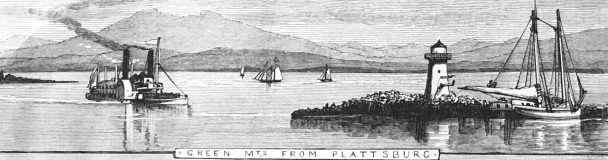
The Vermont was no beauty. From written descriptions — no drawings or plans of the boat survive — we know that it was rather plain. The boat was essentially flat topped; it had no pilothouse or bridge. Instead of a wheel, it was steered by a tiller. Its main features were a tall black smokestack at its center and at least one mast. Its attraction was its size and speed. The boat measured 120 by 20 feet and was able to carry a cargo of 67 tons. Just as importantly, it was capable of making eight miles an hour.
The boat’s engine, which cranked out 20 horsepower, was housed below decks and powered a pair of paddlewheels on the boat’s sides. The Winanses purchased the engine second hand. Perhaps it was the best they could find in the region, or perhaps they couldn’t afford a new one.
In addition to cargo, the Vermont carried passengers, who were housed in an austere room measuring 25 by 18 feet. Most of the bunk space was allotted for male travelers. A second, smaller area was set aside for women and children.
The Winanses planned to offer regular service between St. John, Quebec, on the Richelieu River just north of Lake Champlain, and Whitehall, New York, at the south end of the lake. Stops would be made along the way at places like Cumberland Head, near Plattsburgh, New York, Burlington, and Benson Landing in Vermont. Since a steamboat did not rely on favorable winds, the Vermont could make the 150-mile journey in 24 hours. Northbound passengers could disembark at St. John and catch a stagecoach to Montreal, and southbound passengers could get off in Whitehall and ride a series of stages and boats to New York City.
The Winanses hoped to keep the boat running daily. But the Vermont proved unreliable. Instead of daily runs up or down the lake, the Vermont’s schedule called for it to sit for two and a half days each week in St. John, presumably to allow time for repairs. The boat was difficult to steer – deckhands at times had to shift cargo during the voyage to help turn it. The boiler was also troublesome. While it was running, the engineer had to keep an eye out for cracks, which he would fill by pouring hot lead into them.
Geopolitics also interfered with the Vermont becoming a long-term commercial success. Hostilities with Britain erupted into war in 1812 and the lake became a hotspot. The American military drafted the Vermont into service occasionally as a troopship, transporting soldiers and supplies to the border region.
The boat might well have been captured by the British during the war if not for the help of a smuggler who overheard talk of the plan. The smuggler rowed all night to intercept the Vermont and warn John Winans, who steamed the boat to safe harbor in Plattsburgh. Vowing never to allow his boat to be seized, Winans reportedly loaded gunpowder into its hold that could be detonated if the British attacked. He never had to follow through with his plan.
The Vermont survived the war, but not by much. On Oct. 15, 1815, while the boat was steaming on the Richelieu River, a connecting rod detached from the crank. Before the engine could be stopped, it had smashed the rod through the boat’s hull. Recognizing the wound was fatal, the crew abandoned the boat, which sank on the spot.
Despite its short, troubled life, the Vermont wasn’t the failure that shipping magnate Gideon King had hoped. Like the Clermont, the Vermont bred imitators. Even before the accident, another steamboat was already operating on Lake Champlain. More would soon follow and steam became vital to the expansion of trade in the region.
Part of the Vermont lived on after the sinking. John Winans salvaged the boat’s boiler and engine. They were transplanted into another steamboat, the Champlain, which was launched the same year the Vermont went down.
(Postscript: Salvagers raised the rest of the boat in 1953 and placed it on land near Ausable Chasm in New York, where it was to be part of a planned maritime museum. But the museum was never built and what remained of the Vermont was cleared away to make room for a campsite.)

