


VTDigger posts regular coronavirus updates on this page. You can also subscribe here for daily coronavirus news. Please send your Covid-19 questions to coronavirus@vtdigger.org
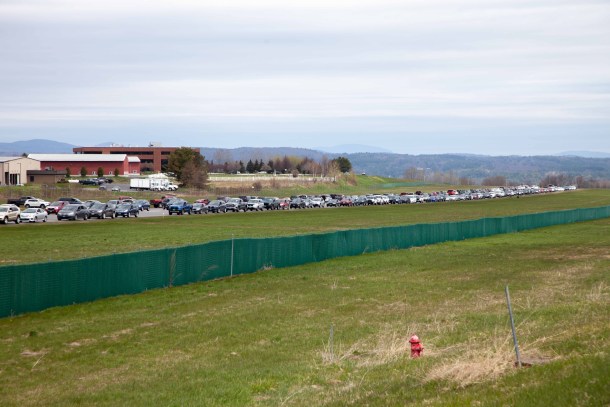
Rebecca Vickery, of Essex, was in one of the almost 2,000 cars waiting in line two Fridays ago to receive boxed food at the Berlin airport.
“I have never seen a line like that in my entire life for anything,” said Vickery, who has six kids in her care, including two foster children, and was hoping to pick up food for three other families.
She didn’t mind the hours of waiting — “It was a beautiful day” — but Vickery, who owns a voiceover business, left empty-handed.
“It was just breathtaking because it was like, there’s so many people here and they wouldn’t be waiting if they didn’t feel such desperation to feed their families,” she said.
On Tuesday, another mass food distribution on the Burlington Beltline drew more than 500 cars, with people arriving hours before the start.
Throughout the state, the long lines of cars waiting to pick up boxes of food underscore the toll pandemic-induced shutdowns have taken on Vermonters. The number of people experiencing food insecurity in Vermont has gone up an estimated 50% since the start of the coronavirus crisis, according to the national nonprofit Feeding America.
Now, advocates are pushing state officials to put more money into food assistance to ease the strain on the network of charities. And, with heightened food insecurity lingering for years after the last recession, they are hoping to spur a broader conversation about systemic changes needed to root out hunger.
“This situation is at a truly devastating level and we need the state to step up and … to show leadership in a way that supports not only the efforts that are already happening, but demonstrates that there is a commitment to solving this problem,” said Nicole Whalen, director of communications for the Vermont Foodbank.
The statewide food bank, which helps supply 215 pantries and other partners around the state, distributed 1.8 million pounds of food last month — 83% more than normal. One of those sites, the soup kitchen at Enough Ministries, has distributed 800% more pounds of food during the pandemic than usual.
“It’s off the hook crazy, I mean, it’s ridiculous,” said Dan Molind, a pastor at the Barre ministry.
There is no grocery store in downtown Barre, and Molind thinks that part of the sharp increase may be attributable to people who don’t have cars struggling to get to the store with diminished bus services.
Enough Ministries switched from sit-down to takeout meals, and opened two new food pantries in Barre and Plainfield. Molind said the Vermont Foodbank helped meet the increased demand, and the ministry also purchased food from local vendors left with surpluses after their normal accounts dried up.
Prior to the pandemic, Molind said Enough Ministries served a lot of individual people without homes; now, there are more families coming by. At first he was surprised to see people coming to the food pantry with relatively nice cars, Molind added.
“But if they live paycheck to paycheck, and got laid off and they’re not able to get a check for unemployment right away … they go searching,” he said. “How are they gonna fill the cupboard and take care of their kids?”
Age Well, the state-designated agency on aging for northwestern Vermont, has had 484 new clients sign up for Meals on Wheels delivery since March 10. The agency is predicting a 40% increase in demand over the next six months.
Tracey Shamberger, the director of public relations for the agency, attributes that uptick largely to older adults’ self-isolating to reduce their risk of catching the novel coronavirus.
UVM researchers found in a survey conducted shortly after the state of emergency started in Vermont that food insecurity had gone up from 18% to 24%.
Meredith Niles, assistant professor in UVM’s Department of Nutrition and Food Sciences and the lead researcher, noted that the survey was completed before many people who were laid off had received federal unemployment checks. The cohort is working on a follow-up in part to better understand how many people have received benefits, and whether they’ve adequately addressed the need.
The concern is rooted in recent history. During the Great Recession, food insecurity spiked in 2008 and didn’t start to meaningfully drop back down until 2014, said Niles.
“So there is a lingering effect, potentially, of food insecurity,” Niles said. “This may not be something that will go away in 30 days for a lot of families, especially if they had an economic impact that they may not be able to come back from.”
A recent national survey from the Brookings Institute found that households with kids 12 and under were almost twice as likely to not have had enough money to buy adequate food during the last month.
Gov. Phil Scott’s administration has said that ensuring Vermonters have adequate access to food during the pandemic has been at the forefront of their crisis response.
Mike Smith, secretary of the state Agency of Human Services, spoke at a recent news conference of the “massive amounts” of food distribution outlets around Vermont. And the state has been working on everything from increasing 3SquaresVT benefits to reaching out to people who could be quarantined without food.
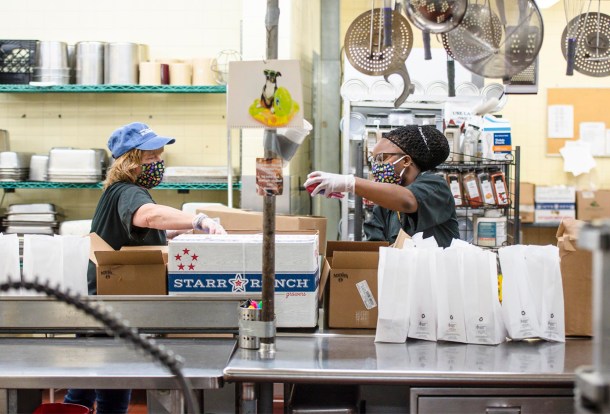
State officials and nonprofit partners began working on an emergency feeding plan at the start of April, which they submitted to FEMA for partial reimbursement. With a patchwork of nonprofit and government entities all trying to make sure Vermonters aren’t going hungry, the state has been trying to leverage as many federal dollars as possible and streamline programs.
A key component has been school districts’ efforts to provide free breakfasts and lunches to any kid under 18. The state paid schools already prepping meals for kids to feed homeless people being temporarily housed in hotels, said Rosie Kruger, of the Agency of Education.
But anti-hunger advocates want state officials to move more aggressively to address the problem. That includes pledging more funding for food bank programs and school meals busing over the summer.
While the income restrictions have now been lifted on the free school meals program, some districts have actually been giving out fewer meals than they were before that change, according to preliminary data. One reason for the decline in certain districts appears to be transportation-related. Overall, districts that bus meals to kids are seeing an uptick in free meal distribution, while districts without busing contracts are distributing fewer meals, said Anore Horton, executive director of Hunger Free Vermont.
Horton said that if the state doesn’t extend those meal busing contracts over the summer, something the governor has signaled support for, “we’re going to have a really serious crisis of family and child hunger in our state.”
The Vermont Foodbank has been spending $300,000 more a month than normal to keep up with the increased demand during the coronavirus crisis. The Foodbank and Hunger Free Vermont are calling on the state to appropriate money to “complement the strained philanthropic and federal resources” that have been filling that gap. They expect the increased demand to last for at least four to eight months, and don’t expect a quick decline to pre-pandemic levels.
The state Agency of Human Services has already spent $120 million on the pandemic response, said Mike Smith, some of which has gone toward food distribution.
“If we need to spend a little bit more to make sure Vermonters are secure in their food, we’ll do that,” he added.

Addressing hunger in the long term
Anti-hunger advocates stress that returning to pre-pandemic levels of food security should not be the goal of Vermont’s response to this crisis. Food is the “one and only” flexible item in a family’s basic needs budget, said Horton, and the UVM researchers found that food insecure individuals have already started to cut back on how much they’re eating to stretch their food further.
That’s why Horton and others have pushed for big picture measures like universal health care and increasing the minimum wage to leave Vermonters with more money to pay for food, in addition to more direct measures like expanding the free school meals program.
“We need to take as universal and structural an approach to this as we can,” said Horton.
With farmers and food banks both facing supply chain challenges, state officials, food banks and farmers have all been working on creative ways to get more local food — like dairy products that would otherwise be dumped — to Vermonters.
At the end of March, Burlington-based Skinny Pancake and partners launched an effort, ShiftMeals, to cook free meals for recently laid-off restaurant workers, artists, musicians and others.
The Vermont Foodbank has purchased 20,000 free to-go meals from the restaurant through June to distribute in Chittenden and Franklin counties. They’re hoping the state will provide funding to expand that program to restaurants in other parts of the state.
“If we can get that money available, we could put people back to work, we could start the supply chains again, … and we could feed people,” John Sayles, the Foodbank’s executive director, said.
Vegetable gardening has seen a surge in popularity during the pandemic. And community-minded Vermonters have started growing food for their neighbors, with the city of Burlington recently launching a “plant for the people” program for Queen City residents to donate extra homegrown produce to the local food shelf.
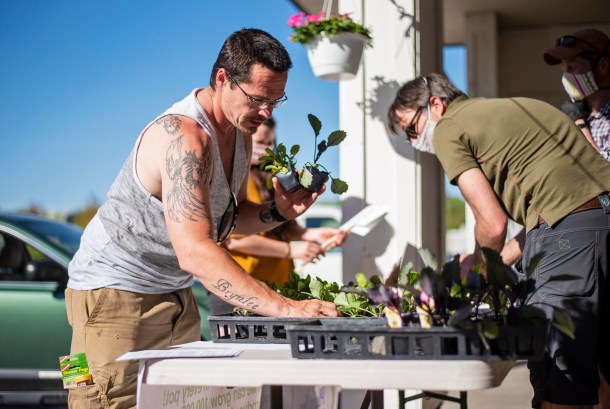
Horton, of Hunger Free Vermont, while stressing that “it’s great to have a garden,” noted that not everyone has the time and resources to do so.
“People who are really struggling to cover their basic bills … and help their kids with a spotty internet connection keep finishing up their school year and all of those things — that’s not a realistic solution to our hunger crisis,” she said.
Sen. Anthony Pollina, P/D-Washington, who sits on the Senate Agriculture Committee, said his committee has discussed hunger issues, but has not yet come out with a food security package.
“It’s not a huge amount of money we’re talking about, probably, but we need to make a commitment to do it,” he said.
Pointing to recent national meat shortages, Pollina added that he wants the response to include boosting the state’s food system as a whole through efforts like increasing school and other institutions’ local food purchasing.
Pollina was the founder and director of Rural Vermont and a founding board member in 2006 of the Vermont Milk Company, a farmer-owned and -operated dairy in Hardwick.
Advocates note the pandemic has stretched people’s finances so far that some are showing up for food giveaways and to food pantries for the first time. But they also stress the problem isn’t new: Niles, the UVM researcher, noted that over 60% of people dealing struggling to have adequate food now were food insecure before this crisis.
To Pollina, the pandemic has made starker pre-existing income inequality in Vermont.
“It’s all kind of related, you know, you’ve got thousands of people lining up for free food, and you got the richest five percent of homeowners saving $237 million” because of the Trump tax cuts, he said.

