

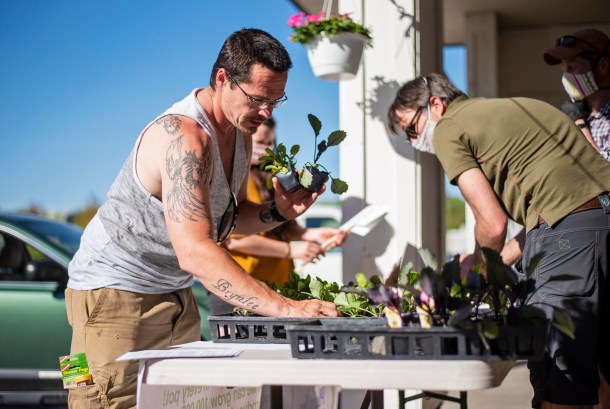
At the Brixton Halaal Market, Rashid Hussein was doing a brisk business — but it wasn’t his usual wares flying off the shelves.
The store owner was giving away plants, part of a city-led initiative to help residents grow fresh vegetables for donation to the food shelf.
A line grew outside when two trays of kale and cabbage and lettuce seedlings were delivered, Hussein said. “Many people were disappointed” when he sent them away empty-handed, he said.
His Old North End storefront was one of five locations giving away seedlings on Friday, and with them, a paper sign on a paint stir stick: “Plant for the people.”
The program aims to help alleviate food insecurity due to Covid-19 — and get people into the garden. Demand at Feeding Chittenden, the Burlington food shelf, has risen 40% due to the pandemic, according to Hannah Harrington, annual funds manager for the organization. The program has set a goal of contributing more than 100,000 pounds of produce over the course of the growing season.
“There’s a huge need [that’s] going to endure for a little while,” said Brian Lowe, who is running the project and works as chief innovation officer for the city. A post-crisis world will likely demand more local food and sustainable food supply, he said.
Lowe came up with the idea when he expanded his garden in the backyard of his home in the New North End. He’d have more tomatoes than his family could eat, he said.
Odds are, he figured, he wasn’t the only one.
Under the program, residents within Burlington and beyond can sign up to grow produce to donate, in pots on a porch, in community garden plots, or in their own backyards. There’s no commitment to contribute a certain amount. “It depends on what their plants produce,” Lowe said.
The city has partnered with Red Wagon Plants in Hinesburg, which has provided discounts on seedlings. The city will spend about half of the $10,000 budget for the program on plants, Lowe said.
On Friday, the offerings included three types of cabbage, kale, potatoes, arugula and pumpkins. The next giveaway on June 5 will provide warmer weather plants, such as peppers or tomatoes. A third is scheduled for August. The plants are meant to supplement, not meet, the goal for food shelf donations; those who picked up the plants aren’t required to donate the food they grow.
When the harvest is ready, the city will collect the produce at designated drop-off sites, clean the vegetables, and deliver them to the food shelf.
With growing unemployment and much of the country confined to their homes, gardening has grown in popularity. Demand for seeds has surged across the country.
Communities around the country are reviving the concept of victory gardens, backyard plots encouraged by the government during World War II to help address food shortages.
Those gardens are now seen as a “universally positive experience in terms of economic security and community reliance,” said Gordon Clark, who works for the University of Vermont Extension Master Gardener program.
In March, Clark started Vermont’s own victory garden project. The UVM Extension created or partnered with more than 30 individual and community gardens around the state, providing expertise and resources. The infant organization has already received nearly half a dozen offers for land to start mini farms to augment the vision, Clark said.

The organization’s 40 master gardeners will also provide advice to newbie gardeners in Burlington.
“What are the things that we gardeners can do to address the need? It’s grow food, and help others grow food,” Clark said.
In Burlington, demand for food at the food shelf has skyrocketed; Feeding Chittenden is providing food and groceries to between 550 and 650 families a week, as well providing meals to 250 people, Harrington said.
They almost never have enough produce. “That’s the food that goes the fastest,” she said.
As the economic downturn lingers, Harrington said she expects that demand is only going to grow.
By midday on Friday, 50 people had signed up to grow produce to donate to Feeding Chittenden. The plants that remained after the giveaway would be planted in community garden plots and grown by volunteers.
Lowe said the program could move the dial on promoting food sustainability even after Covid-19 subsides.
“It feels to me like this kind of program should outlast the crisis,” he said. In a city with hundreds of community garden plots surrounded by local farmers, “we shouldn’t lack for food.” As a city, the question people should be asking is “Can we meet some of that need?”
Get the latest statistics and live updates on our coronavirus page.
Sign up for our coronavirus email list.
Tell us your story or give feedback at coronavirus@vtdigger.org.
Support our nonprofit journalism with a donation.

