


VTDigger posts regular coronavirus updates on this page. You can also subscribe here for daily coronavirus news. Please send your Covid-19 questions to coronavirus@vtdigger.org
State leaders are accelerating efforts to get people connected to the internet during the Covid-19 crisis, just as congressional Democrats on Tuesday unveiled a stimulus package that includes an $8.8 billion fund for emergency broadband services.
Last week, the Department of Public Service released a draft emergency broadband plan to provide immediate relief to people without high-speed connections and to give all Vermont residents broadband access by 2024.
Tuesday afternoon, legislators from the House Energy and Technology and Senate Finance committees probed details of the plan with Public Service Commissioner June Tierney and Clay Purvis, the department’s telecoms director.
Much of the teleconference discussion centered on whether the state could use its existing money from the federal CARES Act — $1.25 billion — to build out new broadband services. That money, however, comes with many restrictions on its use.
“It’s not freely available to be used the way this state for instance might find it most beneficial, which would be to build out infrastructure and buy down subscription rates,” Tierney said. “(But) in the telehealth arena and also the education arena, there are what I’m going to call ‘stretch arguments’ (for using) Covid-19 money.”
She said the emergency plan — which could cost between $85 million and $293 million — is mostly focused on securing other federal dollars.
The plan aims to connect all Vermont residents to internet with a download speed of at least 25 megabits per second and an upload speed of 3 megabits per second, which is the federal benchmark for broadband.
Officials say 23% of the state, or nearly 70,000 business and residential locations, doesn’t have access to internet at those speeds.
Under the plan, the state would give internet providers subsidies to build out broadband to homes that lack connection or have poor service. Carriers would vie for subsidies during an auction process that could be held as early as October.
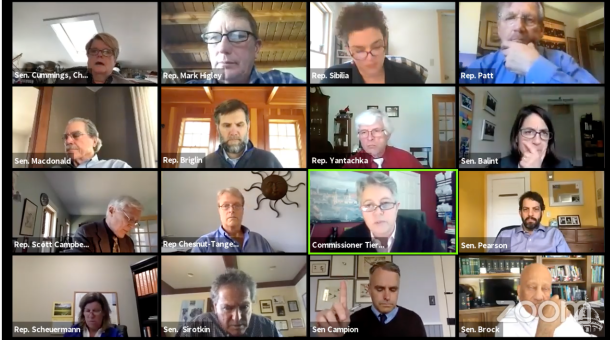
Rep. Michael Yantachka, D-Charlotte, asked whether service providers that already had expansion plans ready to go could obtain Covid-19-related funding.
Tierney said past applicants for the state’s connectivity grants might still be able to revive their projects, and that they might be eligible for that type of federal money.
In looking through those projects, she said the department would prioritize fiber initiatives proposing upload and download speeds of 100 megabits per second.
That touched on a question raised throughout the more than two-hour conversation: In implementing its new plan, should the state use so-called future-proof technologies like fiber, or rely on more readily available services like wireless connections?
“Recognizing that the landscape has changed significantly … our priority needs to be, then, rapid deployment to critical areas, as opposed to future-proof deployment everywhere,” said Rep. Robin Chesnut-Tangerman, P/D-Middletown Springs.
Tierney acknowledged that wireless service would be quicker to roll out, even if it’s not the preferred technology of some broadband advocates.
Sen. Chris Pearson, P/D-Burlington, said he believes offering symmetrical upload and download speeds would be more important than the type of technology.
The draft plan calls for several immediate actions:
- data collection to identify students without adequate internet access;
- partial funding of cable-line extensions to underserved homes;
- legislation and funding to make various broadband installations easier;
- and passing one of two bills that repeal the sunset provision on a regulation related to permits for telecommunications providers.
Some of those points, such as the data collection, are already underway. And the lawmakers on the call Tuesday appeared open to considering some of the legislative workarounds called for by the department.
“The easy one to start with is the streamlining permit requests,” said Pearson.
Earlier this week, internet providers told the state’s congressman that they want to see more funding and less red tape for broadband rollouts.
“(Some areas are) very, very challenging, and the numbers just aren’t there, and we need support,” Cliff Duncan of Duncan Cable told Rep. Peter Welch, D-Vt., during a virtual forum Monday. “We can’t do it all financially.”
They might find some relief if the bill introduced by congressional Democrats on Tuesday is signed into law. The $3 trillion plan includes reimbursements for service providers.
The shift to work and schooling from home since March has heightened concerns about the accessibility of high-speed internet in Vermont — particularly for underserved students. And service providers have been adapting their policies by offering free services, suspending disconnections and switching up how installations work.
