


VTDigger posts regular coronavirus updates on this page. You can also subscribe here for daily coronavirus news. Please send your Covid-19 questions to coronavirus@vtdigger.org
The Vermont Senate passed a medley of Covid-19 response legislation Monday, including bills that make it easier to receive workers’ compensation and that give towns the power to delay the deadline and waive penalties for late property taxes.
The workers’ compensation bill, S.342, would allow any employee to file for benefits if they contract the novel coronavirus on the job. Front line workers temporarily do not have to prove they were injured or fell ill while working.
The measure defines frontline workers as firefighters, law enforcement officers, ambulance workers, correctional officers, health care workers, child care providers, grocery store employees and others while also giving the Labor Department commissioner the authority to deem other jobs qualify.
The provisions for frontline workers would be in effect from March 1, 2020-Jan 15, 2021, however the presumption of proof would not apply if a frontline worker is offered a Covid-19 vaccine and refuses it.
Sen. Michael Sirotkin, D-Chittenden, the chair of the Senate’s Committee on Economic Development, told lawmakers the latest numbers in Vermont are that there are about 60 coronavirus-related claims in the workers’ compensation system — which usually deals with about 16,000 claims per year.
“This is an ever changing landscape with Covid-19,” Sirotkin said.
Sirotkin added that the burden of medical proof has slowed down some claims during the Covid-19 outbreak because some doctor’s offices are closed and it has become impossible for there to be independent medical examinations.
“It’s slowing things down and essentially denying some claimants their due process rights,” he said.
Senate lawmakers are also poised to approve a $90 million essential workers relief program, which would be funded using some of the $1.25 billion allocated to Vermont by the CARES Act.
Under this proposal, employees who work over 108 hours a month will receive a $1,000 monthly grant and workers who work at least 34 hours a month will receive a $600 monthly grant.
An estimated 33,500 workers in the state will be able to claim checks under the current version of the bill, 20-0964.
However, Republican Gov. Phil Scott said Monday he does not think the program is eligible for CARES Act funding and lawmakers may have to find an alternative money source.
“The guidance we received last week doesn’t give me great hope that they’ll be covered under the CARES Act,” Scott said during his press briefing.
“My question would be, to the Legislature, where do you want that to come out of, if it’s out of the general fund at this point in time, we’re going to see some budgetary problems just for fiscal year 20, not to mention greater concern for ’21.”
“So we’ll see what happens — a great idea, a great concept, they’re doing it for the right reasons — but we have to ask ourselves the question, how are we going to pay for it,” Scott added.
The Senate also passed legislation, S.344, that would give towns the flexibility to extend property tax deadlines, and waive penalties and fines for late payments during the Covid-19 crisis.
Towns have this authority already, but under current law, can only delay deadlines if voters act to do so during a public meeting, which are prohibited during the pandemic. The legislation would give town selectboards and other local legislative bodies the ability to delay due dates for state property taxes, which fund K-12 education, in 2020.
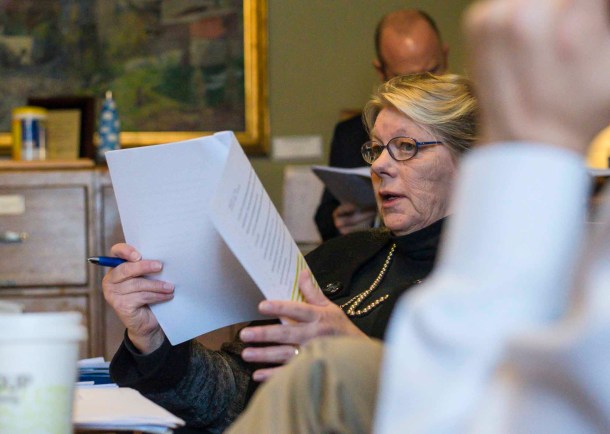
Sen. Jeanette White, D-Windham, the chair of the Senate Government Operations Committee, said Monday that the bill acknowledges that Covid-19 “has created a situation where many people have lost their jobs and are left with fewer resources for paying bills, including property taxes.”
“If a town wanted to ease the burden on its taxpayers, Covid-19 has also created a situation where that cannot happen,” White added. “There simply cannot be a town meeting.”
But delaying the property tax deadlines could pose a challenge for municipal and state finances.
Towns are responsible for paying the state what they owe for education spending, whether they have collected enough property tax revenue to pay for it or not.
And if towns don’t pay the state what they owe on time, they’re slapped with 8% penalties.
If the legislation passes, towns are hoping that lawmakers will do away with the 8% penalties. The Vermont League of Cities and Towns has asked the state to borrow money if towns can’t come up with enough to meet their obligations to the education fund.
Sen. Ann Cummings, D-Washington, the chair of the Senate Finance Committee, noted that the education fund is facing a $20 million deficit in the current fiscal year, and that next year that deficit could be much worse, as revenues plummet because of the pandemic.
She said that the Legislature will look into finding a way to ensure that those who can afford to pay their property taxes this year do so to minimize the strain of the education fund.
“We hope that we’ll find a way to make sure that those who can — because many people are still working — that those who can will pay, and cut down on the amount of the deficit that we need to deal with,” Cummings said.
Towns are responsible for paying the state what they owe for education spending, whether they have collected enough property tax revenue to pay for it or not.
And if towns don’t pay the state what they owe on time, they’re slapped with 8% penalties.
The Vermont League of Cities and Towns is urging lawmakers to add a provision in the legislation to eliminate the penalties towns face for making late payments, if they’re also pushing back deadlines for taxpayers.
The upper chamber also approved two other coronavirus-related pieces of legislation Monday — S.343, a measure which delays a massive special education funding overhaul, and S.345, which temporarily authorizes municipal public bodies to post meeting notices and agendas electronically instead of in designated physical public locations.
The Senate also agreed with their House counterparts to strip a provision out of S.114, a measure that addresses emergency judicial responses to the coronavirus crisis, that would delay the suspension of an operator’s license for driving under the influence.


