

Editor’s note: Mark Bushnell is a Vermont journalist and historian. He is the author of “Hidden History of Vermont” and “It Happened in Vermont.”
As a sales gimmick, it was a beaut. It was dramatic, tinged with danger and sure to grab the public’s attention. If Elisha Otis hadn’t been such a good inventor, he might have been remembered as a marketer.
The stunt was about to reverse the fortunes of Otis’ stumbling company. In 1853, at the Exhibition of Industry of All Nations, held at New York’s Crystal Palace, Otis stood upon an open-sided elevator as it rose high above the crowd. Near the top, he ordered an assistant below to cut the elevator’s cable with an axe. The crowd hardly had time to shudder. The platform fell. Then it quickly caught itself, having dropped only inches.
“All safe, gentlemen,” he shouted. “All safe.”
His invention, the automatic safety brake, had passed the test. Otis had figured out a way to make elevators, crude versions of which had been used for millennia, far safer. The invention – and the stunt used to publicize it – made possible the era of the skyscraper and made Otis a rich man. His company’s elevators would eventually be found in the London Underground, the Eiffel Tower and the Kremlin, as well as in countless less-celebrated sites.
During the 1850s, when Otis’ fortunes were on the rise, few Vermonters would have been surprised to learn that he was one of them. Otis had grown up in the small town of Halifax. From the state’s creation, Vermonters had prided themselves on their resourcefulness and counted among their small numbers some of the nation’s most prominent inventors, and many of its lesser-known ones. Indeed, the state’s history is heavily populated with creative folks who found a better way to do things.
“It can be said … that the pioneers were a choice people,” stated a contributor to “Men of Vermont,” a biographical history of the state published in 1894. “They were of English and Scottish descent, enterprising, adventuresome and bold.” From their ancestors they had inherited the “ingenuity, industry and courage” to innovate.
Despite the book’s tone, which might strike the modern ear as a bit self-satisfied and deaf to the contributions of non-Britons, early Vermonters clearly possessed creative spirits. It was a creativity born of necessity – and one not unique to Vermont. In an era when mass production and interchangeable parts were emerging concepts, people across the new country were finding new, more efficient ways to get jobs done. Looking through Vermont’s past gives one the sense of just how innovative the period was.
From the time the first U.S. patent was issued in 1790 – to Pittsford resident Samuel Hopkins for a new way to make potash, a key component in soap production – Vermonters regularly made the trip to the patent office in Washington. Examples include William Clapp of Montgomery, who patented the first method for canning meat in America; Ezra Butler Eddy of Bristol, who developed many of the methods used in manufacturing matches – his Canada-based company would make him a millionaire; Benjamin Field of Dorset, who with his partner George Pullman created the first sleeping train cars; Philo Stewart of Pawlet who devised the first commercial cook stove; and Joshua Stoddard, also of Pawlet, who invented the steam calliope, a musical instrument that was a sort of portable organ.
Vermont’s best-known inventor is perhaps John Deere, who created “the plow that broke the Plains.” Deere was born in Rutland and moved to Middlebury as a teenager to apprentice with a blacksmith, before opening his own shop. While in his 30s, Deere decided his prospects would be better in the Midwest, which was just opening to settlement. Deere didn’t leave Vermont because the state was some economic backwater; it was more that all the best situations had long before been claimed.
After arriving in Illinois, Deere noticed that farmers were dissatisfied with the plows they had brought from the East. The Midwest’s rich soils tended to stick to the blades, making plowing more difficult. After experimenting with using iron and steel parts in place of wooden ones, Deere created a plow the local farmers loved. He served as president of the company that bore his name until shortly before his death, when he handed control to his son.
Deere used mass production to create his company, much as James Wilson had years earlier, albeit on a smaller scale. Wilson’s claim to inventing fame was that he developed a method for manufacturing globes and became the first nation’s first globe maker. Wilson, a farmer and blacksmith in Bradford, made his first globe in about 1795. Wanting to get the details right, he invested the then rather huge sum of $130 to purchase the 18-volume “Encyclopedia Britannica.” He didn’t put his globes into larger production until 1810, but they sold well enough that he built a second factory in 1817 in Albany, New York.
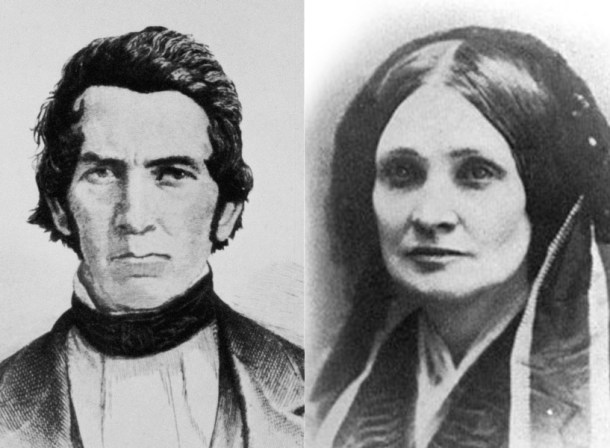
Like Wilson, many of Vermont’s early inventors were farmers. But unlike Wilson, they never gained fame for their creations, which often grew out of their experiences in the fields. Farmers from the town of Poultney alone produced four inventions for shelling corn more efficiently. Others in town created improved pick axes, butter churns, spinning wheels, and horse rakes, as well as a cloth-sheering machine.
While scores of Vermont inventors were tinkering with devices that might slightly improve daily life, some strove to make major advances. Two became famous as much for their bad luck as the big ideas they nurtured.
Among his inventions, Samuel Morey worked endlessly on his idea of creating a steam-powered ship. During the 1790s, Morey steamed up and down the Connecticut River in his craft and spoke with fellow inventor Robert Fulton about his ideas. Morey rejected an offer to sell his plans to Fulton and a partner only to see Fulton create a steamship remarkably like his own. “Blast his belly!” Morey is said to have roared. “He stole my patent!” Though it would have been small consolation, one of Morey’s inventions has been credited with being a forerunner of the carburetor.
Thomas Davenport suffered a fate similar to Morey. Davenport is one of those early American characters with little formal education but loads of practical experience. Born in Williamstown, Davenport later moved to Brandon and opened a blacksmith shop. In 1831, he witnessed a demonstration of an electromagnet that could lift 750 pounds. He was enthralled by the device and had to have it. Davenport sold his brother’s horse to raise the money to buy the thing. He took the device home and soon manufactured a second magnet, then he tested a theory he had been mulling. He attached the magnets to a wheel and ran wires (insulated with silk from his wife’s wedding dress) to it from a battery. By switching the current from one battery to the other, he found he could make the wheel turn. He had invented the first electric motor.
But he might not have done it alone. Some people argue that Davenport’s wife, Emily, should be remembered as co-inventor of the electric motor, having contributed far more than part of her wedding dress to the project. Descendants of Brandon resident Orange Smalley, who lived next to the Davenports, have argued that he too helped design the motor.
Whoever designed the device, it was Davenport who decided to walk to Washington to secure a patent. But he spent his application money along the way. After returning home, he mailed his application, which arrived in Washington just in time to be consumed by a fire that destroyed the Patent Office. He did finally receive his patent in 1837, but never made any money from it.
Davenport used his motor, which is now in the collection of the Smithsonian Institution, to power all things electric – a railway, a trolley, a piano, a printing press and a telegraph. The motor, however, remained too large to put any of these inventions to practical use. Davenport would have gotten credit for the telegraph if he had come up with a simpler design. He had created a device with 24 wires – one for each letter in a simplified alphabet – but Samuel Morse did him one better. He devised a code that required only one wire and an operator adept at tapping out the right sequence of dots and dashes.
If Morse’s invention became a part of everyday life, Karl Hamlen Martin’s certainly did not. Martin worked in Bennington to create the Martin-Wasp motorcar. This splashy vehicle was a beauty, fashioned of aluminum over a wood frame and trimmed in seasoned white ash. Few could afford the $5,000 to $6,000 sticker price of the Vermont-made car. Between 1920 and 1925, Martin’s company produced fewer than 20 of them. The only remaining example is housed at the Bennington Museum.

Like most rare objects, this one was in high demand among the wealthy. When the Wasp was on display at an auto show in New York City, the actor Douglas Fairbanks Sr. rode down from his room in an elevator (thanks to Elisha Otis), took one look at the car and bought this example of Vermont know-how.
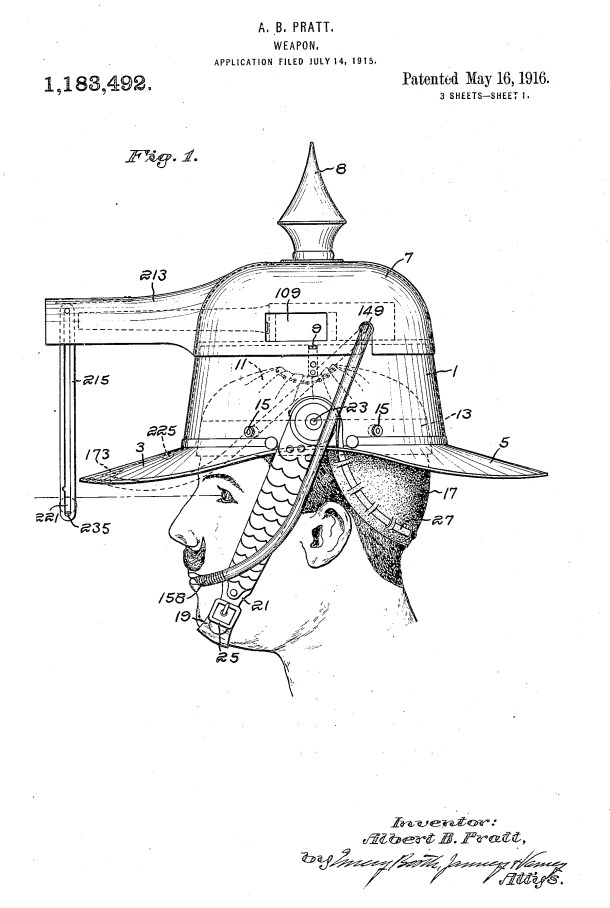
If Vermonters have a deserved reputation for creating brilliantly designed, useful and largely popular items, perhaps U.S. Patent No. 1183492 is an exception that proves the rule. During World War I, Albert Pratt of Lyndon devised and patented a helmet that had a working pistol built into it. The wearer would fire the pistol by blowing into a tube, thereby expanding a bulb that would trip the trigger. Pratt boasted that the gun could be aimed automatically, as the wearer would naturally turn toward the target, whether it was an enemy soldier or an animal. The design featured a gunsight hanging from the pistol’s barrel so it was aligned with the wearer’s eyes. Even in the dark, Pratt said, the wearer could aim with some accuracy by turning toward the sound of the target. And since the gun was fired pneumatically, that is with the breath, the wearer’s hands would be free for defense or any other use. The helmet’s utility, whether it was worn by a soldier or a hunter, didn’t end there. As an adding feature, the helmet could be disassembled and used as a cooking pot. When the helmet was used this way, the spike on top could be driven into the ground to hold the pot steady. Albert Pratt thought of everything.

