


LAS VEGAS — Early Friday morning, near La Bonita Market and the La Rumba nightclub, Sen. Bernie Sanders’ army of volunteers and organizers was preparing for one last push just 24 hours before Saturday’s Nevada caucuses.
More than 40 people gathered in the first Nevada field office the Sanders campaign had opened, back in mid-2019, strategically placed in the predominantly Latino and working class neighborhood of East Las Vegas.
“We are one day away from the caucus and there are a couple questions that have been on the table for a little bit: who is the front-runner and can Bernie Sanders win the Hispanic vote,” said Luis Vasquez, regional director of Sanders’ Las Vegas strategy, Friday morning.
“The way we answer those two questions is going to be tomorrow during our caucus when we have a huge turnout of Hispanics for Bernie Sanders,” he said.
“This was our first office that we opened up, this was not an afterthought,” Vasquez said. “The Latino vote was not an afterthought, it was our first thought when we came into Nevada.”
After winning the New Hampshire primary and finishing in the top two in Iowa, Sanders has become the front-runner for the Democratic nomination. But rivals and critics have argued he has not been able to grow his base of support and that he has no chance of defeating President Donald Trump in a general election.
The Sanders campaign is looking to address part of that critique in Nevada by building support among a diverse electorate in the runup to the caucuses.
This has been Sanders’ Nevada strategy for the better part of half a year. His fundraising advantage and name recognition allowed him to put money and resources into Nevada’s Latino communities while his rivals have had to focus resources on New Hampshire and Iowa.
This has included spending more than $1.2 million in 2019 on Solidarity Strategies, a consulting firm run by Chuck Rocha, a top Sanders adviser. Rocha has been on the frontlines of Sanders’ Latino strategy both in 2020 and during the Vermont senator’s failed 2016 run.
During the early voting period for the Nevada caucuses, held in the first part of this week, Rocha, along with senior advisers Jeff Weaver and Ari Rabin Havt, marched to early voting precincts with thousands of people who had decided who they were supporting ahead of Saturday.
Thursday evening the Sanders campaign held a Spanish language caucus briefing for community members in East Las Vegas. In December 2019, weeks after Rep. Alexandria Ocasio-Cortez, D-N.Y., endorsed Sanders for president, she held a town hall entirely in Spanish in Las Vegas, in an attempt to reach non-English-speaking voters.
Sanders’ gambit seems to be working, as he heads into Saturday; one in three Latino Democrats registered to vote in Nevada say they intend to vote for him in the caucuses, according to a Feb. 18 poll by Univision News.
That puts Sanders 11 points ahead of his closest competitor, former Vice President Joe Biden, who has 22% support among Nevada’s Latinos.
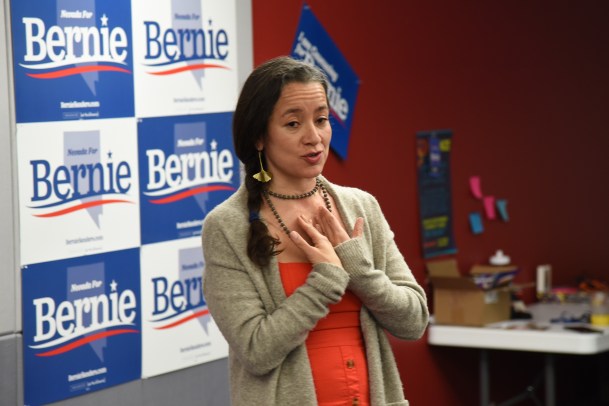
Ana Maria Archila, the co-executive director of the Center for Popular Democracy — the first network of community organizations to endorse Sanders in for 2020 — said Friday that Sanders has made Latinos believe they are valued in the U.S., even amid Trump administration policies and rhetoric aimed at immigrants from Central and South America.
“That’s why Latinos across the country are looking at Bernie and saying that’s my guy,” Archila said.
“He’s the one that’s going to make sure that my family stays together. He’s the one that’s going to make sure that my kids go to college, he’s the one that’s going to make sure that my people are safe,” she said.
David Beltran, an organizer for Sanders who was born in Mexico but raised in the U.S., said he first became a supporter of the Vermont senator in 2016 and that he decided to do everything he could to help him get elected this time in 2020.
Beltran added that both his parents support the 78-year-old Jewish Vermont senator.
“A lot of Latinos love Bernie because he may not look like us, but we see someone who is standing fighting for us,” he said. “This whole movement is about that, it’s about standing with each other and fighting for someone you may not know.”
Recent polls of the Nevada contest have Sanders averaging a 13-point lead over his closest rivals. An Emerson College poll published Thursday has Sanders at 30%.
That poll has former South Bend, Indiana, Mayor Pete Buttigieg at 17%, Biden behind with 16% and Sen. Elizabeth Warren, D-Mass., sitting fourth, after making a strong impression at Wednesday’s debate, with 12%.
However, after feisty debate performances by most of the candidates this week, it is possible the race could be closer than the polls are predicting, leaving the possibility for a result similar to the close New Hampshire and Iowa contests.
Sanders’ Nevada campaign projected a sense of confidence ahead of Saturday when people who did not take part in early voting will head to caucus locations.
However, when the results come Saturday evening, Sanders will not be in the state. The campaign announced Friday the Vermont senator will be in Texas, a key Super Tuesday state, for the second time in as many weeks.

