

Editor’s note: This commentary is by Scott Thompson, of Calais, who chairs the Washington Central school district board (Berlin, Calais, East Montpelier, Middlesex, and Worcester). The views presented here are his own.
Is the state of Vermont overtaxing us? A lot of us seem to think so.
Scrolling down through two articles in VTDigger’s New Year’s Eve edition that are still well worth reading in their own right (Art Woolf on population loss, Elletson and Allen on our growing economic divide), you will find the comments buzzing with complaints about our state taxes. (If you missed your opportunity then, you are cordially invited to make up for it at the bottom of this page.)
I have no doubt that such comments express the truth of their authors’ personal experience. People are experts on their own lives. I trust them to know what they are going through, and I respect their act of bearing witness to it.
At the same time, if we are right that our own individual tax burdens are feeling heavier over time, then we have to reckon with a paradox. Taken per person, Vermont’s total state tax collections have not trended up over the past 12 years in relation to our personal income (open-source data and graphs are thanks to the Federal Reserve Bank of St. Louis):
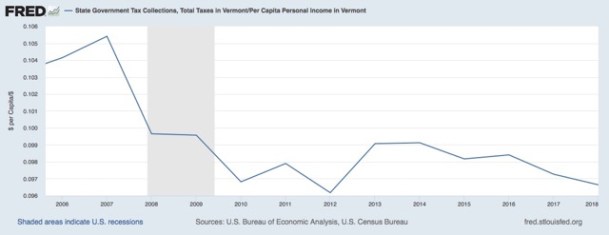
How can state taxes be weighing more heavily on us as individuals if the relative burden is the same or less overall?
One perennial reason springs to mind: widening income inequality. This is nothing new. It has been pulling us apart for decades. A 2007 article by Gittell and Rudokas published by the Federal Reserve Bank of Boston found that the rate of increase in Vermont’s income inequality between 1989 and 2004 was already the second highest in the country (after Connecticut). Income inequality remains a frequent topic of reporting in these pages.
So for a lucky few of us the relative tax burden could be shrinking even when for most of us the burden grows heavier.
But income inequality may not be the whole story.
It was some 40 years ago that Ronald Reagan declared, “government IS the problem.” This idea has been drummed into our heads for so long that many of us now hold it as an article of faith. There’s no doubt that even when government tries to do the right thing, it trips over its own shoelaces often enough to make Reagan’s claim at least thinkable. And more than a few officials chosen for high positions in government seem bound and determined to prove him right.
But what if the claim isn’t true? Could it be that it’s not state government that’s running amok, but the famously efficient, competitive, innovative, free-market, cost-conscious private sector? What might we see in such a case?
For one thing we might see a state tax burden whose major components trend flat over time, while certain categories of private sector charges grab an ever expanding share of Vermonters’ personal income per capita. Something like this, perhaps:
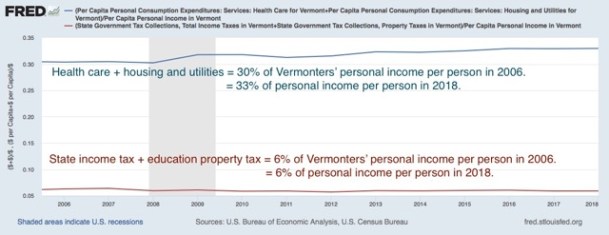
State government isn’t taxing us any more than usual. But private sector services — such as health care and housing — are generating a kind of covert, private tax increase.
This private tax hike is roughly equal to a 100% relative increase in either the state income tax or the education property tax, spread over 12 years. But it comes out of the private sector. So we give it a pass.
Here we catch a glimpse of the Great American Inequality Machine in action: the vast social machinery of laws, regulations, policies, practices, and decisions big and small, which cranks out a net transfer of wealth from the poorer to the richer, from the smaller to the bigger, from the younger to the older, from the more rural to the more urban, and in general from the weaker to the more powerful, at every scale of economic activity in our state and country.
It’s not about capitalism vs. socialism, two words so encrusted with 150 years of ink and spittle that they’re barely fit for use as tools to think with anymore.
Let’s just say that for too many people the world we’ve made for ourselves isn’t working. Why not just deal with it the way we deal with other things that don’t work?
What would a farmer do with a balky tractor that keeps veering sharply to the right? Or whose engine revs up all by itself and then sputters out, over and over again? Or whose plow turns only one deep furrow out of every 100?
Our farmer wouldn’t get rid of it as long as it had some life left. But he wouldn’t be afraid to strip it down, replace the broken parts, and rebuild it the way it ought to function.
Maybe the answer then is a right to repair the world we live and work in. Maybe we could call this right, “democracy.” Come gather ‘round, people. There’s a lot that needs fixing.

