


After weeks of testimony, House Speaker Nancy Pelosi announced Thursday that impeachment articles will be drafted in the coming week. The House of Representatives is slated to vote on Dec. 20 on whether to strip President Donald Trump of his power to run the country.
The question would then go to the Senate.
It is the fourth time a U.S. president has faced impeachment by the House in the nation’s history: Andrew Johnson was impeached by the House in 1868 and acquitted; Richard Nixon resigned in August 1974 before impeachment proceedings could begin in the fallout of the Watergate scandal; and Bill Clinton was impeached by the House for obstruction of justice and lying under oath (like Johnson, he was acquitted by the Senate).
And it’s the fourth time a Vermonter has played a key role in the impeachment proceedings of a president.
In the hearings in which Trump stands accused of abusing the power of his office, Rep. Peter Welch, D-Vt., was a surprise addition to the House Intelligence Committee at the beginning of the new Congress.
Since then, Vermont’s sole congressional representative has become a regular on cable news networks as the go-to Democrat to explain the case against the president.
One of Welch’s comments on the first day of public hearings in the impeachment investigation was widely acclaimed. The congressman said he would be happy to have the person who “started it all” take the stand. The statement went viral.
It turns out it’s not unusual for Vermont politicians to play a prominent part in the impeachment proceeding of a U.S. president. Thaddeus Stevens, George Aiken and Jim Jeffords all gained the national spotlight — just as Welch has — in previous impeachment hearings.
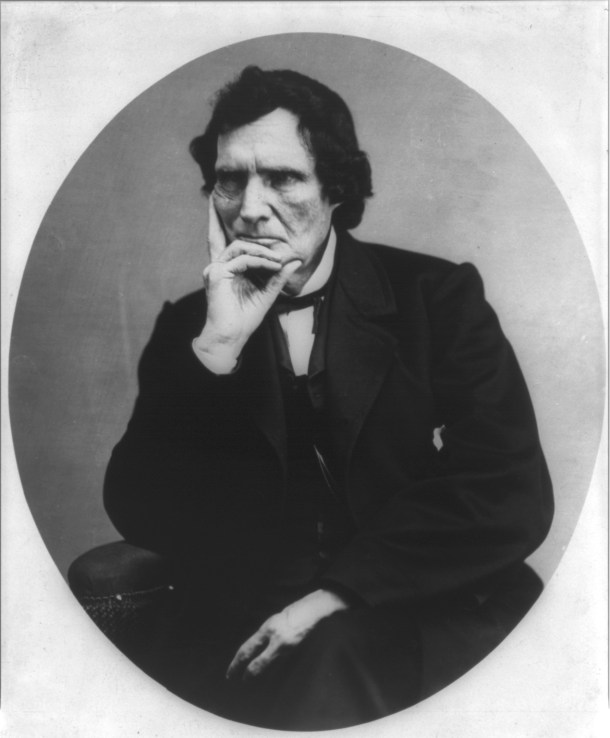
In the 1868 investigation of President Andrew Johnson, it was Pennsylvania Rep. Thaddeus Stevens, who was born in Danville, Vermont, who led the charge against the president.
In the case of President Richard Nixon, Republican Sen. George Aiken, as dean of the Senate, called on the president to resign after the White House tapes made it clear the president had acted illegally.
During the impeachment trial of former President Bill Clinton, it was Sen. Jim Jeffords who dramatically reversed his position on removing Clinton from office, becoming one of the Republican defectors who voted against impeachment. Clinton was acquitted by the Senate.
“In one case you have a Vermonter leading the charge against Johnson and in another you have Jeffords opposing the case against Clinton,” said Garrison Nelson, a political science professor at the University of Vermont.
The impeachment of Johnson
During the country’s first impeachment process, it was Stevens, a staunch abolitionist and chair of the House tax panel, who pushed for Johnson’s impeachment.
Stevens went to the University of Vermont for one semester before he was expelled for killing a cow on campus and finished his education across the Connecticut River at Dartmouth College, according to Nelson.
“The single most important person in the impeachment of Andrew Johnson was the Vermonter Thaddeus Stevens,” Nelson said, describing him as the “de facto leader of the House.” In addition to the tax committee, Stevens chaired the House Appropriations Committee during his time in Congress.
During the years immediately following the Civil War, Johnson clashed repeatedly with the Republican-controlled Congress over reconstruction of the defeated South.
Johnson, who was known for his racism and hate of nonwhite people, vetoed legislation that Congress had passed to protect the rights of blacks who had been freed from slavery.
The clash between Johnson and the Republicans culminated with the House of Representatives voting on Feb. 24, 1868, to impeach the president.
Of the 11 articles of impeachment drafted against Johnson, Stevens championed the final charge accusing the president of declaring the Congress unconstitutional and stripping it of legislative powers because it did not include all of the Southern states.
Stevens argued this put Johnson in violation of his presidential oath requiring him to “take care that the laws be faithfully executed.”
The House voted 126-47 to impeach Johnson of high crimes and misdemeanors, but the Senate fell short of the 36 votes needed to find the president guilty of any of the charges — with Vermont’s Republican Sens. Justin Morrill and George Edmunds voting to remove Johnson.
The Senate decided to only vote on the three articles of impeachment — including Stevens’ charge — they believed had the best chance of receiving support for convictions. Thirty-five senators found Johnson guilty while 19 said he was not guilty. The upper chamber acquitted him.
Aiken pushes for Nixon’s resignation
As reporting about the break-in to Democratic National Convention offices at the Watergate hotel began to trickle out, Vermont Republican Sen. George Aiken, as the dean of the Senate, was still supportive of Nixon.
On Nov. 7, 1973, as discussions around impeaching Nixon began to heat up, Aiken gave a speech in the Senate, proclaiming the House should “impeach him or get off his back.”
“He urged the House to do its duty and not delay but to hold impeachment hearings and if it so decided, then it should send articles of impeachment to the House floor,” said Steve Terry, who worked as a legislative assistant for Aiken from 1969-1975.

Aiken’s well known challenge to the lower chamber was lifted from a letter written to the senator by former Vermont state Rep. Peter Giuliani — no relation to Trump’s personal lawyer Rudy Guiliani — according to Terry.
“He wrote Aiken a letter and he ended it with this advice — either impeach him or get off his back,” he said in a recent interview.
In early February 1974, the lower chamber gave the judiciary committee the go-ahead to investigate Nixon, ending with the oversight panel recommending impeachment on grounds of obstruction of justice, abuse of power, and contempt of Congress.
Vermont’s House member at the time, Rep. Richard Mallary, a Republican who died in 2011, was fully supportive of removing Nixon from office in 1974.
In a 1998 interview with the Associated Press, Mallary said it was less the break-in to Democratic Party offices and more the ensuing cover-up.
“The failure to keep faith with the American people is the fundamental failure,” Mallary said.
Nixon’s “greater crime” Mallary told the Associated Press was the president had “created an atmosphere in the White House where something like this could be contemplated,” referencing the president’s illegal behavior for personal political gain.
Following a subpoena from the committee, in April, Nixon made edited transcripts of conversations regarding Watergate public. Democrats pressured the White House for access to all of Nixon’s recorded conversations, and, in the summer of 1974, the U.S. Supreme Court ordered Nixon to release the White House tapes.
“Aiken was still supportive of Nixon on Vietnam, but his attitude towards Nixon changed when it became clear he was covering up a crime. He could no longer support him remaining in office,” Terry said.
When it became clear that if the House approved its three articles of impeachment, there would not be enough support to exonerate the president, Aiken, as dean of the Senate, urged Republican leaders to hold a private meeting with Nixon urging him to resign.
“House Minority Leader John Rhodes and Senate Minority Leader Hugh Scott and Barry Goldwater went to the White House, with Aiken’s blessing, and said that he no longer had the support of Congress and for the good of the nation he should resign,” Terry said.
Nixon would resign less than a week after the meeting, on Aug. 9, 1974, but would be given a full pardon a month later by President Gerald Ford.
The Clinton affair
In December 1998 as the House was poised to vote in favor of impeaching President Bill Clinton for having an affair with a White House intern, Monica Lewinsky, and then trying to keep it from the American public, then Rep. Bernie Sanders, I-Vt., said he was opposed to impeachment but did not condone the president’s actions.
“In my eight years in Congress, this is probably the most significant vote I’m going to cast,” the Burlington Free Press quoted Sanders saying about his decision to vote against all four articles of impeachment.
“When all is said and done, this is a president who cheated on his wife, lied about and tried to cover it up,” Sanders added at the time.

It would be after the president was impeached by the House of Representatives on Dec. 19, 1998, with the beginning of the Senate trial in 1999 that Vermonters would play integral roles in the Clinton affair.
With the concerted effort by Republicans to impeach Clinton, Sen. Jim Jeffords, R-Vt., entered the national spotlight as he became a potential swing vote to oppose impeachment in the Senate trial.
The Los Angeles Times, on Jan 23. 1999, wrote that “no one better embodies the tension between Republicans who want to oust the president and voters who support him than Jeffords.”
Jeffords, who died in 2014, went back and forth on how he would vote throughout the Senate trial, expressing discomfort with how, in his view, Clinton had made his staff accomplices in his affair with Lewinsky. But Jeffords also voiced concern about setting precedents for future impeachments.
“If you say lying about a non-crime can be converted into a high crime by the way he handled it, that sets a pretty low standard to me,” Jeffords told the Los Angeles Times.
Jeffords would end up bucking the party line. He voted against removing Clinton from office, becoming one of what the media dubbed the Republican “defectors.”
After Clinton was acquitted, Jeffords called the impeachment proceedings a “long and sad chapter in our history” and called for the country to put partisanship aside, according to the Burlington Free Press.
“It is not the time for retribution or retaliation, but a time for reconciliation and a rededication to the business of the nation,” he said.

The Associated Press reported that people called Jefford’s Senate office threatening to kill him and saying that he should watch his back because of his decision to exonerate Clinton.
For the Senate Democrats, Sen. Patrick Leahy, D-Vt., took the lead as one of the lawmakers tasked with deposing key witnesses, including Lewinsky, while also admonishing House Republican theatrics.
Leahy would also vote against impeaching Clinton, arguing that House members had failed to prove their case against the president.
“The House sent over a partisan impeachment and the Senate rejected it. I think that what that does is make it more difficult to do an impeachment for partisan reasons,” Leahy told the Burlington Free Press.
“Our actions can stir a chord that will vibrate through the history of the Republic,” Leahy added after. “I will cast my votes wary of the dangers posed by the House members’ seductive invitation to vote to remove the president for symbolic purposes.”
Sanders reiterated the sentiment of his Vermont colleagues, professing thanks the “impeachment nightmare is over.”
Welch: ‘Congress has a duty to act’
Speaker of the House Nancy Pelosi, D-Calif., announced Thursday she has asked committee chairs to draft articles of impeachment against President Donald Trump.
When a vote on impeachment goes to the House floor, it would only be the third time in the country’s history this would take place. This could also be the second time Leahy and Sanders would decide whether to remove a president from office.
Welch has repeatedly stated he believes Trump should be impeached for allegedly attempting to coerce Ukraine President Volodymyr Zelensky into investigating the Biden family.

In a recent interview Welch said it was always “politically inconvenient” for the House to take action against Trump, but that the circumstances became so serious that it would have been immoral not to open the impeachment investigation.
“My view has been, especially after the Ukraine information, the Congress has a constitutional duty to act,” Welch said.
“As a member of the House of Representatives, it became time. It was my duty to do and I had to do it independent of the politics of it,” he added.
In the Senate, Sanders, who has been vigorously campaigning across the country to win the White House in 2020, has also said he supports impeachment.
Leahy, meanwhile, has stayed mostly mum on whether he thinks Trump should be impeached, as he tries to remain an impartial juror for the expected Senate trial.
The senior Vermont senator has already discussed guidelines for the trial with Senate Majority Leader Mitch McConnell, R-Ky., and Minority Leader Chuck Schumer, D-N.Y.
“Leahy is expected to play a unique role in the upcoming impeachment trial as the most senior senator who has served since Watergate, and as the dean of the Senate, and as a leading member of the Senate Judiciary Committee,” said Leahy spokesperson David Carle.

