


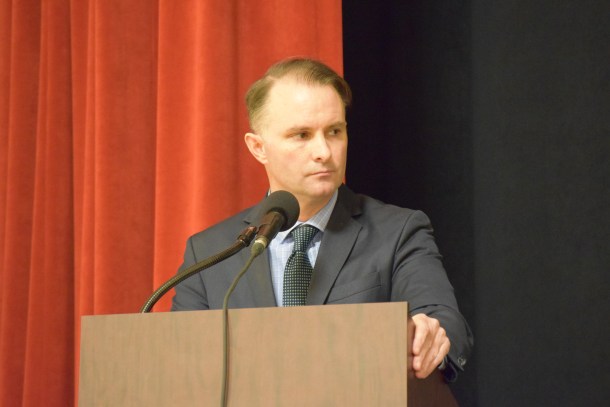
BURLINGTON — Attorney General TJ Donovan says that Vermont’s current marijuana laws are bad for consumer protection and public health.
A month before lawmakers return to Montpelier where they’re poised to resume debate on marijuana policy, the state’s top prosecutor hosted a panel focused on the regulatory systems Maine and Massachusetts have put in place.
“I think Vermont is in a really weird position when it comes to cannabis,” Attorney General TJ Donovan said at the event Thursday. “In fact, I think we’re probably in the worst position we could possibly be in — where we legalized possession of cannabis but we’ve remained absolutely silent on how Vermonters obtain it.”
Vermont legalized adult possession of small amounts of marijuana in 2018, but sales remain illegal. Donovan, who came out in support of a regulated market in January, has concerns about gray areas in Vermont’s law, like a provision that allows adults to give small amounts to each other so long as there is no exchange of goods or services.
“We need to act,” he said after the event.
During the 2019 legislative session, senators passed a bill to establish a regulated market, but that bill stalled in the House. House Democrats have said they plan to take up the bill early next session.
But Gov. Phil Scott has said he won’t sign a retail bill unless it allows roadside saliva testing for driver impairment. Senators have expressed concern over the accuracy of such tests and potential civil liberties violations.
Kevin Conroy, an attorney with the Foley Hoag firm, which has an office in Boston, said regulation is going “very, very well” in Massachusetts, where legalization was passed by ballot initiative in 2016.
There are 35 dispensaries today spread out across the state. Massachusetts is expecting to take in about $125 million in tax revenue next year, according to Conroy.
“This is a highly regulated industry that’s not going to change your state too much,” Conroy said. “And you’re going to have more revenue.”
Massachusetts has a very strong local control option, which gives towns the power to decide whether to allow sales or not. Vermont lawmakers are considering how much control towns should have. Conroy said that in his view Massachusetts has “too much local control.”
A hurdle for the cannabis industry is access to loans and capital. Because marijuana is illegal at the federal level, banks with federal insurance will not approve loans or have any business dealings with state level legal cannabis operations. Most dispensaries across the country operate on a cash only model.
Joe Bergeron, president and CEO of the Association of Vermont Credit Unions, said any bank may lose their federal deposit insurance for working with a marijuana company, or even a company that provides services to a marijuana operation.
Legislation to protect financial institutions that deal with legalized markets passed the U.S. House in September, with nearly all Democrats and about half of Republicans supporting the measure, but the Senate has not taken action on the bill.
“Credit unions and banks aren’t taking a position on legalization one way or another, but they do want to serve these businesses,” Bergeron said. “In order to do so, they need some clarity and some safe harbor so they know they can do so rightfully without risk of losing their deposit insurance.”
In April, Brattleboro Savings and Loans was set to become the only bank in Vermont to lend to marijuana and CBD businesses, which could put them in legal jeopardy with federal banking regulations. Bergeron said, to the best of his knowledge, he hasn’t heard of any bank in any state losing their insurance so far.
Laura Subin of the Vermont Coalition to Regulate Marijuana said Vermont could craft regulations to ensure that small farmers could participate in the market. The bill under consideration would establish a regulatory board, that could create a tiered licensing system.
“We have to be protective of small farms,” she said.
Subin also emphasized the need for safety and quality controls, and said that Vermont policymakers should craft a system that creates opportunities for residents and communities harmed by the prohibition on cannabis.
States have varied approaches to taxing cannabis. Both Massachusetts and Maine have a 20% excise tax on cannabis products. The bill the Vermont Senate passed last year would tax recreational marijuana at 18%. In some states, like Colorado and California, tax rates are as high as 40%.
“Part of the goal from a law enforcement perspective is to eradicate the black market,” Donovan said. “Is 20% or 18% the right tax to do that or do you get to a price point where it just grows the illicit market?”
Conroy said the tax rate really doesn’t matter to the black market; consumers will be drawn to the regulated market regardless of the rate, he said.
“I think most people want to buy product in a regulated environment where their product has been tested and they do that in a legal way,” he said.
More than 50 people attended the panel discussion. While some in the audience favored a regulated system, others spoke out against creating a legal market. Donovan twice asked the audience to “be civil.”
Bishop Jethro James, a pastor from New Jersey and former adviser to several New Jersey attorneys general and governors, raised concerns about THC, the psychoactive component of marijuana, being found in mothers’ breast milk.
“I’ve led the fight against what you’re doing here,” he said to the panel.
He questioned why, if Vermont already has legal possession, the state needs a regulated market. No states that have legalized marijuana have fully eradicated the black market, he said.
“What makes you think that you’re going to be different?” James asked the panel.
Panelist David Mickenberg, a partner at Burlington-based Mickenberg, Dunn & Smith law firm, said the Vermont bill dedicates 30% of tax revenue to substance abuse prevention programs. Conroy said there are “very, very detailed regulations” in Massachusetts about advertising aimed towards children and encouraged Vermont to take the same path.
