

Editor’s note: This commentary is by Ed Stanak, who was the Act 250 district coordinator for Washington and Lamoille counties from 1980 to 2011.
Everyone knows and loves the Green Mountains of Vermont but not many are aware of the Finite Mountains of Vermont.
The dictionary tells us that “finite” means “having limits or bounds.” It’s time that we reflect on the limits of the mountains to sustain the natural resources that we and future generations of Vermonters depend upon.
What are these mountain natural resources? They are the critical headwaters of Vermont’s streams, rivers and wetlands. They are the aquifer recharge areas for the water supplies of so many residents and businesses. They are necessary wildlife habitats, including the travel corridors essential for the survival of many species. They are the rare and irreplaceable natural areas and the homes of endangered plant species. They are the remaining contiguous forests. They are the carbon sinks which are our buffers from extreme climate change impacts. And they are the aesthetic heart of Vermont.
There are limits to what these natural resources can endure.
When we think about Vermont’s mountains most of us do not apply objective factors: We know mountains when we see them. But over the last 50 years state laws, policies and decisions of environmental regulatory panels have relied upon elevations to determine where the headwaters and other mountain features are. The 1,500-foot elevation contour has long been acknowledged as the area that begins to distinguish valleys from mountains.
When we say that the mountains of Vermont are finite we can rely on data that quantifies the involved land masses. Here are the facts about the high elevation land areas in Vermont – which has a total land mass of 5.9 million acres:
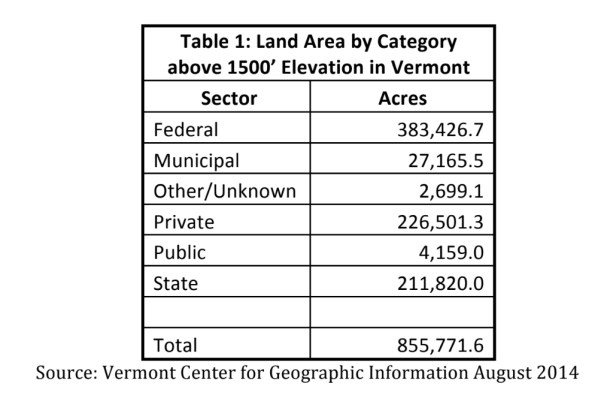
What are we currently doing to protect these finite natural resources from unwise land uses and changes? We have a hodgepodge of Agency of Natural Resources technical permits, zoning reviews by some towns and a limited role by the Act 250 process. But in many instances, there is little or no oversight of proposed changes on the mountains. There is definitely no comprehensive state policy.
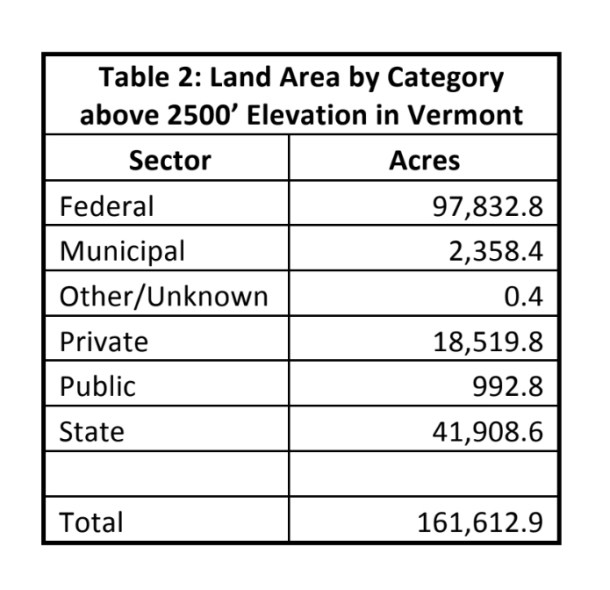
Since 1970, state law has required that construction for commercial and industrial purposes, as well as logging, above 2,500 feet in elevation requires review under Act 250. There are no particular provisions for the review of the subdivision of large undeveloped lands above that elevation. Here is the breakdown of the land mass above 2,500 feet, noting that only “private” lands are protected by that law:
In 2016 the Vermont Legislature passed Act 47 establishing a study commission to examine how Act 250 might be enhanced to address 21st century land use and growth impacts. That commission issued a report in December 2018 which found that only about 30% of all development and subdivision of land in Vermont is subject to Act 250 review. This is due to multiple factors including expanded zoning and subdivision regulations in some towns and exemptions to Act 250 that were created incrementally by the Legislature over many years in an effort to “incentivize” growth in preferred areas. The commission report recommended that Act 250 jurisdiction be extended to encompass the review of development above 2,000 feet in elevation.
You might consider taking a look at a topographical map for your town and/or for your favorite places in Vermont — whether it’s along the scenic corridors of I-89 or I-91 or perhaps somewhere that you visit for relaxation and renewal – and gain an understanding of where the 1,500-foot contour is located. You might also want to take a ride or walk into some of the high elevation settings and observe the existing characteristics — both natural and developed.
What can be done to ensure adequate protection of the high elevation settings while allowing appropriately located and designed development to go forward? And what should be done to safeguard forest and habitat areas from less than prudent fragmentation into subdivided lots?
There is growing concern that the traditional rate and types of growth in Vermont will be altered by the adverse impacts of climate change in other parts of the United States which will result in the migration of population into Vermont. Mountain slopes will become sites for the construction of single family residences, gated communities and related commercial development.
The Legislature can act during its 2020 session and recognize that there are compelling state interests substantiating the preservation of mountain natural resources by enhancing Act 250 jurisdiction so that: 1) all development for commercial, industrial and state purposes on more than one acre of land above 1,500 feet in elevation (while retaining current exemptions for “home occupations” and “de minimis” construction), and 2) the subdivision of land into three or more lots within a five-year period will be subject to reviews by the regional district commissions with opportunity for public participation.
Why should the Legislature take such action? Because when these finite natural resources are gone, we will no longer benefit from the values they provide to all Vermonters.
Why should Vermonters discuss these issues now with their legislators? Because they are better able to talk with you about these things before they return to the Statehouse and the pressure of the legislative session commences.
Why should we commit to conscious consideration of the loss of these finite natural resources? Because if we cannot leave these mountains for the benefit and enjoyment of future generations, what will we leave them — and what will be our legacy?

