

Editor’s note: This article is by Madeline Bodin.
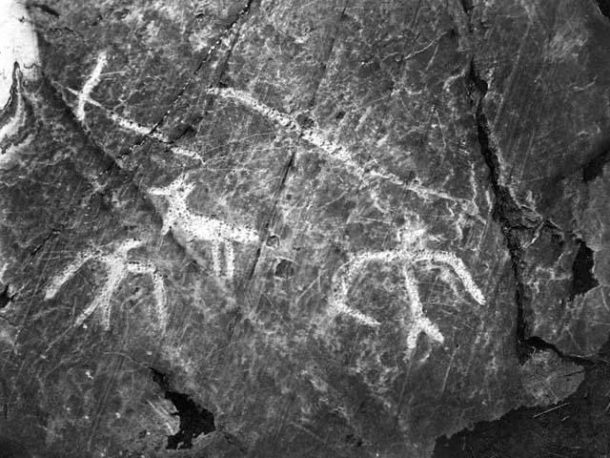
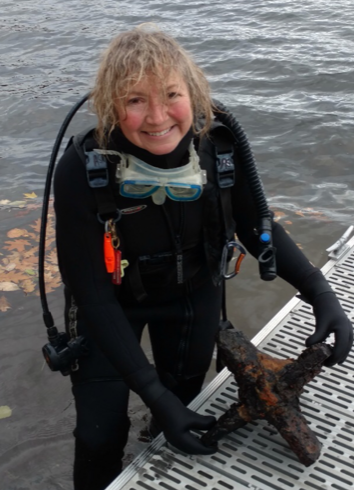
On an afternoon in October 2017, Annette Spaulding of Rockingham was 15 feet below the surface of the West River alone. Her scuba tank was nearly empty and her GoPro video camera battery was dead. She had dug three feet into the riverbed with a small fireplace shovel, then brushed away the last of the sand from the rock below her by hand. When the cloud of sand settled, Spaulding saw a curved shape carved into the rock – a wing. She quickly cleared the other wing, and then, an entire eagle figure.
Spaulding knew that shape by heart. She had been searching for it for 40 years, ever since seeing a single photocopied sheet in a library file. She had been searching for information on Fort Dummer, the first English settlement in what would later become Vermont, built in 1724.
The sketch in the file looked to Spaulding like five eagles, a man, a dog or wolf, and two eels or lampreys. “Facsimile of the drawing by – Larkin G. Mead,” was typed beneath the sketch. It represented “Indian Rock,” a collection of Native American rock carvings, or petroglyphs, on the West River, near where it enters the Connecticut River in Brattleboro.
“Indian Rock” has been submerged in the West River since 1909, when the Vernon Dam was built. Nobody expected the area to flood. An airstrip and the remnants of Fort Dummer were drowned as well. The exact location of the petroglyphs had never been recorded.
Spaulding, a retired income tax consultant and a search-and-rescue diver with decades of experience under her dive belt, has gone scuba diving all over the world, from a deep glacial lake in northern Canada where she searched for, and found, a historic airplane, to a shark cage off Baja California where she dove with white sharks. But the Connecticut River is her diving home, the place she calls “410 miles of adventure.”
Few fellow divers shared her zeal for wafting silt or shoveling sand. Mostly, she dove alone. (“I know, I know,” she says of the danger. “I’ve been a rescue diver for decades.”) Little things kept her going as the years wore on. Once, in Montpelier to give a talk about her search, she saw that the Ethan Allen statue outside the Statehouse was sculpted by Larkin Mead, the artist whose sketch launched her quest. It buoyed her spirits.
After finding the eagle-like carving deep under the river, Spaulding knew who she had to call: Rich Holschuh, a member of the Vermont Commission on Native American Affairs and a spokesperson for the Elnu Abenaki Tribe of southern Vermont. The two had met several years before, after Spaulding found a different petroglyph while searching for the larger petroglyph panel, this one of a face.
At their meeting, Holschuh explained that the petroglyph panel Spaulding was seeking had never been forgotten by the Abenaki people living nearby. The petroglyph she found, and the ones she was still looking for, are not relicts of the past, he said, but significant to the Elnu Abenaki’s living culture.
When Spaulding began her search, the state of Vermont did not recognize Native American tribes within its borders. The myth of Native disappearance is not unique to Vermont, says Colin Calloway, a Dartmouth College professor of Native American studies and history, but may be a little stronger here because the English arrived here relatively late in the colonial period.
Calloway has tracked Native families through local records, and seen their identities transform, as they passed for white or were listed as other races or ethnicities. Jess Robinson, archeologist with the Vermont Division for Historic Preservation, says that the archeological record confirms that there has been a continuous Native American presence in Vermont from before European contact to today.
Just a few miles from where Spaulding first saw the sketch of the petroglyphs, a band of Native Americans were quietly growing tobacco, making twine from milkweed fibers, and planting corn, beans and squash using techniques passed down through generations.
Over the same decades as Spaulding’s search various Vermont Abenaki groups petitioned the state and federal government for recognition, and were denied each time. Then, in 2011, the state of Vermont recognized two Native American groups – including the Elnu Band – and two more in 2012.
The petroglyph, Holschuh explained to Spaulding, “is a standing message from the ancestors that still resonates for the people who recognize it.” Native people left messages everywhere, Holschuh says, on leather, on pottery, on trees. “Only the most important messages are carved in rock.”

“There is this Abenaki resurgence that has paralleled Annette’s search. She has been searching for decades and during that time, the Abenaki are reclaiming their place in society and on the landscape,” Holschuh says.
The Abenaki call the West River “Wantastekw.” Among the meanings of that name is, “the river where things get lost.” “It’s the place that is significant. That’s why the petroglyphs are there,” Holschuh says. A whirlpool that a historical journal entry and an old photo show at the site may be part of the place’s significance. The petroglyphs may indicate “a convergence there of sky, land and water,” Holschuh says.
The Elnu Abenaki are working with the Vermont Land Trust to conserve the land adjacent to the petroglyphs. Holschuh believes that conserving the petroglyphs’ setting – as much as is possible – is as important as conserving the petroglyphs themselves. “What has come out of Annette’s long search is that this place is going to be preserved for perpetuity,” Holschuh says.
Holschuh imagines the place as conserved public land, perhaps as part of a nearby wildlife sanctuary. He wants to ensure that Native American people always have access to it. He also sees an opportunity there to show non-Natives the world through Abenaki eyes – particularly this piece of it.
There are authorities on northeastern Native American culture and history whose expertise comes both from academic degrees and their own Native American heritage who will not speak a word about any petroglyphs along this Vermont stretch of the Connecticut River. They don’t want anyone else to say anything either, considering it a further colonization of their culture.
And New England’s Native American petroglyphs have a history of abuse. For example, the Bellows Falls petroglyphs, 20 miles north of the Brattleboro petroglyphs, were altered in the early 20th century to attract tourists.
“I choose to approach those dilemmas from a different perspective: one of asserting and affirming Abenaki presence and continuance here in order to challenge and displace that colonized narrative,” Holschuh says.
When Spaulding returned to the river last September, she found the driveway marker she had staked at the petroglyph site. She painstakingly dug figure after figure from the sand. When each of the figures that were present on the photocopied sheet were visible, she got ready to film the scene with a GoPro camera.
Suddenly, a strong current swept down the West River. When Spaulding turned her head, it threatened to rip the dive mask from her face. It was the weekend of the annual West River dam release for recreational paddlers. “I had forgotten all about it,” Spaulding says. Sand covered the figures as Spaulding scrambled to the surface. “I was hysterical.” She still intends to return to the site, clear the sand from all the figures and photograph them as a set.
Holschuh says it doesn’t matter if the figures are ever freed from the sand, are ever above water, or if human eyes ever see them again. “They are there and they are still doing their job. I’m OK with them being exactly where they are.” Because even in the river called Wantastekw, just because something can’t be seen, doesn’t mean that it’s lost.
