


Editor’s note: This is the third story in a series on the Vermont Catholic Church’s hidden history of clergy abusing children. Part 1, “One boy,” offers the perspective of a survivor. Part 2, “One priest,” reveals how the state’s most problematic cleric stayed on the job. Part 3, “One diocese,” reports on the collective past and current attempts to acknowledge and atone for it.
Dan Gilman can cite too many reasons for questioning his childhood faith in God. Take the freak accident that paralyzed him at age 15. The subsequent two years of sexual abuse by a priest. His adult attempt to return to his hometown parish, where the pastor greeted him by asking, “Does your equipment work?”
The cleric, looking at Gilman’s lap, wasn’t inquiring about his motorized wheelchair.
The full story is told
in Part 1, “One boy.”
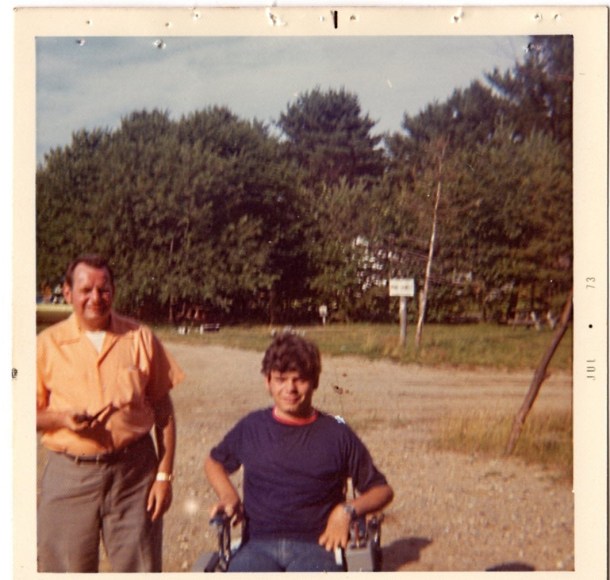
But none of that stopped the 62-year-old Rutland resident from reaching out to Vermont Catholic Bishop Christopher Coyne last fall when the leader of the state’s largest religious denomination gave long-locked personnel files to a lay committee to review and publicly release the names of problematic priests.
Coyne, on the job since 2015, hasn’t followed in the footsteps of his predecessors, who covered up decades of allegations of clergy molesting children, flouted court orders and failed to reconcile with survivors to the point the Boston Globe supplemented its Pulitzer Prize-winning 2002 series on Massachusetts priest misconduct with a story headlined “Vt. Diocese Called Slow to Respond to Abuse.”
Coyne instead has released accusers from past nondisclosure agreements and worked with a local and state task force of police and prosecutors now investigating the history of church-wide misconduct.

“This is not rocket science — we can fix this,” he told the Globe in a recent interview. “You know why? Because the laity is forcing us to get it right. The folks in the pews right now, they’re not going to be quiet anymore. They’re not going to settle for halfway measures.”
Receiving Gilman’s call a year ago, Coyne traveled to Rutland County to meet the survivor, then followed up this summer with advance notice that a lay committee was set to release an online report acknowledging the statewide Roman Catholic Diocese of Burlington knew of its abuse problem for at least three-quarters of a century but did nothing to alert the public or police.
“Until now, the scope of all of this has been our ‘family secret,’” Coyne said in a resulting statement. “We are supposed to be a people of love, a place of hope, and a community of healing. But that is not always the case. … It is clear to me that we must be fully honest about these sins of our past.”
Such words are earning approval in the present.
“I’m very supportive of what Bishop Coyne has done,” Gilman says as a survivor.
But as seen in the report, court records and personnel files obtained by VTDigger, the change of course also could lead to a bankrupting wave of lawsuits in the future.
‘For every kid who reported abuse there were more who didn’t’
Of the approximately 400 priests under the diocese’s supervision since 1950, at least 40 — or about 10% of all clergy over the past seven decades — have faced credible allegations of child sexual abuse, the lay committee found in its review. But the problem dates back farther, as New Hampshire records show a priest accused of molesting a child in the Vermont town of Bradford as early as the 1940s.
The most problematic priest has been Edward Paquette, the subject of nearly 40 court cases with more awaiting because of assignments in Rutland in 1972, Montpelier in 1974 and Burlington in 1976.
The full story is told in
Part 2, One Priest
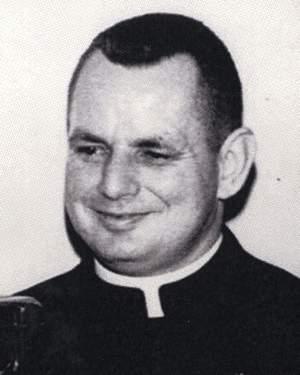
The second-most sued priest, Alfred Willis, now 75 and last known to be living in Virginia, has faced eight cases. The diocese received its first warning shortly after Willis entered seminary in 1972 (“there might be a problem,” internal paperwork said) and more reports of him acting out sexually at his ordination (“with a young man … who had just played the guitar”) and during stints in Burlington in 1975, Montpelier in 1976 and Milton in 1979. But the church didn’t take action until a secret tribunal declared Willis “infamous” in 1981 and dismissed him four years later.
“I have become convinced,” then-Bishop John Marshall, who served from 1972 to 1992, wrote privately in 1983, “that (1) Father Willis is a pathological liar and consummate actor; (2) … he is almost certainly a social psychopath; (3) he uses and manipulates persons and he is quite capable of doing so even with experts in the psychological field; (4) he cannot return presently to this diocese as a priest because the statute of limitations has not expired on the charges against him; (5) he should not be allowed to serve elsewhere as a priest, as long as he is associated with the Diocese of Burlington because this diocese (and the other diocese too) would be subject to civil suits that we had knowingly and willfully given him an opportunity (‘cover’) to continue to victimize minors.”
Three former priests have faced two lawsuits each (James McShane, George Paulin and the late Benjamin Wysolmerski), while eight former priests have faced one each (the late Donald Bean, James Dunn, the late Joseph Dussault, the late Edward Foster, John Kenney, the late Michael Madden, Stephen Nichols and the late Charles Towne).
Collectively, the cases don’t convey the full extent of the problem — just the number of survivors willing to share their stories in court.

“The sad truth is for every kid who reported abuse there were more who didn’t,” says Mark Redmond, executive director of Burlington’s Spectrum Youth & Family Services and a co-chair of the lay committee.
That’s because the diocese has a decades-long history of disregarding survivors, court orders and outside review. Consider the case of Madden, who was charged with sexual improprieties during a 20-year career at six parishes, starting with Burlington in 1970 and moving to St. Johnsbury in 1974, Colchester and Stowe in 1976, Waitsfield in 1977 and Barton from 1985 to 1988.
In the 1980s, a county state’s attorney tried to subpoena then-Bishop Marshall to testify against Madden in court. The diocese, citing the Bible and the U.S. Constitution, argued its leader was immune from such calls.
“In order for the church, its priests and bishops … to enjoy the constitutional right to freely exercise their ecclesiastical or religious functions,” one of its lawyers argued, “it is essential that they have independence from state authority.”
A judge went on to rule the diocese had to provide internal information. But the church didn’t comply with that demand either, prompting the state to drop multiple sexual assault charges against Madden in return for a no-contest plea on a single count of lewd and lascivious conduct.
The priest, spared prison with a deferred sentence, opted out of a state Corrections Department sex offender treatment program for a church-run alternative. There he told a therapist he had molested dozens of teenage boys, then went on to violate his probation six times and, only because of that, serve two years in jail.
‘Criminal investigation of numerous allegations remains active’
Although most accusers are male, a few have been female. Take the instance of two women who reported being raped as teenage girls by the now deceased priest Benjamin Wysolmerski, who began his 35-year career in Bellows Falls in 1950.
“He did it while he was the teacher at the school teaching us catechism,” one woman said in a 1994 court deposition. “He did it on back roads going to visit people who he was helping in the parish. He did it to me in the attic of my grandmother’s home.”
The woman said Wysolmerski eventually impregnated her and paid for an abortion. She went on to write then-Bishop Marshall, believing he already knew because the priest had showed her a letter other women had sent the diocese about the situation.

Instead, Marshall replied: “My study has uncovered nothing so far to corroborate your story and some rather strong evidence, which would seem to exonerate the one against whom you have made your allegation.”
Wysolmerski, for his part, would be moved to Burlington in 1958, Barre in 1962, Bridport in 1963, St. Albans in 1966, Bennington, Newport and Middletown Springs in 1971, Pittsford in 1977 and back to Bellows Falls from 1987 to 1993.
Leaders of the Vermont church and law enforcement first launched separate investigations into the statewide problem in 2002 upon publication of the Globe series dramatized in the Oscar-winning film “Spotlight.”
The diocese initially downplayed the number and nature of complaints as “a few” and said it didn’t plan to give prosecutors the names of anyone accused. Within weeks, however, the church placed six unnamed practicing priests on leave and provided paperwork on them and 13 unidentified former clergy to the state.
Unsatisfied, then Vermont Attorney General Bill Sorrell — who served from 1997 to 2017 — demanded all the diocese’s clergy misconduct records since 1950. After months of review, the state didn’t issue a public final report nor charge anyone criminally — only because the office discovered credible claims but deemed them too old to prosecute under statutes of limitations at the time.
Accusers, however, were free to file civil lawsuits or seek financial settlements. More than 50 Vermonters went on to pursue court cases alleging childhood sexual abuse.
The church was anything but conciliatory. In one case, its lawyers argued state statute at the time of one reported aggravated sexual assault called a rape victim “a female person” and “since plaintiff is male, his alleged rape could not have violated” the law. In a second, they denied the existence of nearly three decades of personnel records on a particular priest, only to announce “they were misfiled” after a month of court pressure and press coverage. In a third, a judge declared a mistrial after church counsel disregarded an agreement about what questions couldn’t be asked in front of the jury.
“Perhaps now on retrial we will have a different judge with a different perspective,” one of its lawyers said after.
The diocese thought it had concluded its legal drama in 2013 upon agreeing to a multimillion-dollar blanket settlement intended to close the remaining claims. Coyne’s installation as bishop in 2015 was supposed to confirm a fresh start. Then the church found itself again under scrutiny upon publication last year of a BuzzFeed story titled “We Saw Nuns Kill Children: The Ghosts of St. Joseph’s Catholic Orphanage,” which recounted the history of the now-closed Burlington facility that operated from 1854 to 1974.
Back when former orphanage residents first spoke publicly in the 1990s about what BuzzFeed summed up as “unrelenting physical and psychological abuse of captive children,” the diocese offered each $5,000 to waive their right to further legal action. As many as 160 pursued the deal and more than 100 accepted payment, according to news reports a quarter-century ago.
The reemergence of those memories spurred current Attorney General TJ Donovan to form a task force of local and state police and prosecutors last fall to revisit the diocese’s history of personnel abusing children.
“The criminal investigation of numerous allegations remains active and ongoing,” the task force said in a recent update.
But Donovan won’t elaborate on or off the record, leading some to question how authorities expect to report anything more than Sorrell found in his review two decades ago.
Burlington lawyer Jerome O’Neill, who has secured settlements for more than 50 Vermont accusers, is one of the few people outside of church and law enforcement circles to review the diocese’s records. He obtained personnel files, transcripts of interviews with people claiming misconduct and correspondence between Catholic and state officials through a court order. He isn’t sure the latest probe will expose much new information.
“I still have all the files,” O’Neill says. “Cynics would say the diocese probably destroyed some of them. You never know with certainty, but if someone was going to get rid of documents, you would have destroyed the ones we received. There was such incredibly incriminating information. I have no reason to believe there are any significant documents of which we are not aware.”

‘The wound of this is going to haunt us for decades to come’
As authorities have stayed silent, Coyne has spent the past year holding a series of press conferences and public meetings where he has answered every question asked.
The son of a Massachusetts mailman and church-going mother, the bishop grew up with firsthand knowledge of the career challenge awaiting him: He and his fellow schoolboys dodged a priest they knew as “Father Touch-and-Feel.”
“We were warning our friends that that guy was a little creepy,” he told the Globe.
A greater devotion to the Catholic faith led Coyne to become a cleric and eventually the Archdiocese of Boston’s spokesperson shortly after the start of its sexual abuse scandal in 2002.
“Coyne’s has been a more forthcoming and compassionate voice,” the Globe wrote at the time he replaced a less-transparent lay official, “and, perhaps because he is a priest, his words seem to many to carry greater weight.”
In 2015, Coyne became leader of the Vermont church as well as communications chairman for the United States Conference of Catholic Bishops and Pope Francis’ media aide when “the people’s pontiff” met with national and world leaders in Washington, New York and Philadelphia. He has used all his platforms to address the abuse scandal.
“I would say personally, from day one when it was happening,” the bishop told the Globe, “it made me more committed to the church because I wanted to be someone who would try to fix it if I could.”
Coyne notes Vermont records show only one case — that of Nichols, who was sentenced to 30 days in jail after pleading guilty to fondling an inebriated 18-year-old in 2005 — occurred in the current century. But with the arrival of the lay committee report and a new state law repealing time restrictions on filing civil lawsuits, the overall number throughout history is expected to rise.
O’Neill, attracting clients as a former federal prosecutor whose representation of survivors has been well-publicized, has filed five new cases and counting so far this year.
“Any time there is a significant event — Boston in 2002, the Pennsylvania grand jury report last year — people come forward,” the lawyer says.
Unlike past bishops who fought O’Neill in court, Coyne has settled all recent lawsuits before trial. He has considered such cases anomalies because the state long has required civil claims be filed within six years upon realization abuse caused personal harm, and most survivors have known longer.
Then the Vermont Legislative unveiled a bill earlier this year to repeal the time restriction. The Catholic Church has spent more than $10 million in the Northeastern states of Connecticut, Maine, Massachusetts, New Hampshire, New Jersey, New York, Pennsylvania and Rhode Island to oppose such efforts. Coyne, in contrast, hasn’t lobbied against such legislation.
“If I was to go down to the Statehouse, the first thing that someone would come out with is, ‘You have no rights to lecture us about moral law given what the church did to children,’” he has told Vermont Catholics about his perceived inability to opine on a variety of political positions.
The Legislature went on to approve a law allowing survivors to file civil lawsuits any time in the future, leaving the diocese in a precarious position.
“We made a decision to publish this list (of accused priests) before anybody knew the statute of limitations was going to be removed in the state of Vermont in perpetuity,” Coyne says. “I want to give justice to someone who was abused. But we have no more insurance, very limited unrestricted funds and few assets at the diocesan level.”
Vermont’s Catholic Church has spent more than $30 million in the past two decades on settlements, raising money in 2010 by selling its historic 32-acre Burlington headquarters overlooking Lake Champlain and its 26-acre Camp Holy Cross property along Malletts Bay in Colchester.
The diocese now operates out of a South Burlington office building purchased in 2014 for $2.2 million. Its latest public financial statement lists $16 million in unrestricted net assets, which don’t include churches, schools and other properties under the control of local parishes rather than the statewide organization.
As lawyer for most of the accusers, O’Neill says he’s not aiming to cripple the church.
“My intention is to get justice for our clients,” he says. “The latest report brought in all kinds of queries, but queries don’t always lead to cases. There is a possibility we will file additional ones, but so many have already been brought and resolved that I don’t believe we’ll see a large wave forthcoming.”
Then again, lawyers and church leaders said the same thing after the blanket settlement in 2013.
“I hope we can settle new cases,” Coyne says, “but with the removal of the statute of limitations, I think it’s going to be much more difficult.”
Vermont’s Catholic Church is financially healthy, its latest records show. But under a worst-case scenario in which many more survivors file lawsuits, declaring bankruptcy wouldn’t be out of the question. The Diocese of Rochester, New York — run by former Vermont Bishop Salvatore Matano — just became the 20th nationwide to seek protection from creditors in the face of financial fallout upward of five times its assets.
“I don’t know,” Coyne says about his church’s future. “I just trust in God. I just have to trust.”
But he doesn’t regret sharing the diocese’s secrets.
“It is a difficult story, but I think it’s one that has to be told. The wound of this is going to haunt us for decades to come. All we can continue to do as a church is do the right thing for the right reasons, one person at a time. I don’t see this as closing a chapter, but I think it’s a major step towards moving forward.”
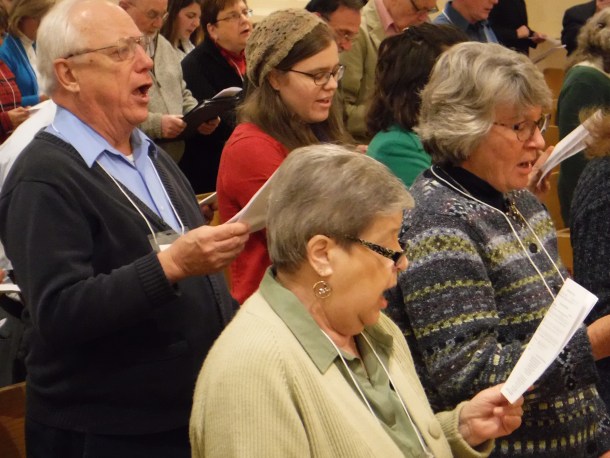
Vermont Catholics gather for a statewide meeting in White River Junction’s St. Anthony Church. Photo by Kevin O’Connor/VTDigger 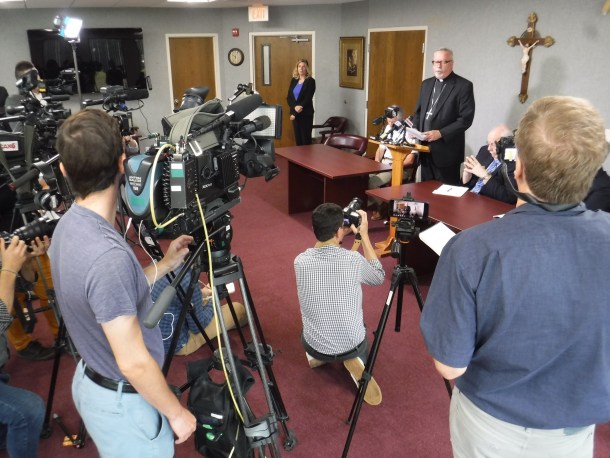
Vermont Catholic Bishop Christopher Coyne addresses reporters at a recent press conference. Photo by Kevin O’Connor/VTDigger A 1978 Vermont Catholic Church internal memo on priest misconduct concludes, “No longer could keep lid on things.” John Marshall served as Vermont Catholic bishop from 1972 to 1992. Vermont Catholic Bishop Christopher Coyne speaks to a parishioner in St. Albans. Photo by Kevin O’Connor/VTDigger 
Vermont’s Catholic Church is headquartered in South Burlington. Photo by Kevin O’Connor/VTDigger Vermont Catholic Bishop Christopher Coyne speaks to parishioners in Rutland. Photo by Kevin O’Connor/VTDigger
