

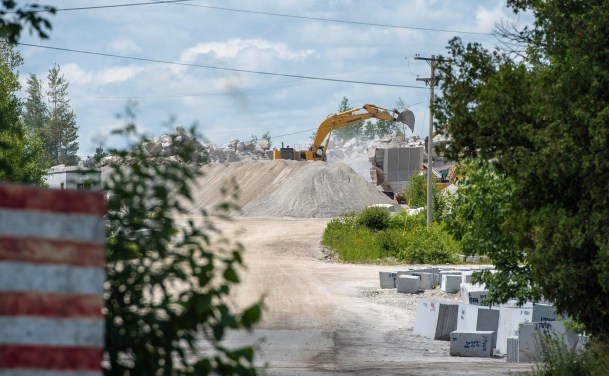
The Vermont Supreme Court decided Friday that a lower court “committed no error” in determining that the NorthEast Material Group was complying with its Act 250 permit.
“Considering the evidence, the court found the testimony from residents who stated that the crusher did not meaningfully or harmfully impact their experience to be credible,” the judges wrote.
Residents of the eponymous Graniteville section of Barre are no strangers to living near a granite quarrying operation. But some residents say the noise, smell, dust and trucks from NorthEast Material Group’s rock crushing operation and asphalt plant have changed their quality of life for the worse.
“It’s disappointing of course because we’re still experiencing the negative impacts,” Lori Bernier, a lifelong resident of Graniteville who belongs to the grassroots group Neighbors for Healthy Communities that appealed the permit, said of the Supreme Court’s decision. “We still feel that the enforcement is failing to do what they’re supposed to.”
Jim Goss, a Rutland attorney representing NEMG, said that his client was “obviously very pleased” with the ruling.
“This has been a long, drawn-out battle and the Supreme Court decision was dead-on,” he said.
The crushing operation, located off Graniteville Road, began in 2009 once the District 5 Environmental Commission decided that it did not need an Act 250 permit. Four years later, NEMG opened an asphalt plant nearby.
A group of 13 Graniteville residents appealed the Act 250 review panel’s decision to not require a permit. In 2016, the Supreme Court concluded that the “likely effect of the noise and clouds of rock” was significant enough to warrant a permit.
The District 5 Environmental Commission denied NEMG’s application for an Act 250 permit for the crusher, saying the project did not meet criteria for noise and air pollution. On appeal, the environmental court reversed that decision. Neighbors for Healthy Communities appealed the permit approval to the Supreme Court.
The Supreme Court agreed with the lower court that while the number of truck trips associated with the operation might “shock” a person in a more remote village, it did not represent a significant increase from the background level of industrial activity in Graniteville. The court also said that NHC did not directly provide evidence that dust was caused by the crushing, as opposed to work in the quarry, and that there was conflicting testimony about how great an impact the dust had on area residents.

Bernier stressed that she, and other residents who have been fighting against the operation, are not anti-business. They feel, however, that NEMG has been violating its state permit conditions.
And they question whether the Natural Resources Board, the statewide Act 250 administrator, does enough to investigate those complaints. Bernier said she feels the state relies too much on “self-reporting” and provides NEMG with too much advance notice of inspections.
When NRB staff say they don’t see any violations, she thinks “no kidding, you don’t tell a bank you’re going to rob them.”
“It’s not Act 250 that’s not working,” said Bernier. “It’s the follow-up, it’s the enforcement.”
Goss feels the Supreme Court’s decision clarifies the process for Act 250 review of the “adverse aesthetic impact” from potential increased trucks for a project.
“There are cases that were, quite frankly, all over the map about how to do that,” he said. “This decision is crystal clear now about what has to be done and what the standard is.”

