

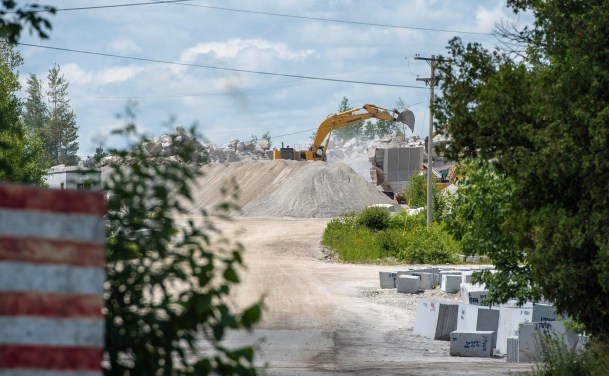
[G]raniteville has always been a quarry town.
The quarry itself takes whole chunks out of the village, revealing the rock underneath like a geode. Houses — most small, with peeling paint — sit studded into the mountainside. The town’s roads are cut out of the hills, winding beneath looming granite.
Lori Bernier has lived in the Graniteville section of Barre her entire life. She bought her current property from her mom a while back; they lived next door to each other for years, on a side road enshrouded by trees.
During a recent visit, Bernier rested against a beam on her front porch. As she looked out over a nearby playground, she asked — rhetorically — what could be heard.
Birds, mostly. Wind. Kids shouting, a visitor noted, muffled by heat.
And then, faintly, a thudding noise.
Bernier nodded and raised her eyebrows. It’s often worse, she said.
Bernier has been battling that thudding for the past eight years. She knows better than anybody that Graniteville is a quarry town — but when a rock crusher and asphalt plant run by NorthEast Materials Group started in 2009 and at a second site several years later, Bernier understood that the businesses were something different. The noise (and the smell, and the trucks, and the dust) has changed life as Bernier knew it.
She’s been fighting back ever since.
Right away, Bernier helped form an advocacy group — Neighbors for Healthy Communities (NHC) — that has met for almost the past decade. The group has taken their case to the Vermont Supreme Court, twice. The members themselves have gotten sick, moved away, and changed careers. Many have become friends; a few have died.
But for all that upheaval — and all that advocating — the folks in Graniteville have made little progress.
The main argument is over the rock crusher and asphalt plant’s compliance with Act 250, the state’s land use law. NHC believes that the businesses are not complying with their permits. Vermont’s Natural Resource Board (NRB) and the Air Quality and Climate Division have repeatedly found no violations.
“Rather than get angry, you try to work with the system,” Bernier said. “But I mean, after eight years, there comes a point where — how can there be such a contrast, to see what’s going on here? It’s as if they think we’re making it up.”
In March, the community group submitted a complaint to the NRB that they feel was not properly responded to. Just like in the past, the neighbors believe they provided substantial evidence and got a substanceless reaction. And just like in the past, the group from Graniteville is at a loss — but this time it’s unclear where, if anywhere, the advocates have left to turn.
Granite going way back
To begin with, Bernier wants people to know she is not against quarries.
Rock of Ages began quarrying granite in the 1880s, and many Graniteville residents have long-standing memories of what it is like to live near a quarry. Bernier remembers ice skating and swimming there as a kid. She used to work in the granite industry herself.
What is new, Bernier said, is the rock crusher. NEMG, which leases property from Rock of Ages, began the crushing operation in 2009, and it added an asphalt plant four years later. The neighbors found both industries disruptive. They brought the matter to the Supreme Court, which agreed: in 2017, the company was asked to get an Act 250 permit for its rock crusher.

The neighbors’ win was short lived. Instead of complying with the order, the company built another crusher 3,000 feet away. NEMG argued that because Rock of Ages has existed for centuries, Act 250 does not apply to any operations on the land.
The crusher got its Act 250 documentation — finally — in 2018. It is now operating legally, although advocates believe the company is not complying with its permit requirements.
Pamela Austin, an original NHC member and a nurse who once cared for Bernier’s mother, said that her interactions with the state have often felt belittling.
“I’m sorry, but he was a real jerk,” she said of an investigator from the Air Quality and Climate Division. “He came up here, bawled us out … just read us the riot act.”
Austin took Bernier out to her front porch to talk, her dachshund Chile yapping at her feet. Like Bernier, Austin has lived in the village her whole life. Like Bernier, Austin has family (including her 93-year-old father) living a few doors down. She couldn’t afford to leave Graniteville if she wanted to, Austin said — but she doesn’t want to. This is her home.
Also like Bernier, Austin only wants the state to listen.
“This road is not meant for 200 trucks,” Austin said with a sigh. “It’s never been that way. Rock of Ages, way back when they were booming, had 13 trucks. They were numbered.”
“They tell me that I don’t know what I’m talking about,” she added. “That really bugs me, because I do know. I was 9 years old, and I know.”
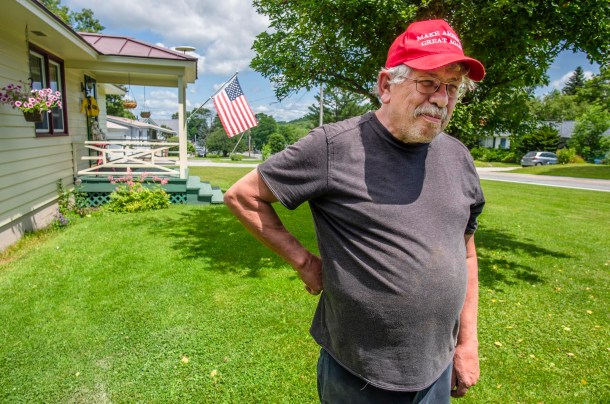
A few years ago, NorthEast Materials Group sued Bernier, her husband, and her mother for complaining about the asphalt plant because the complaint allegedly violated their deed. The lawsuit was unsuccessful; looking back on it, Bernier rolled her eyes. The attempt was representative of how her dealings with the state and the plant owners have gone, she said.
As of a few months ago, Bernier and the neighbors are barred from entering the quarry’s property. Bernier said she’d never been on their land anyway.
But according to representatives from both the NRB and NorthEast Materials Group, the state is listening to the neighbors’ concerns very carefully. Greg Boulbol, general counsel for the NRB, said he wants to help — there are just no Act 250 violations to respond to.
“This is something that we’ve been working on for a number of years now, and we’ve been out to the site a number of times,” Boulbol said. “The Agency of Natural Resources, as well, has been out a number of times, and to date we have not been able to find an actionable violation.”
Eric Morton, the general manager of NorthEast Materials Group, concurred.
“We are fully permitted to operate and operate in compliance with Act 250 requirements,” he wrote in an email. “All of the complaints against us by the small handful of local activists have been investigated and found to be baseless.”
Sitting back in her chair on Austin’s porch, Bernier hypothesized that the state investigators aren’t coming to Graniteville for long enough. She acknowledged that the disturbances can be hit or miss — but if investigators spent a day or two in the area, Bernier thinks they might see and hear what the neighbors do.
“All’s we want is for them to hear us, see what’s going on here, and do their job,” she said over the roaring of a granite truck. “Enforce.”
In lieu of the NRB granting the neighbors the kind of investigation they want, Bernier and her colleagues have turned to other state officials. They have worked with Rep. Francis “Topper” McFaun, R-Barre Town, for some time now; recently, they also reached out to Sen. Anthony Pollina, P/D-Washington.
Pollina said he shares the neighbors’ concerns over potential Act 250 violations. He is equally worried, however, by the NRB’s lack of communication: Just this spring, one official told him a report was ready while another said they were still working on it.
“You wonder why they would tell me they had already responded to the concerns if, in fact, they were still working on the response,” Pollina said. “It really makes you wonder if they’re being upfront with us.”
According to Boulbol, the NRB is doing the best it can with limited resources. There is only one enforcement officer for the entire state, and the entire NRB is comprised of four board members, a chair, and nine board staff.
“If we do, in fact, see a violation at any time, we’ll take it seriously and will follow our mandate in pursuing an enforcement action,” Boulbol said. “If we get to that point. Right now, it doesn’t appear that we’ve gotten to that point.”
Noise, dust, fumes and trucks
But as the legal battles close in on their first decade, for some neighbors, the problem’s duration has only magnified its intensity.
Gus Osterberg, 78, is bothered by the noise. He lives in a small ex-farmhouse that his grandmother bought in the 1930s; the new rock crusher is just across the street. With every boom, the porch vibrates in the thick heat.
“It just seemed like it’s — ”
Osterberg was cut off by an especially loud crash.
“ — real noisy,” he finished. “Just continuously.”
There is a house two doors down, Gus noted, that has been on the market for a long time with no interested buyers. He said the rock crusher is partly to blame. Who would want to live — eat, sleep, watch TV — next to something so loud?
Just down the road, Bernier stopped in on Louise and Ronald Gagne as they prepared to go camping. Sitting out on their patio (which Ronald built out of granite, naturally) the couple expressed their own set of concerns. The Gagnes are less bothered by the noise. The trucks are a different story.
According to Bernier, trucks are supposed to use one labeled route. In a few hours in Graniteville, at least eight drive by in other places. The Gagnes say it tears up the roads and poses a safety risk. Like the noise, they say using alternate routes violates the agreements the crusher and plant have agreed to follow.
“This is a residential neighborhood. There are a lot of houses around and there are kids around — there’s a playground here,” Ronald said.
“That’s right,” Louise concurred, shaking her head. “You don’t want these kids getting hit by somebody who’s not supposed to be there.”
Back on Austin’s porch, she and Bernier said that health is a major concern for Graniteville, too. Granite produces silica — a dust that damages lungs when inhaled in large quantities — and the asphalt plant emits pollutants including formaldehyde.
According to Austin, the impacts on her mental health are palpable.
“It was bad. It made you ugly. And I didn’t realize how angry it made us feel, until one day, I come out here, and there was no pressure,” Austin said.
Bernier hummed in agreement. “You don’t notice this stuff. And then all of a sudden they started up again, and it was like, now I know why I feel agitated,” she said.
For Austin, physical health is also a significant concern. Austin is a nurse; she said the smell of the asphalt makes her sick.
“When we had that break from the rock crusher, my doctor even said, I don’t know what you’re doing, but if you keep this up, you can come off all your medicine,” she said.
‘We just want to be heard’
The problems hitting Graniteville have been exhaustively documented. From her kitchen table, Bernier flipped through photos: a plume of smoke coming from the asphalt plant. Dust clouding up around a truck. Smog hovering in the air like in an oil painting.
Bernier has sent these photos to the state time after time, only to be told that they are snapshots — unrepresentative snippets in time. Not evidence.
The most recent round of complaints began last fall, when the NHC provided what they believe to be proof of the asphalt plant running illegally in 2018.
“The premise of NRB enforcement is to protect the environment, public health, and integrity of the Act 250 program; so how about after 8 years you finally do that!” a May letter from the neighbors ends.
Michaela Stickney, the enforcement officer for the NRB, took her most recent trip to the area on May 31. She expected to complete a report on the investigation by July 8; on July 11, Boulbol said that it should come out soon. In an email to Pollina, however, Stickney offered one preliminary finding: that the plumes photographed as proof of asphalt production were actually steam from drying filters.
When asked about the possibility of the plumes being steam, Austin snorted. “In a truck? When it’s going down the road?” she said. Austin believes she saw new asphalt being transported from the plant — a sure sign of production.

According to Bernier, it is demoralizing to feel so untrusted by the state. She is not, she repeated, anti-business. She is not anti-granite or anti-truck. She loves the industry: she’s lived near it for a lifetime. She just doesn’t like being disbelieved.
After she finished visiting the neighbors, Bernier drove her husband’s pickup truck back up the hill to Upper Graniteville. As the car turned around an especially steep corner, a passenger called the view — a cyan lake underneath pillars of granite, lined by pine trees — “beautiful.”
Yes, Bernier exclaimed. It’s beautiful. People don’t see it that way, but it is.
And now, Bernier says all she wants is to protect that beauty.
“We just want to be heard, and we want them to see what we see,” she sighed. “And we don’t understand how they can’t.”

