


[B]URLINGTON – The original plans for the ill-fated Champlain Parkway were conceived four years before man landed on the moon. Lyndon B. Johnson was president. And the mayor now hoping to complete the project was yet to be born.
City Councilor Joan Shannon, D-South District, said south enders have developed what has become known as “Champlain Parkway fatigue” from the decades the road has been repeatedly pitched and promised to residents as the solution to their traffic woes.
“You can look through generations of documents and people bought it, and then they either died or moved out of town or gave up,” she said. “The project has outlived generations of opponents.”
After more than half a century of planning, consideration and obstacles, construction on the $46 million Champlain Parkway is expected to break ground in the next year.
The 2.8-mile road in the Queen City’s South End is the result of several plans which began as a four-lane divided highway in 1965. While a few potential obstacles remain, project officials have obtained rights of way clearance and a permit for construction-phase stormwater. They are aiming for crews to begin work in December.
Peter Clavelle, who served seven terms as mayor of Burlington between 1989 and 2006, describes it as a project that has had a “lot of false starts.” Before becoming mayor, Clavelle served as the head of the Community and Economic Development Office in Bernie Sanders’ administration.
“Never in my wildest dreams would I have guessed it would have taken this long,” he said. “You can go back to many press conferences and public statements 30 years ago where I said that the project will be under construction within the next year or the next two years.”
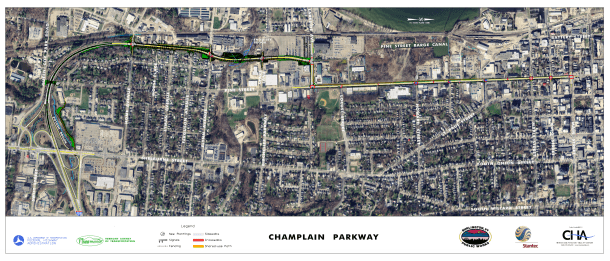
Current plans show a new 25 mile-per-hour city street with a mixed-use path for pedestrians and cyclists, new stormwater infrastructure and features designed to ease traffic along the corridor.
Mayor Miro Weinbeger has been working to advance a project that seven administrations before him failed to complete and has gone on, he said, for “too long.”
“I think it is problematic to have a project that sits out there unresolved, resources continuing to go into it, for going on six decades,” Weinberger said in an interview.
Path to breaking ground
The Champlain Parkway will begin where Interstate 189 meets Shelburne Road, and be a limited-access roadway before intersecting with Home Avenue. The proposed route will continue by the south end City Market, crossing Flynn Avenue and Sears Lane before running through the end of a parking lot and joining Lakeside Avenue.
New signalized intersections will be built along the Parkway and street upgrades will be made on Pine Street between Lakeside Avenue and Main Street, including new signalized crosswalks and intersections. Several neighborhood streets which currently lead towards the proposed path will become dead ends.
A separate shared-use path will run parallel to the roadway and along Pine Street until Kilburn Street and will become a bike lane.

Public Works Director Chapin Spencer said there are compelling reasons to address transportation issues in the area, like truck traffic on residential streets, which the project aims to eliminate. He said one of the biggest challenges is convincing people the road can actually break ground.
“We have a viable path to construction in the next six to 12 months, and we are dedicating significant effort to achieve that milestone,” Spencer said in June.
City officials say the project aims to reduce truck and cut-through traffic in South End neighborhoods, improve biking and walking infrastructure, and make the streets safer.

Weinberger said the current main roadways in the South End see the some of the most transit-related injuries in the city, which will be improved with the Parkway.
“We have what really feels for a lot of it like this sort of suburban arterial,” he said. “But the problem is that a mixed use neighborhood with lots of active transportation, lots of walkers, lots of bikers has emerged around it.”
The project will be 95% federally funded, with a 3% contribution from the state, according to Spencer. The city’s 2% share, plus other expenses including street lighting and landscaping, total $3.2 million.
The Champlain Parkway will be paid for over three years and was approved for the city’s fiscal year 2020 budget.
The project that couldn’t get done
Generations of proponents and opponents can agree on one thing: the Parkway was always two years away from being built.
The roadway dates back to the 1960s, when the Vermont Department of Highways published a study calling for the construction of a four-lane highway. Known as the “Burlington Belt Line.” Plans showed it running the entire length of the city.
A $45 million state highway program under Gov. Phil Hoff included funds for the Belt Line project, designed to reduce traffic on city streets and link areas of Greater Burlington.
That route would have spanned from Bartletts Bay Road in South Burlington to the Winooski River in the city’s north end, according to a project map published in 1966. The road would have cut across the city’s west side, running along the waterfront, as part of a 20-year highway plan for the Burlington area rolled out by the state.
The first phase, which was ultimately built, is the present-day Route 127 “Belt Line” connecting the Old North End of Burlington with Colchester. The total price tag for the Belt Line project was estimated at more than $26 million in 1966.
But concerns were raised about the highway being too large and disruptive to the waterfront. Officials instead preferred building a section from Interstate 189 to Main Street to provide a better connection to the downtown.
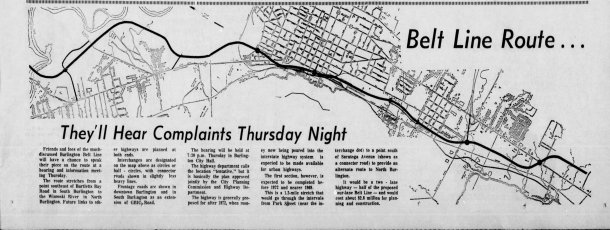
By the early 1970s, the Burlington Belt Line had lost support and plans for a new roadway, now dubbed the “Southern Connector” were drafted by a consultant. The new route proposed a connection between Interstate–189 and Pine Street north of Flynn Avenue. Under the original plans, the roadway would diverge through the former Pine Street Barge Canal to join the southern end of Battery Street.
The state prioritized financing for a different project and the city applied for federal funding to move forward with the road under Mayor Gordon Paquette, who served throughout the 1970’s until ousted by Bernie Sanders in 1981.
The route was controversial, in part because it required the demolition of homes along the right of way. About 15 families, mostly on Batchelder Street, would be forced to relocate.
One Briggs Street resident, Andre Boisvert, expressed concern about the uncertainty, according to reporting about a public meeting in the Apr. 15, 1976 edition of The Burlington Free Press.
“Do we do repairs to our homes or just sit here waiting… It could be two years from now before anybody sitting on that little black dotted line will know if we’re going to have to move,” Boisvert said.
Present day sentiments about the Champlain Parkway were shared at the public meeting in 1966, with some residents suggested the money should be spent on studying public transit and park and ride areas on the edge of the city.
“I think we want to preserve the quiet beauty of Vermont, which is why we came here in the first place,” said Millie Gautherat of Lyman Avenue in the Free Press coverage of the meeting.
The city’s Waterfront Board was also worried about damage to natural areas at the Pine Street Barge Canal site which became a bird sanctuary for snowy owls nesting in the winter, and a popular spot for ice skaters.
Roadblocks from toxic waste to citizen complaints
The ill-fated connector was always reportedly on track before encountering nearly every type of opposition and obstacle imaginable, news reports from the 1970s show.
An archeologist at the University of Vermont found three prehistoric Native American sites with pottery along the proposed route, which would need to be circumvented to preserve artifacts.
The highway also faced a complaint filed with the Civil Rights Commission, alleging that the road would isolate the largely French Canadian neighborhood known as Lakeside. Residents claimed the community would be cut off from its church, school and shopping area if the Connector was built
“I think it’s very disturbing that people are forgotten,” resident Armand Beliveau told the Free Press on Oct. 22, 1978. “What are environmental impact statements for? Just grasses and birds and bees?”
The Federal Highway Administration and Vermont Department of Transportation moved forward with the Southern Connector in the late 1970s, but encountered a major roadblock. While preparing an environmental impact statement, traces of oil and later coal tar were found in areas near the Pine Street barge canal.
Due to concerns about the high presence of waste after further tests, the Environmental Protection Agency added the canal to its national priorities list of hazardous waste sites. It became a superfund site.
In 1987, construction crews began work on the Southern Connector, nearly completing the first section of the roadway – known as C-1 – from Interstate 189 to Home Avenue. But the need for a remediation plan at the Barge Canal prevented work on the next section from moving forward. Some of the proposed solutions included building an elevated highway over the superfund site.
Houses were removed in the expectation that the road was imminently coming.
“That’s one of the very sad parts of the history of this road,” said Shannon, who has represented the neighborhood at City Hall for the past 16 years.
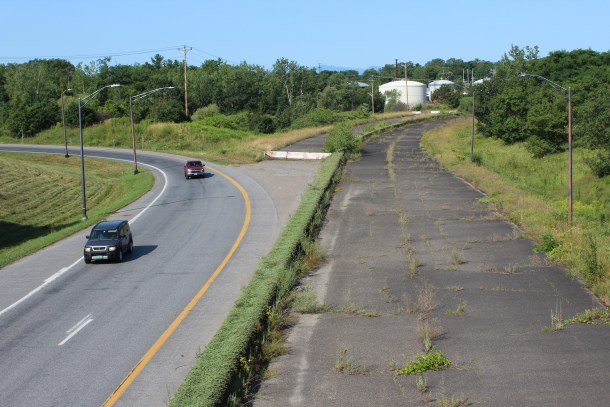
The first section has been closed to traffic, sitting empty as a road to nowhere and a reminder of the project that never reached completion. Weeds and grass have sprouted out of the highway’s cracks, and the asphalt is covered with graffiti, trash and pieces of abandoned furniture. It’s a site that has seen more traffic by skateboarders than cars.
The Connector becomes the Champlain Parkway
The same year construction began, the Burlington Planning Commission voted to change the name of the Southern Connector to the Champlain Parkway. The push continued by Burlington City Council under the new name into the 1990s, and responsibility for future development shifted from the state to the city.
“Over many years and with a very strenuous effort, we were able to redesign the project to become more pedestrian friendly,” Clavelle said. “And to reduce the size of it from a constant four lanes to something less, and essentially to convert an interstate style design into an urban boulevard.”
Burlington abandoned plans to pass through the Pine Street Barge Canal, and moved forward with recommendations from VTrans to connect to Lakeside Avenue and improve Pine Street infrastructure to Main Street.
The parkway went through a series of Act 250 Land Use permit appeals, settling with all parties but one. The District Environmental Court ruled in favor of the project, although that decision has been appealed to the Vermont Supreme Court.
One Maple Street resident, Alan Hunt, opposed the parkway for years and hired a lawyer to counter the city during the Act 250 environmental hearings. He also distributed anti-parkway lawn signs.
In 2013, the city reached a settlement over an appeal Hunt filed in Environmental Court.
Under the terms, the city agreed to install red-brick crosswalks and rapid flashing pedestrian signals. The city also agreed to tell VTrans that it opposes having signage at the intersection with I-189 that indicates which direction is “downtown.”
The terms also include plans for a Neighborhood Enhancement Program for the Maple and King Streets area after the parkway is built.
Clavelle generally supports the project, but insists that it’s important to route the traffic around the King Street neighborhood through the railyard. He said it was challenging during his administration to work with the railroad to move its facility.
In 2005, the city’s project manager estimated about $30 million has been spent on the parkway over the years.
The parkway has long been pitched by officials as the solution to taking cut through and truck traffic off neighborhood streets and easing the bottleneck heading into downtown.
Shannon said support from residents who want that neighborhood traffic relief has helped propel it forward through the past two decades.
“A lot of people feel that this project is very important and have been promised this project for decades,” she said. “And for those folks they’re like, why the anguish? Just build it.”
Activists continue to fight plans

The Champlain Parkway project is facing opposition in court from local activists who want a cheaper, greener and safer roadway. The Pine Street Coalition, with about 150 members, filed a lawsuit in federal court in June asking for an injunction to halt construction.
The coalition alleges that the project’s 2009 environmental impact statement is no longer valid because it contains outdated information on traffic, population and land use.
Many coalition members and leaders don’t live in the South End where the project will run, and several have worked to block other city projects, including CityPlace Burlington and City Hall Park renovations.
“There does seem to be a group of people who are opposed to things for the sake of being opposed,” Shannon said.
Pine Street Coalition member Steve Goodkind is a former Public Works director and city engineer who worked on the project. His group is not entirely opposed to the Parkway, but takes issue that the city wants to start building this year.
“They just want to pull ahead with this thing and it’s going to be pretty awful. It’s just it’s an old, old idea,” he said. “If it had been built what it should have built maybe in the 80s, it would be obsolete right now.
A federal judge allowed a delay in the coalition’s lawsuit on Aug. 9, permitting additional outreach in the predominantly low-income and minority King Street and Maple Street neighborhood.
Tony Reddington, also part of the coalition, said a key issue is ensuring a complete analysis of safety is conducted, particularly in the neighborhood where stop signs will turn to traffic lights. He said this will result in cars speeding through yellow lights in the residential area.
“We really need to do a two to three year process so we have a road that our city can love and that meets the needs of the south end today,” Reddington said.
Goodkind said the alternative he and others pushed for was having the route go through the railyard and connect at the southern end of Battery Street, rather than funnelling traffic into the King Street and Maple Street neighborhood.
Weinberger stressed that the project has greatly evolved from the original four-lane highway to a two-lane, 25 mile per hour city street.
“What’s being talked about today is continuation in a sense of that conversation,” he said referred to the initial plans. “But it is a very different proposed project that I think is much more in keeping with where we are well into the 21st century.
The coalition members aren’t alone in their fight against the road. A group of residents near the South Burlington city line have banded together to create their own group – The Parkway Alliance – to change the current design.
‘This desire to get it done’
The project cleared a major hurdle on June 5 when the City Council voted 9-3 to approve the design, secure financing and allow for bidding and construction of the Parkway.
Three of the council’s Progressives voted against the proposal.
Jack Hanson, P-East District, said he doesn’t think the city should be spending any more public dollars – federal or local – on car-focused infrastructure projects.
“It does include substantial walk/bike infrastructure, which is great,” he said. “But the primary focus of it is to make it easier to travel by car, which I think is not the direction that we should be going in 2019.”
Max Tracy, P-Ward 2, said he doesn’t support how the design doesn’t provide separate facilities for cyclists and pedestrians. He said the shared path could be “potentially dangerous” when high speed bikers share it with walkers.
“My concern is really that there’s just this desire to get it done, but maybe not to get it done in the best possible way,” Tracy said. “And I understand that there have been all these delays and problems, but I think if we’re going to do it, do it right.”
Shannon, a Democrat who said she “represents the people who love this road and hate this road,” backed the final plans. She believes the projects helps with neighborhood traffic relief but does nothing to improve access to downtown.
“I know that many, many people have bought houses being told that they’re going to imminently have traffic relief with this road and it hasn’t happened, and they’ve been very disappointed,” Shannon said. “And probably many of them would have lived in those homes for a period of time and then moved.”
Critics say they don’t expect changes to the roadway after it’s built, but that doesn’t mean the ability to make alterations won’t be there. The city entered into an agreement with the federal government and state to allow for adjustments as needed.
Spencer said the city can look at different crossings, on-street parking and intersection designs in the future.
“One of the concerns has been if we build it, are we locked in? And the answer is no,” he said.
Weinberger remains optimistic that the Champlain Parkway will break ground in the next year.
“I don’t think I imagined we’d be sitting here seven years later, after real focus and effort has gone in, still talking about this as a not yet construction project,” he said.

