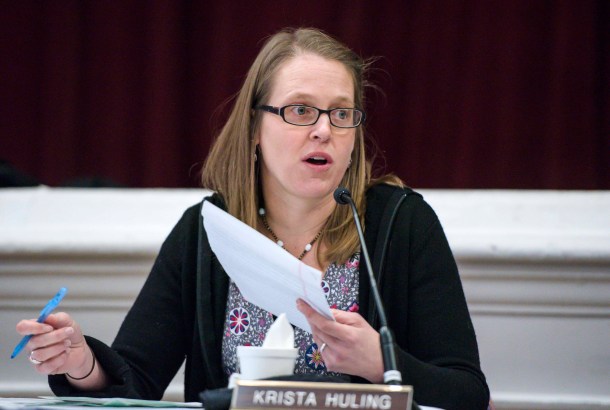
[K]rista Huling, the chair of the State Board of Education, has resigned her position to work on former Vermont Education Secretary Rebecca Holcombe’s gubernatorial campaign.
Fellow board members had expressed discomfort with Huling’s involvement in the high-profile political contest, and worried it would compromise the public’s perception of the body, which sets key education policy for the state.
“I have always served as a way to improve the lives of Vermonters and I feel I can best pursue that end by working to elect a governor who will be an advocate for public education, ensure all Vermonters can care for loved ones at the beginning and end of life through paid family leave, and help pass sensible gun legislation to keep Vermonters safe,” Huling wrote in a letter to board members on Thursday afternoon.
Huling publicly endorsed Holcombe as soon as she declared her candidacy in mid-July, and the campaign said when it launched that the state board chair would serve as its treasurer, an unpaid position.
“It became clear that board members were uncomfortable with me doing both. And if I was going to make a choice, then I had to think back about what I most valued and what kind of Vermont I want for my daughter,” Huling said in an interview Thursday.
The 39-year-old South Burlington High School teacher has been on the board since 2013, when she was appointed by then-Gov. Peter Shumlin, a Democrat. She was elected chair by its members in 2017, and re-elected to the position earlier this year.
Her departure means Scott will get to appoint a seventh voting member to the 11-member body. (The state board includes two non-voting members: the Secretary of Education, and one high school junior.)
Despite Vermont’s tradition of local control, the board still holds important powers: it got the final say on school district mergers under Act 46, it has some financial oversight of independent schools, and it sets the academic standards for K-12 schools.
Most board members did not respond to inquiries from a reporter or declined to comment about Huling’s campaign involvement, but she acknowledged concern was widespread within the body. One board member, Bill Mathis, did speak publicly about his unease.
In an interview earlier this week, before Huling’s decision to step down, Mathis noted she had been quoted recently by VTDigger in an article about a nearly year-long delay in the release of test scores, criticizing the Agency of Education, which is now helmed by Holcombe’s successor, Dan French, for a spate of delayed reports.
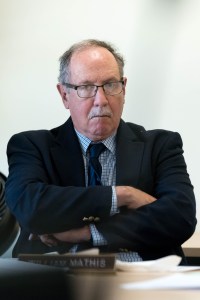
Mathis said he agreed completely with what Huling had said. And her comments to the press largely echoed a board discussion at a recent meeting. But Mathis said he worried Huling’s campaign role undermined the message.
“Who’s speaking, the chair of the board or the finance officer of a competing campaign? That causes a credibility problem,” Mathis said.
French, who was appointed by Gov. Phil Scott, has already come under fire from the Holcombe campaign for floating the idea of a statewide voucher system.
Board members serve staggered, six-year terms, which is intended to help keep any one governor (who appoints its members), from having too much influence.
But even if the board is supposed to stay above the partisan fray, many of its members over the years have hailed from the political realm. Several of its current members have previously served in the Vermont Legislature, and others – including Mathis – have donated to political campaigns.
It’s not the first time the board’s independence has been called into question.
Amidst a heated debate over the state board’s regulations of private schools, a trio of state lawmakers sought an ethics probe into Mathis in 2017 for his work for the National Education Policy Center at the University of Colorado at Boulder, saying his research work, much of it critical of school choice, implied a conflict of interest.
Mathis dismissed the accusations as political harassment, and said his salary was paid by the university, and not, as his critics suggested, by outside funders, including unions.
One of the then-lawmakers seeking that probe, Oliver Olsen, now sits on the board. He declined to comment on Huling’s campaign involvement.

Holcombe, in an interview, she was “very, very grateful” for Huling’s support. But she said she wasn’t surprised by the blowback over her involvement.
“I think both the Agency and the Board have become very politicized. So I think it was an inevitable conversation,” she said.
Former state board chair Stephan Morse, Huling’s immediate predecessor, was himself steeped in politics. A longtime Republican state lawmaker, he served in leadership roles in both the House and the Senate before coming to the board. When Huling had asked him for his thoughts before accepting the post on Holcombe’s campaign, Morse said he didn’t see a problem.
“My advice was that as long as people were aware of this, by Vermont standards, I didn’t see how it compromised her position as chair at all,” he said.
Huling had initially hoped to stay on the board, and had earlier this week told a reporter she had placed the subject of her political involvement on the agenda for the board’s next meeting on August 21 after being criticized by fellow members. She said she wanted a public discussion, and for the board to use the opportunity to clarify what kind of political activity its members should – or shouldn’t – participate in.
Huling ultimately changed her mind about staying on, and decided she’d rather go all in Holcombe’s campaign.
“I think that will make a bigger difference for the state than my service on the board,” she said.
But she thinks the board should still develop a policy on political involvement, particularly since so many of its members come to it through politics. Huling herself was appointed to the board after meeting Shumlin in 2012 at the Democratic Party Convention, she noted, where she was a delegate for Vermont.
“We’re all there because we were put there by a governor,” she said.