


Editor’s note: Mark Bushnell is a Vermont journalist and historian. He is the author of “Hidden History of Vermont” and “It Happened in Vermont.”
[W]hen the Civil War broke out in the spring of 1861, joining the Union Army wasn’t Harmon Olds’ first thought.
“For some time after the strife commenced I did not make up my mind to do more than stay at home and attend to my business and let them fight it out as they liked,” he wrote some years later, “provided they let me alone.”
But within months, Olds had a change of heart. Something he saw while visiting an encampment of recent volunteers in Burlington set his mind to enlisting.
We know of Olds’ actions, and some of his thoughts, thanks to an old manuscript in the collection of the Vermont Historical Society. A sort of military memoir, the well-crafted document details Olds’ experiences during his first year and a half in the Army. Apparently Olds reworked his wartime diary and gave it to his daughter, Helen, in 1864. He wanted to record his life in the military in case he didn’t survive the war, which he did.
Olds’ memoir makes interesting reading because it offers a glimpse into the life of an enlisted man, who also happened to be a good storyteller. His experience of war was more as observer of the fighting, and its gruesome aftermath, than as an active participant. Someone in authority had noticed his intelligence and comparatively good education and made him a clerk. As a result, we get a view of the war through the eyes of a common soldier, but one whose position gave him a broader view of the conflict. As a clerk, he prepared the casualty lists, but also knew the scuttlebutt he overheard from officers.
It’s not clear exactly what convinced Olds to enlist. On this particular issue, words fail him. All he writes is that after visiting the Burlington encampment, “I often thought that I would like very well to enlist.” Perhaps he found it hard to explain to his daughter why he would pick the Army over staying with her.
Born in Fairfield, Olds grew up in Franklin County, took a job with a wagon manufacturer, married and had two children. It was a successful life, but apparently not a particularly exciting one. “Business being very dull as the Season advanced, I made arrangements to dispose of my business [and enlist],” he wrote.
Olds’ experience of Army life began in St. Johnsbury as a member of the 3rd Vermont Regiment of Volunteer Infantry, which he joined because his brother-in-law belonged to the unit. A week after arriving in town, the regiment was ordered to stand for inspection and be mustered into the Army. Just before Olds’ company was called for its turn, he was told he had visitors. His wife, Sarah Sturges, and a friend had come, hoping “if possible to persuade me to return with them before mustering in, as there would be no escape afterwards except by discharge or desertion.” Whatever his reason for enlisting, he wouldn’t be talked out of it.
Several men changed their minds at the last minute. They departed amid the jeers of spectators and their former comrades. That sight changed Sarah’s mind. “(She) said she had rather have me go with the rest then (sic) be among the cowards.”
While still in St. Johnsbury, the regiment suffered its first violent death. The Army camp’s sutler, who sold the troops uniforms and other goods, was gouging the men. When soldiers started walking the mile to town to buy cheaper goods, the sutler complained to the camp commander, who forbade the troops from doing so. The men grew angry and the sutler got nervous. He persuaded the commander to post a guard inside his establishment (Pike’s Refreshment Saloon).
One night, soldiers attacked the saloon and the guard shot and killed one of them, Sgt. John Terrill. The men destroyed the shanty, and if they had found guard, “he would have been sacrificed by the infuriated soldiers,” Olds wrote.
Rumors circulated through camp that hundreds of miles to the south the first major battle of the war had been fought, and the Union had fared poorly. The next day, July 23, the troops struck camp and headed south by train to Washington, D.C. Along the way, they passed a train carrying survivors north from the Battle of Bull Run. They were “three month men” whose tour of duty had just expired. The encounter gave Olds and his fellow Vermonters a sense of what they might soon face. “They were decidedly a tough looking lot, had lost or thrown away in the fight everything but what they happened to have on, a great many without coats or hats, and many wounded among them,” he wrote. “Ragged and dirty, they did not give us a very good opinion of the pleasures of War.”
Once in Washington, Olds’ unit was assigned to guard a bridge to Virginia. Some listened nervously to the occasional sound of not-too-distant gunfire. “(D)ozens of heads could be seen protruding from the tents and anxiously making a survey of the surrounding camp as if to make certain that the Johnnies had not taken possession,” Olds wrote.
Olds volunteered for picket duty one day. He crossed the bridge into Virginia with three others. They could hear the sound of drums from the Rebel camp. The day was uneventful until 9 p.m., when they heard “the steps of a man who came tramping along, as though there was not a half dozen muskets resting on the bottom rail of the fence, ready to blow him into the middle of next week,” he wrote. After one of the pickets fired, and missed, the man quickly identified himself as a Union soldier trying to get back behind their lines.
Olds seemed unimpressed by celebrity. He noted in his diary that President Lincoln, as well as other top administration officials and generals, visited the regiment, but he only mentioned that they stayed about an hour. When Gen. Benjamin Butler arrived in Washington to be feted for his troops’ seizure of two North Carolina forts, Olds wrote, “they had a jubilee over his victories, a large amount of gas & speechmaking.”
Then he added, “Prof. Lowe has also been using gas but in a different way.” Olds was referring to Professor Thaddeus Lowe, whose experiments with a hot-air balloon he had witnessed. Lowe was using the balloon to call in long-range artillery fire onto Rebel camps.
In September, Olds wrote that he had survived a bout of what he believed was cholera. He recovered in time to witness the would-be execution of Pvt. William Scott of Vermont. Scott had been caught sleeping on guard duty, tried by a court martial and ordered shot. Olds and his fellow troops were drawn up into a three-sided square to watch the execution. “(T)he prisoner (was) placed on his coffin,” he wrote, “the firing party all detailed and drawn up with muskets loaded …” Then a messenger arrived at the last minute, bearing a pardon from Lincoln. “The man (Scott) was so overcome that he had to be carried back to his quarters,” Olds wrote. “I think he suffered more than he would had he been shot.” Olds heard a rumor that Lincoln had come to the encampment to make sure no mistakes had been made.
The Scott incident was followed two days later by a suicide at camp. A soldier went to his tent in the afternoon and slit his own throat. “The only reason that can be assigned for that act is homesickness,” he wrote.
Olds did what he could to keep his spirits together. He traveled the short distance to Washington and bought himself a “pretty good sized meal: Roast Beef, Steak, Sweet Potatoes, Onions, Tomatoes, Eggs Coffee & etc.”
A month later, Olds’ regiment was still defending Washington when they got word of a disaster. “Rumors come in today that there has been a hard battle up the river somewhere,” he wrote. Men reported seeing the bodies of Union soldiers floating downstream. Two days later, the newspapers reported a massacre at Balls Bluff. “(O)ur troops were utterly routed and driven into the river,” where about 300 were shot to death or drowned, he wrote.
Olds’ diary, which documents only the early part of the war, shows the uncertainty that the Union side faced. His regiment moved into Virginia and then stalled, like the overall Union war effort, trapped by the region’s mud and the hesitancy of generals.
As a consequence, much of what he described was camp life. He mentioned seeing Vermont artist Larkin Mead sketching Vermont soldiers examining the so-called Lincoln gun. Capable of throwing a 460-pound ball, it was the largest cannon yet made by the United States, Olds reports. Mead’s drawings later appeared in Harper’s Weekly.
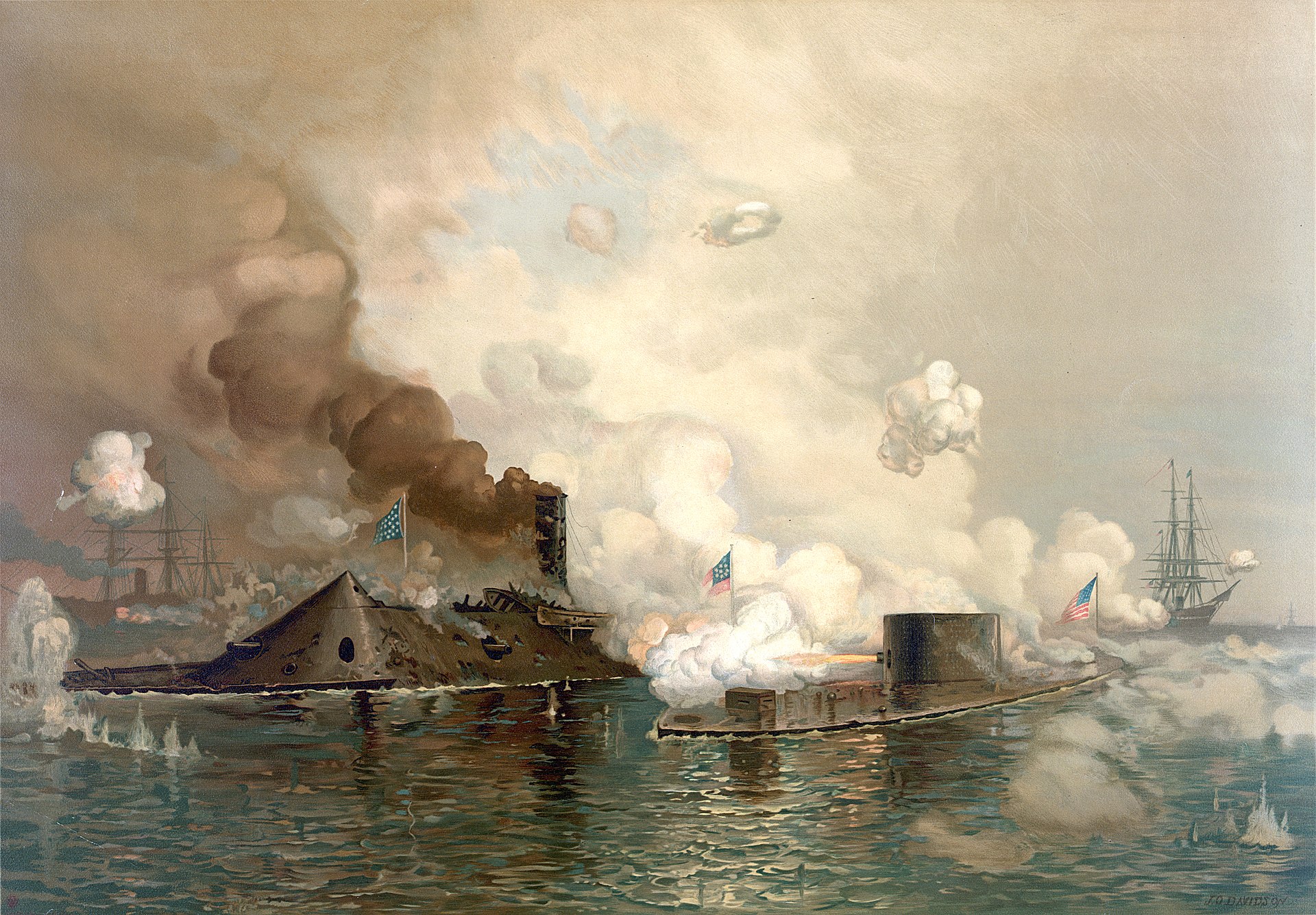
That same day, March 25, 1862, Olds wrote that he could see the docked ironclad USS Monitor from his campsite. “(It) is indeed a curious looking vessel,” he wrote. Already the ship was famous, having two weeks earlier fought the Confederate ironclad Virginia (formerly the USS Merrimack) to a draw, ending its predation of the Union fleet at Hampton Roads.
Union soldiers were likewise predatory with the surrounding farms. When food ran short, a “foraging party” took what it could from a nearby farm. A general, who Olds does not name, was incensed by the theft. He ordered the men to gather the animals they had stolen. Most had already been slaughtered. “(Those) confiscated delicacies made quite a pile and on top was a live pig only 3 weeks old,” Olds wrote. “Most of the animals which had been slaughtered were spring poor and did not look very tempting.” The general ordered the men to bury the meat. They learned a lesson, but it might not have been the one intended. “I think they were careful in future that if the men brought any contraband into camp that the Genl did not find it out.”
Olds thought the whole affair “a most laughable occurrence.” It would be the last such incident he would record in his diary.
Three days later, he witnessed the fighting at Lee’s Mills, where Vermont troops got pinned down while crossing a creek. Olds reported that a 16-year-old fifer named Julian Scott braved enemy fire, crossing the creek eight times to bring in injured soldiers. Scott would receive a Medal of Honor for his actions. (He later became a renowned painter. His massive “Battle of Cedar Creek” is on display at the Statehouse.)

The next month found Vermonters at the Battle of Williamsburg, where Olds recounted some grisly incidents. While the Vermonters were searching the woods for the wounded, the underbrush caught fire. “If anyone still hid among the branches,” he wrote, “they have found a speedy death.”
During the search for survivors, he added, Vermonters came upon a Massachusetts soldier “standing on one side of a fallen log with the bayonet of a Reb through him, while his own bayonet securely pinned the Grayback, both of course stone dead.”
Olds would see worse, but from a distance, at Fredericksburg that December. Watching from a high bluff across from the town, “(w)e could see when the smoke lifted our men making their gallant and desperate charge(s) on the enemy’s strong position on Marye’s hill which were each time repulsed with so great a loss, the position occupied by the Rebs being almost impregnable … It was merely a slaughter pen.”
Despite the carnage he had seen, and his initial ambivalence about the Union cause, Olds sounded optimistic when he ended his diary a few weeks later on New Year’s Eve. “It is now nearly two years since this war commenced and the end seems a long way off yet. … But still we feel just as fully determined not to give up, as at first, but it seems as if the Rebs cannot hold out much longer, without assistance from some other power, and even if England or France interferes I still think we will be able to succeed in ‘Preserving the Union’ of the States.”

