

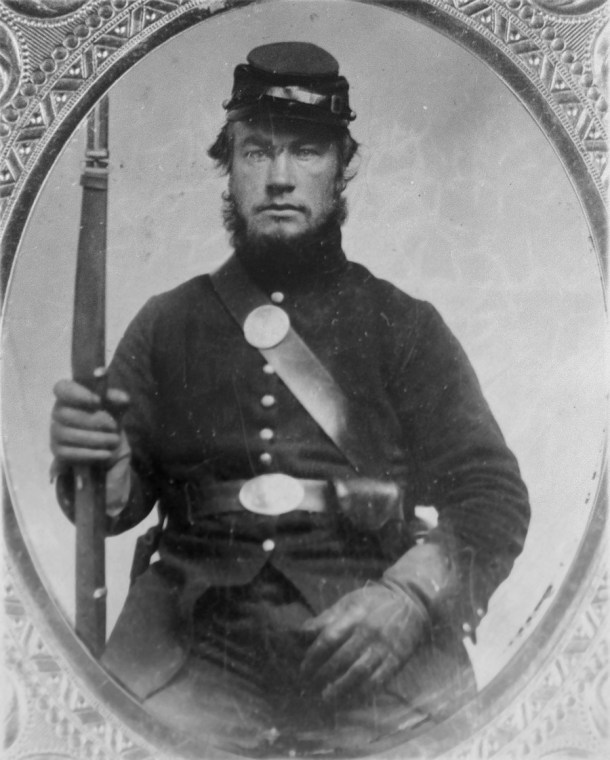
Editor’s note: Mark Bushnell is a Vermont journalist and historian. He is the author of “Hidden History of Vermont” and “It Happened in Vermont.”
[W]illiam Scott was a wreck. It was Sept. 9, 1861, the day he was to die. Waiting for the moment must have been excruciating.
The morning must have been similarly agonizing for the six men assigned to kill Scott, who, like them, was from Vermont. They were to be his firing squad. They stood and watched as he was led from a tent and taken to the spot where he would be shot.
Scott, who was born in Groton, had fallen asleep while on sentinel duty on the outskirts of Washington. This was in the early stages of the Civil War and the city was in danger. Confederate troops were 10 miles from the capital and Union forces were less than confident they could withstand an attack. The uncertainty was understandable – barely a month before, the Union Army had suffered a shocking defeat at Bull Run in the first major battle of the Civil War.
Scott had been caught napping early in the morning of Aug. 31. His commanders were outraged that the troops didn’t seem to understand the precariousness of their situation, so they decided to make an example of Scott. That Scott was a raw recruit – and had been on the family farm just six week earlier – didn’t seem to matter. A court-martial, made up of 12 Vermonters, convicted Scott and sentenced him to death. Gen. George McClellan, commander of the Army of the Potomac, agreed with the sentence.
A witness described Scott trembling as he was led before the firing squad. All stood quietly as an officer read the order aloud: “Private William Scott, of Company K of the Third Regiment of Vermont volunteers, having been found guilty by court-martial of sleeping … has been sentenced to be shot …”
Then the words took an unexpected turn. The officer read that commanding officers of the brigade and regiment, as well as other Vermont officers and privates, had pleaded for leniency, so that “mercy may be extended to the criminal.”
“This fact,” the officer continued, “viewed in connection with the inexperience of the condemned soldier, his previous good conduct and general good character, and the urgent entreaties made in his behalf, have determined the major general commanding to grant the pardon so earnestly prayed for.”
Scott would live to see another day. The Vermont troops cheered wildly. Scott, perhaps drained by the experience or not quite believing his luck, seemed unemotional, one witness recalled.
The story made its way into newspapers across the North. As it was told, people began to wonder what had happened behind the scenes to spare Scott’s life. Details began to emerge. Some said that Scott’s sister, living in Indiana, somehow got word of the sentencing and raced to Washington to fight for her brother’s life. Arriving the day before the execution, she had been turned away by Gen. McClellan. Her only hope was President Lincoln – surely he would take pity on a young farm boy.
She was right. Lincoln, moved by her plea, dashed off a note to a Gen. Francis Spinner. “Will Gen. Spinner please see and hear this young lady. A. Lincoln,” the note read. But just then, Spinner walked into the room. Lincoln threw the note into a wastepaper basket – from which it was miraculously rescued – and convinced Spinner to stop the execution.
That night, Lincoln’s worrying nature got the best of him. He couldn’t sleep, for fear the commutation wouldn’t arrive in time. He ordered his carriage brought up and in it he raced to the encampment.
There, Lincoln slipped into Scott’s tent and told the terrified young man. “My boy, you are not to be shot,” he said. “I am going to trust you and send you back to your regiment. But my bill for this service is a heavy one, and only William Scott can pay it. If, from this day, William Scott does his duty so well that if I was there when he came to die, William Scott can look into my face and say that he has kept his promise, and that he had done his duty as a soldier, then I will consider my bill as paid, and paid in full.”
An amazing story. Too bad it’s not true.
Like so many great stories, it has been adorned over time, to the point that it is hard to tell what really happened.
Researcher Thomas Lowry, who wrote a book on Lincoln’s commutations, has perhaps the clearest understanding of how Scott was pardoned. According to Lowry, regimental officers worked on two fronts to spare Scott. They presented a petition to Vermont Brig. Gen. William Smith and sent a delegation to nearby Washington. There, they met with another Vermonter, Lucius Chittenden, who was a Treasury official. Chittenden quickly arranged a meeting with Lincoln, who agreed to delay the execution. McClellan wrote to his wife that during a meeting Lincoln had urged that Scott be spared, and the general agreed.
There was no plea by Scott’s sister from Indiana, whom historians have not even been able to identify; no note to Spinner, who was not yet even in the Army; and no evidence of a late-night race by Lincoln, who apparently never met Scott. (The death sentence itself might have been fake. Some historians believe that from the start the Army planned to commute the sentence to teach a lesson, without risking the blow to morale that an execution might cause.)
The story – at least its basic outline – was too much for poets and playwrights to resist embellishing. So was the way Scott’s story ended.
The following April, Scott was serving with his unit in Virginia. During a skirmish there, he was shot and killed. The story was that he died helping lead a charge on a Confederate position. As Carl Sandberg wrote in his famous biography of Lincoln, “among the fresh growths and blooms of Virginia springtime at Lee’s Mill [Scott] took the burning messages of six bullets into his body. All he could give Lincoln or his country or his God was now given.”
In the surgeon’s tent, Scott supposedly said, “You know what you can tell them at home, that I tried to do the right thing. If any of you ever have the chance, I wish you would tell President Lincoln that I have never forgotten his kind words to me, that I have tried to be a good soldier and true to the flag. …”
Another great, though invented, story. Scott did die at Lee’s Mill – actually it was at nearby Warwick Creek, but that’s a quibble. But he wasn’t shot while attacking; he and the rest of his unit were retreating from an ambush. By some reports, Scott was carrying an injured comrade when he was hit.
The surgery tent speech is also probably fiction. A person shot through the chest is unlikely to soliloquize, Lowry points out. Besides, according to the surgeon, Scott was unconscious when he was brought in.
The story doesn’t need a poet’s adornments. Scott’s experience, told straight, speaks volumes about the period. It makes clear how seriously the Union feared losing its capital at the start of the war, how brutal and alien military life must have seemed to green Vermont farm boys and how dangerous it was for them to serve.
More than 5,000 Vermonters died during the Civil War. In a state of only 315,000 people at the time, the loss was staggeringly hard to comprehend. Perhaps, then, the poets did us a favor by dramatizing the story of William Scott. They ensured that at least one Vermont soldier would be remembered, and that in some small part his death would come to symbolize the thousands of others who also died.

