

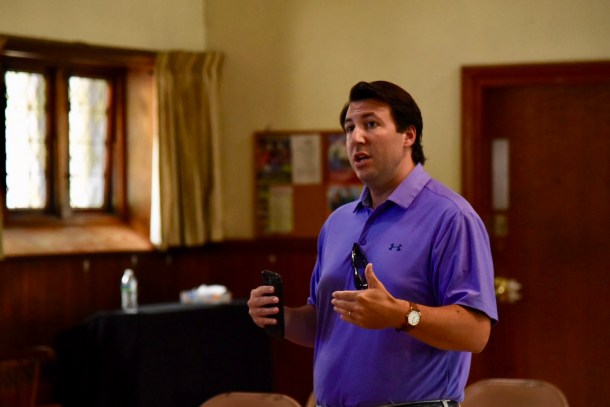
[W]EST LEBANON, N.H. — Just before 10 a.m. on a hazy Saturday, Joe Caiazzo drove up to the small house, off the main strip in West Lebanon, that will serve as Bernie Sanders’ campaign office in the Upper Valley for the next 200 days.
With warnings that the temperature could rise into the 90s that weekend two weeks ago, the 32-year-old New Hampshire campaign state director was dressed in a polo shirt and khaki trousers.
As he introduced himself, Caiazzo’s accent betrayed his Massachusetts roots, but he was quick to say that he was technically born in New Hampshire, albeit in Derry — about 20 miles from the state line.
With Sanders in Iowa for the weekend, Caiazzo planned a drive to Keene to hear Nina Turner — the Vermont senator’s senior adviser and firebrand — speak to supporters at the Unitarian Universalist Church, and then back north to West Lebanon for the grand opening of what would be the sixth Sanders office in the state and to hear Turner rally the troops once again.
The Vermont senator gained momentum from the Granite State during his 2016 presidential bid, roundly beating the frontrunner, former Secretary of State Hilary Clinton in New Hampshire. This time around, with two dozen Democratic candidates in the race, Sanders faces tougher competition and has tweaked his strategy accordingly.
Now, four years after his ultimate defeat to Clinton in the primary, the Sanders campaign is slicker, and the populist, who once drew thousands of people to his rallies, has opted to forgo large rallies for more personal gatherings.
The strategy is less about winning states and more about calculating how many delegates are needed to win the Democratic nomination.
Inside the headquarters, three staffers hurriedly turned on three air conditioning units, making sure cool air was circulating around the office, located on the main strip in West Lebanon, just over the bridge from White River Junction.
Bernie 2020 campaign signs decorate the ground floor’s three rooms, along with a regional map of New Hampshire pinned to the wall.
At a plastic fold-out table, situated just inside the doorway, field organizers laid out paperwork, ready for Vermont interns and volunteers making the hour and a half trek down from the Burlington office to knock on doors.
People soon began arriving in small groups of three or four. All were young, dressed in bright blue T-shirts emblazoned with “Bernie” in white letters.
There was a mix of political campaign expertise in the room. The field director most recently worked for the Wyoming Democratic Party, an intern from the Burlington office is fresh off working on an Arizona Senate race, another just came from local election campaigns in Chicago.
One canvasser spoke about his work during the last primary election, pointing to Claremont. “That’s the first place I knocked on doors for Bernie in 2016.”
Others are students from Middlebury College and Northern Vermont University who are new to political organizing.
“It is hot as hell out there, as you all know, so hydrate,” Caiazzo warned. “If you aren’t feeling so well, take a break, sit in the car, turn on the A/C, get some water. Keep yourself OK. Today is not the day to be a hero.”
Creating a network of grassroots organizers has been a hallmark of both Sanders’ campaign efforts, and this cycle’s New Hampshire ground game is no different, with Caiazzo stressing the importance of the people who came out on that hot Saturday.
“We have 205 days until the first national primary. We need you on all of them.”
After a 30-minute training on how to canvass, including advice on how to “share personal stories” and not to put flyers in people’s mailboxes (“that is a violation of federal law”), the group of 15 went out into the heat to knock on doors.
The state of the race
On the drive south towards Keene on Interstate 91, Caiazzo is an easy talker, quick to give his opinion on everything from the economic recession in 2008 to state politics in New England.
Caiazzo was named the state director of New Hampshire on Feb. 19 — the same day Sanders formally announced he was kicking off his 2020 presidential campaign.
Last presidential election cycle, he also worked for the Vermont senator. After Sanders lost, he was hired on by the Hilary Clinton campaign to work on the Rhode Island state campaign. In between, Caiazzo ran the successful re-election campaign for Sen. Sheldon Whitehouse, D-Rhode Island.
Now Caiazzo is heading up six offices with a full-time staff of 45 throughout New Hampshire. On that 95 degree Saturday, as the team of 15 canvassers were working the pavement in the Upper Valley, a group of 30 had left the Manchester headquarters to knock on doors throughout the city.
The majority of those 45 people are in the labor union, after the Sanders’ campaign became the first presidential effort in U.S. history to unionize in May. Caiazzo said so far there have been no grievances against anyone in the state. On July 22, a charge was filed with the National Labor Relations Board by an unnamed individual against the Sanders’ Iowa campaign.
The campaign has also been public about its efforts to address sexism after staffers from 2016 raised allegations of misconduct and bias. In the second quarter, the campaign paid Working Ideal, a human resources consulting firm that specializes in making sure there is equality in the workplace $30,704.
Now, a 13-point code of “expected conduct” is pinned to the wall of the West Lebanon office that advises campaign staff, contractors and volunteers: “See something. Experience something. Say something. We are only as safe as we make it.”
The campaign plans to open additional offices in New Hampshire in the coming months, as it tries to build on the strong support for Sanders in the 2016 primary. The Vermont independent’s insurgent campaign got a huge boost when he beat Clinton by 22 points, winning 60% of the vote, in the 2016 New Hampshire contest.
Since then, Sanders has maintained a group of about 75 supporters who have been meeting monthly since 2016 to formulate a grassroots campaigning strategy.
In Sanders’ first New Hampshire campaign speech in March, the Vermont senator underscored just how important the Granite State is for him, historically and moving forward.
“This is where, in 2016, the political revolution began,” Sanders said at the time. “With your help on this campaign, we are going to complete what we started here.”
But Sanders faces a more difficult road to victory in New Hampshire than he did four years ago when the decision for voters was him or Clinton.
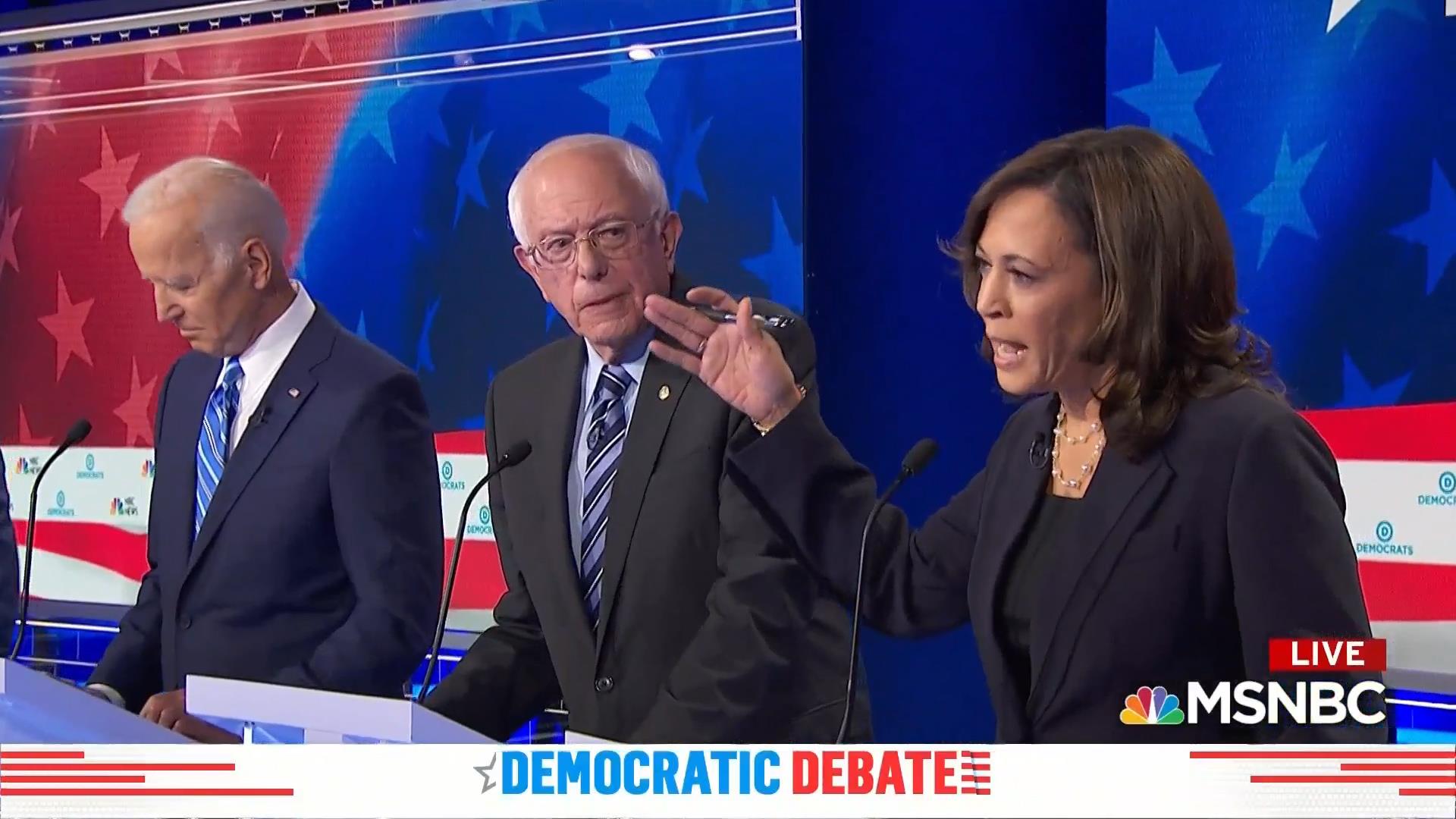
In the most recent CNN poll conducted by the University of New Hampshire, Sanders is tied for second place with Sen. Elizabeth Warren at 19%. Former Vice President Joe Biden leads the pack with 24% while 10% support South Bend, Indiana, Mayor Pete Buttigieg and 9% back California Sen. Kamala Harris.

In New Hampshire, the Biden campaign said it has more than 40 staff, but has only opened a headquarters office in Manchester, with plans to open field offices soon.
While Harris has a presence in the state — the campaign reports 30 staffers on its payroll in New Hampshire — her campaign has yet to set up a ground game in New Hampshire comparable to Sanders’ operation. Harris is also contemplating setting up offices in Vermont.
Trailing Biden, Sanders — the senator from the Granite State’s neighbor to the west, is receiving his stiffest competition from Warren, of Massachusetts, who has maintained strong support in New Hampshire.
The Warren campaign would not confirm how many staff it has in the Granite State, but it has offices in Keene, Manchester, Nashua and Portsmouth. In total, Warren has more than 300 staff. Sixty percent are working in Iowa, New Hampshire, South Carolina, and Nevada.
A volunteer for the Sanders campaign, who would not give his name but lives in Brattleboro, said Warren has a staff of five in Keene, while Sanders’ Keene team is made up of three full-time members. The senator has more volunteers in the area that Warren does.
“Warren has been very active here,” he said, but added that Biden has not. “He’s doing nothing. He’s done a few fundraisers, but not much else.”
Different year, different strategy and a whole lot of math
As Caiazzo ambled south on I-91 — hovering around 66 miles per hour in his Jeep Compass — he said that if Sanders had not won New Hampshire in 2016, the primary would have been over before it started for the Vermont senator.
This time around, with so many candidates in the running, it’s a completely different race with a completely different strategy.
New Hampshire isn’t as important for Sanders’ path to the nomination this cycle, Caiazzo said, because with more than 20 candidates in the field, the game is about winning enough delegates to stay in the game.
“Do we have to win here? No. Do we have to win anywhere? No. Do we have to do well?” he said. “Do you have to go undefeated to win the Super Bowl? No. Would it be nice? Yes. Would it be nice to go 14-2, yes, but is it imperative? No.”
The campaign’s newfound focus on the number of delegates is straight out of the Democratic primary playbook of David Plouffe — a longtime campaign strategist — who is credited with focusing former President Barack Obama’s 2008 campaign on maximizing the total number of pledged delegates instead of focusing solely on primary states.

In New Hampshire, that would mean capturing most of the 24 primary delegates up for grabs, and beating out the other candidates for most of the other estimated 3,744 pledged delegates in play.
“Any time you have more than a three-way race, it becomes a delegate race,” Caiazzo said. “There’s a lot of math going on.”
The Sanders camp is not only focusing on the early primary states, however, and with an eye to the general election, the Vermont senator has already targeted states that Trump won in 2016 — including Michigan, Wisconsin and Pennsylvania.
The campaign is also already casting an eye toward New England Super Tuesday states, like Maine.
Super Tuesday may not be until March 3, but Sanders’ camp has already met with Maine Senate President Troy Jackson — who had been an active Sanders supporter in 2016 — and State Rep. Ben Collings — who ran Sanders’ last presidential campaign in Maine. Sanders won 64% of the vote during the 2016 Maine primary and 17 delegates, but ceded eight delegates to Clinton and her 35%.
Sanders campaign infrastructure has not picked up in Maine yet, and Collings said it’s unclear if an active campaign will begin closer to the end of 2019 or in early 2020.
“People want us to function at the October level now,” Caiazzo said. “People want to get rolling.“
In New Hampshire, the campaign has been dialing back the number of big rallies and large crowds — something Sanders was famous for in 2016 — for more intimate gatherings throughout the state.
Utilizing Ben Cohen, who is a national campaign chair and cofounder of Ben & Jerry’s, the campaign has held “ice-cream socials with Bernie” all across the state.
Caiazzo said the strategy is to hold smaller events with a compact schedule to make it more personal for Sanders and voters.
“No rallies, no big podium,” he said. “Let’s give them a chance to meet him.”
At these meetings, Sanders has been asked to autograph forearms, take family pictures, and pose for hundreds of selfies. Caiazzo said the one thing the Vermont senator will not do is hold people’s babies, out of fear he will drop them.
“We know we can fill the stadiums, let’s go roll it back, let’s do it the Vermont way,” he added.

Turner turns up the heat
At the Unitarian Universalist Church in Keene, a rainbow-colored LGBTQ pride flag hung in the corner, as two overhead fans worked full bore and six floor fans busily whirred to combat the oppressive heat.
In the church, it was an intimate affair and a far cry from a stadium setting.
Twenty people gathered to hear Nina Turner — the former Ohio state senator and current Sanders’ surrogate — speak, including one man who had driven almost two hours in a car without air conditioning. Before she spoke they all gathered around her for photos and to talk with her one-on-one.
While Sanders has been reticent about other Democratic candidates and their policy positions, Turner made a point of contrasting the Vermont senator with his competition — and telling personal stories to illustrate Sanders’ stances on issues.
“The senator will say they are all fine people, they are all my friends, but there is a difference between them. One of the major differences is that he’s not just running to be the next president of the United States of America, he’s running to create a real revolution — that sets him apart,” Turner said.
Turner also pointed to Democratic candidates who have announced they now support Medicare for All, canceling student debt and raising the minimum wage to $15 per hour, saying that “evolution is good but consistency is even better.”
“Why would you vote for the copies when you can have the original,” she said of how other candidates have embraced policies Sanders has long advocated for.
Turner talked about her mother’s death at the age of 42, and how she was forced to make the decision “to pull the plug.” She explained how she and her seven siblings were “safety net children” and that Sanders understands that economic struggle.
“He would never say he was as poor as somebody like me, but he grew up in a working class family. They lived in rent control housing. His mother died at the age of 46 years old. We have that in common,” she said.
As Turner was escorted to her next engagement by Shannon Jackson, the Northeast regional director for the campaign, Caiazzo grabbed lunch at Odelay Taqueria — three tacos for $9.95 — at the recommendation of the Keene field staff.

Anybody’s race
A woman working at the restaurant said former Colorado Gov. John Hickenlooper had been in the restaurant last week. Though she was undecided about who in the Democratic field she would vote for, she stressed she was most concerned about how the Democrats would beat Trump in 2020.
“We can clean his clock, if we do this properly,” Caiazzo said.
On the drive back north, a Subaru Outback passed near Windsor, Vermont, with three bicycles on a trunk rack. An “I’m with her” sticker, a relic of Hillary Clinton’s 2016 bid, was on the driver side bumper.
Caiazzo wondered out loud, “Look at that. Who do you think that person supports this time around?”
Back at the West Lebanon office, the canvassers had already retreated to the air conditioned office from the 95 degree heat.
The table, which that morning had sign-up sheets and paperwork on it, now had “Bernie 2020” T-shirts selling for $27 — that would go to the campaign as a donation. “But you do get a sticker,” one staffer said.
Turner who was scheduled to address the 30 people who crammed into the small house, had not yet arrived, and volunteers, supporters and staffers alike were enjoying Ben & Jerry’s ice cream — Cherry Garcia and chocolate — scooped from two large cardboard boxes.
Jack Hanson, a 24-year-old Progressive who was recently elected to Burlington City Council, said he plans to volunteer as much as he can, and “potentially” work for the Sanders campaign.
“I want to make sure I’m active on the campaign because we can’t afford to lose again,” said Hanson, who worked as a staffer on Sanders’ 2016 effort and managed the 2016 campaign of Vermont Sen. Chris Pearson, P/D-Chittenden.
Turner arrived at 4:30 p.m. and started in again on her stump speech from Keene.

“As the senator would say, all the folks who are running are his closest, dear friends,” says Turner. “So I’m going to say the same. Most of them are good people.”
“But none of them are him. It is OK to have copies, but, baby, when you can have the original why would you want copies. Sen. Bernie Sanders is the original,” she went on.
Turner also took a shot at Biden, who has recently criticized Sanders’ Medicare for All proposal, and railed against health insurance companies, and the premiums and deductibles that Americans pay to have access to health care.
She ended by telling the small crowd to raise their hands in support of getting Sanders into the White House.
“With these hands we will make Mr. Bernard Sanders the next president of the United States,” said Turner as the group of 30 people erupted in cheers and applause.
Hanson was impressed by Turner’s energy. “It makes you feel something,” he said.
With Labor Day six weeks away, Caiazzo said he believes the primary will continue to be “scrappy,” but that it will toughen up the eventual Democratic candidate and the campaigns for the general election.
But as for which campaign and candidate will rule the day, Caiazzo still isn’t sure.
“I would be willing to bet that the Warren campaign, the Beto campaign, the Biden campaign, are all running different models from us and each other,” he said. “One of them is going to work, I don’t know which.”
“I hope it’s ours, obviously.”

