

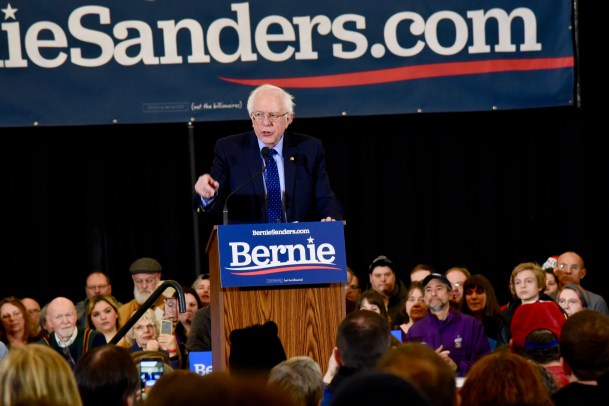
In his first speech in New Hampshire since he announced his 2020 presidential bid last month, Sanders stressed the differences between himself and President Donald Trump. Sanders did not once mention other Democratic candidates by name and seemed to assume a primary victory.
“I am here to tell you, that because of all the work we have done, we are now on the brink of winning not just an election, but transforming our country,” Sanders said. “Donald Trump wants to divide us up by the color of our skin, our country of origin, our gender, our religion and our sexual orientation.”
“We are going to do exactly the opposite. We are going to bring our people together – black, white, Latino, Native American, Asian American, gay and straight, young and old, men and women, native born and immigrant,” the Vermont senator said.
The Vermont independent senator lost his insurgent bid for the Democratic nomination in 2016. This time around, Sanders has assumed the mantle of the front-runner — even as the 2020 Democratic presidential field continues to grow.
The current Democratic presidential field has 13 candidates vying for the nomination, and former Vice President Joe Biden and Beto O’Rourke are expected to announce campaigns shortly.
Recent polls show Sanders has a slight advantage over his closest competitor, the not-yet-declared Biden, in New Hampshire, but in other early primary states Biden has a slight lead.
In a University of New Hampshire poll, 26 percent of Democratic primary voters support Sanders and 22 percent favor Biden. He is followed by Sens. Kamala Harris of California and Elizabeth Warren of Massachusetts with 10 percent and 7 percent, respectively.
Ray Buckley, chair of the New Hampshire Democratic Party, said Sanders has a significant advantage in the state compared to other candidates because of his history of working with and for people in New Hampshire.
“Sen. Sanders has a decades long relationship with New Hampshire Democrats and New Hampshire progressives. He has been here throughout the years campaigning for our candidates and the party,” Buckley said.
While the Sanders campaign has no staff on the ground in New Hampshire yet, Buckley said the Vermont senator does have a contingent of about 75 “uber-activists” that have been meeting monthly since 2016 to formulate a grassroots campaigning strategy.
“He has that level of strong support in the state,” Buckley said. “He starts out with a level of enthusiasm and energy that other candidates are just building.”

Joe Gunnison, a teacher from the Concord area who did not vote in the 2016 primary, said he is still undecided about who he will vote for this year, but came to hear what Sanders had to say.
“Hopefully he’ll say something that really convinces me. We’ll see what happens. At this point I’m still undecided,” Gunnison said. “It’s a lucky thing we have, living in New Hampshire, is that we are the first primary state in the country so it’s a good thing for any citizen to take advantage of the opportunity having all the candidates come here for the upcoming election.”
In 2016, Sanders’ campaign got a huge boost when be beat Clinton by 22 points in the New Hampshire primary. The Vermont senator won 60 percent of the vote while Clinton garnered 38 percent.
In his remarks Sunday, Sanders said in 2020 he will build momentum from his last round in the Granite State.
“This is where in 2016 the political revolution began,” Sanders said. “With your help on this campaign, we are going to complete what we started here.”
While visiting a state where Sanders already has a strong base of support may seem an odd strategy, it is, according to Sanders’ campaign manager Faiz Shakir, part of a larger “five-core early state” plan put together by the Sanders campaign to target all the early primaries — Iowa, New Hampshire, Nevada, South Carolina, and California.
Sanders will be making stops in South Carolina on Thursday and Nevada on Saturday, after already visiting Iowa last week. There are also plans for him to hold a campaign rally in California.
Shakir told VTDigger last week the campaign plans to build on strong support in the early primaries and then to move to historically Democratic states that Trump won during the 2016 national election.
“The first track is making it clear that Bernie Sanders has the strongest national electability to beat Donald Trump,” Shakir said. “States that have been historically blue but Trump turned red, like Michigan and Ohio, Bernie has a strong ability to turn those states back to blue.”
Shakir said the campaign will bank on the senator’s existing grassroots organizing infrastructure and money raised from citizen supporters who have already contributed $10 million.
Sanders and his campaign are also working to overcome tepid support in the South. It remains unclear how Sanders will fare with moderate Democrats if Biden enters the race.
Omar Andrews, a U.S. Marine Corp veteran who drove from Maine with his five-year-old daughter to hear the senator, said he supports Sanders because of the work he has done to bolster the Department of Veterans Affairs, as well as Sanders’ commitment to helping underprivileged people.
“As a black man in America, the next step of civil rights is workers’ rights,” Andrews said. “I don’t think there is another candidate that exemplifies that as much as Bernie Sanders.”

