


A district would allow municipalities to share services, and it could include 10 towns in the region, said Evan Carlson, an entrepreneur-in-residence at Lyndonville’s Do North Coworking center who is part of a group working on the plan.
The group includes representatives from each of those 10 towns: Burke, Danville, East Haven, Kirby, Lyndon, Newark, Sheffield, St. Johnsbury, Sutton and Wheelock.
“Ultimately, the end goal is to really develop a district that serves our direct areas but also includes some of the remote areas,” Carlson said, pointing to places north of Island Pond in Essex County.
Broadband internet refers to a high-speed connection that is always on and faster than dial-up, according to the Federal Communications Commission. To qualify as broadband, a fixed (rather than mobile) service needs a download speed of 25 megabits per second and an upload speed of 3 megabits per second, the FCC says.
The Northeast Kingdom’s three counties — Caledonia, Essex and Orleans — have some of the lowest availability of 25-and-3 coverage in Vermont. Essex has the lowest rate at 21.7%, according to state data from 2018. Orleans has the third-lowest at 50.6%, and Caledonia has the fourth-lowest at 51.2%.
Right now, representatives are reaching out to people in their towns to explain how a district would work, Carlson said. Starting in October, they will ask selectboards to add a question about joining the district to 2020 March Town Meeting Day ballots.
State law requires at least two municipalities to create a district.
Focusing on Lyndon and six nearby communities, the study found that only 24% of survey respondents were satisfied with their internet service and many believed the lack of high-speed internet access had hurt local businesses.
The study’s recommendation: Consider creating a union district modeled after ECFiber, also known as the East Central VT Telecommunications District.
In 2016, ECFiber became Vermont’s first communications union district after a law signed the previous year allowed municipalities to team up to provide internet service. According to its website, the district has 24 member towns in east-central Vermont and more than 3,500 customers. The organization says eight of those towns now have “essentially full coverage” and it plans to double that number by the end of this year.
The Northeast Kingdom–based union wouldn’t be the first to follow ECFiber’s model. Twelve municipalities voted last year to form Central Vermont Internet, or CVFiber, including Barre City, Berlin and Montpelier.
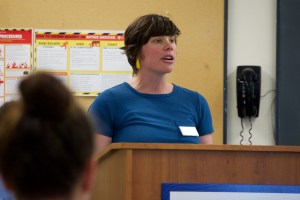
Jeremy Hansen, vice chair of the Berlin Selectboard, spearheaded that effort. At a summit on broadband issues Thursday hosted by the Northeast Kingdom Collaborative, Hansen said the district hopes to start building its fiber infrastructure next year.
Carlson said the potential district would start providing service in higher-density areas like St. Johnsbury before stretching to more remote locales. He said he wants to see speeds of 100 megabits per second.
“The CUD allows the tax liability and potential risk to fall on the CUD, versus the actual municipalities and taxpayers,” he said, explaining the benefit of the model.
The group is looking to use funds made available by the broadband bill, H.513, passed by the House in March and signed into law by Gov. Phil Scott last month. The bill was designed to help local internet providers expand service in rural areas.
“That is certainly something we will be taking advantage of,” Carlson said, explaining that the group wants to use funds to hire a consultant to draw up a business model.
Carlson said the district would be a grassroots effort.
“What’s really working in rural Vermont is when communities band together and/or partner with providers to build their own networks,” said Katherine Sims, director of the Northeast Kingdom Collaborative.
“It’s up to us to create this vision and secure the resources,” she added.
