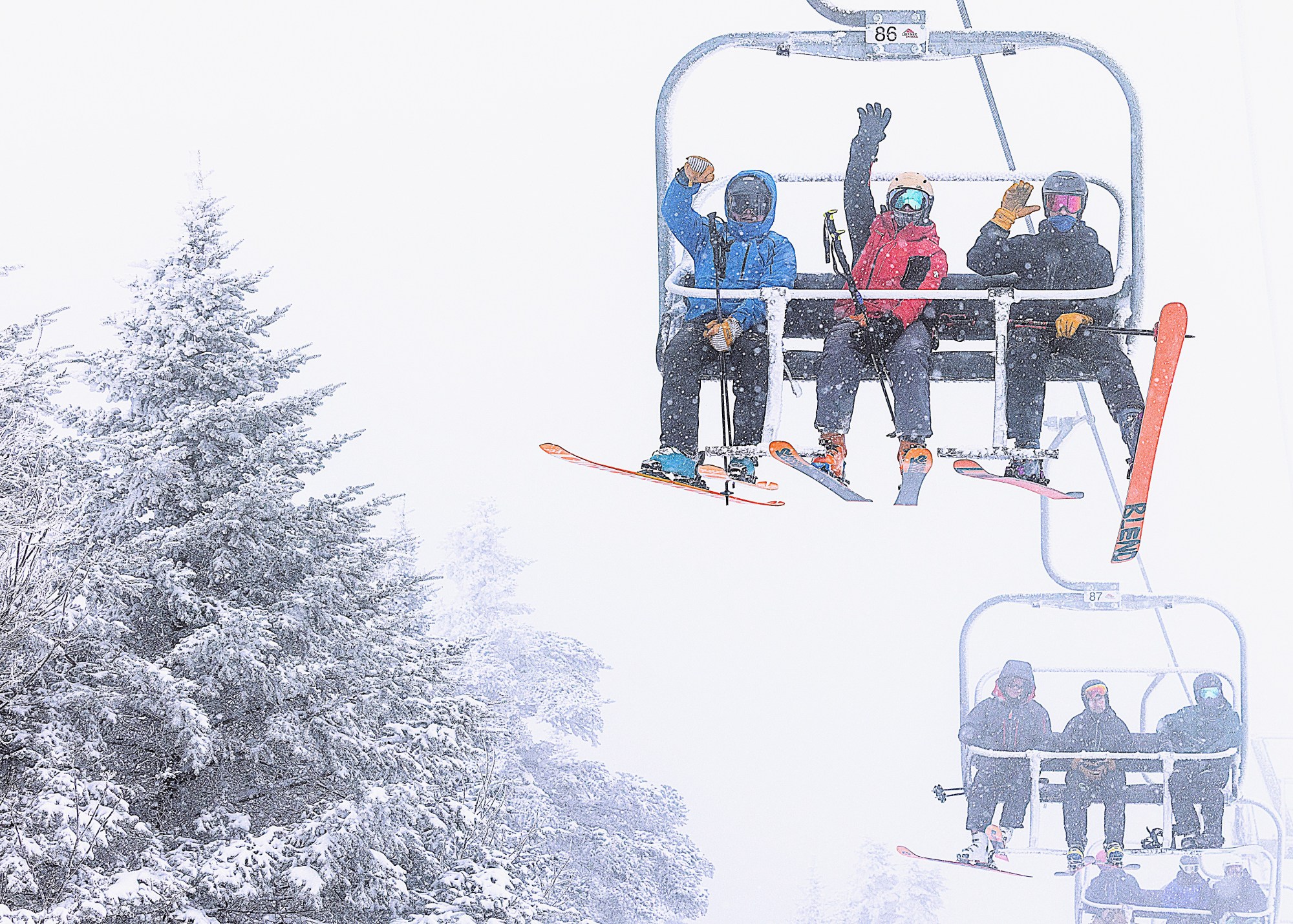

It’s been a banner year for Vermont’s mountain resorts but for Okemo ski lift operator Casey Jennings, it’s been business as usual: getting a quick break to warm up from the extreme cold or to visit the bathroom can involve slowing down the lift — leaving guests on long cold lift rides — in order to recruit cover for his post.
Casey’s dilemma and the grueling job of enduring the cold as a ski lift operator has been a long-standing worker protection issue in Vermont and other states. Last year, a bill called the Extreme Weather Worker Protection Act was authored that could offer some protection, though it is not certain the measure will get approved by the end of the biennium, according to lawmakers. The result is lax worker protections in an industry that is key to tourism in the state.
“Workers deserve to be protected from dangerous heat and cold conditions during their work day,” according to Curtis Clough Vermont Teamsters union president and an advocate for legislation mandating weather protective gear and breaks. “Especially, this key industry can afford to do that.”
Regulators, including the Vermont Occupational Safety and Health Administration, have not offered much relief to workers. In the last six years, ski lift workers have filed 18 complaints about working conditions, including extreme weather conditions, to VOSHA. Only one of the complaints resulted in a citation. Around two thirds of the complaints did not result in action beyond a letter of inquiry by the administration, according to records obtained by VTDigger.
Frozen out
Vermont’s OSHA received 18 complaints from ski resort workers, resulting in one citation.
VOSHA program manager Anna Hill said the administration doesn’t have the regulatory authority to mandate specifics about breaks, staffing issues or workplace temperature to employers unless it poses the risk of serious injury or death to a worker. The federal Occupational Safety and Health Administration has a cold stress guide, but defers to a general duty clause to enforce protections against hazards like cold exposure.
One complaint from an anonymous employee at Okemo in the winter 2025 alleged a fellow employee was injured after being stationed alone at a fix-grip lift, while another complaint alleged an employee was left alone at a lift without breaks and told to “go in the woods to go to the bathroom,” an employee wrote. VOSHA conducted a partial investigation, but found the complaint unfounded and Okemo remained in compliance, according to the records.
In another complaint, a lift worker alleged: “We can’t leave the lift running with just one person or no person (I’ve been alone running the lift several times, it’s dangerous). We’re resorting to things like peeing in soda bottles in the engine room.”
Ski resort blues
Vermont’s ski resort workers reported a wide range of workplace complaints.
An Okemo spokesperson wrote in an email that guest and employee safety is the resort’s “highest priority,” and Okemo adheres to all state and federal regulations and standards to ensure a safe work environment.
Across Vermont’s industries, approximately 31% of the 1732 complaints received have resulted in citations between January 2020 to 2026, according to data provided by VOSHA. Given the high volume of complaints, Hill said the state administration has to prioritize complaints that allege a specific violation of federal rules or a serious safety or health hazard by an employer.
Vermont’s lawmakers have yet to pick up the issue despite a bill that has been drafted that would require employers to allow breaks to warm up or cool down, provide equipment to protect against extreme weather and employ a “buddy system” so workers can monitor themselves for cold or heat related illness, among other measures.
One of the House sponsors of the bill, Rep. Conor Casey (D-Montpelier), said the House Committee on General and Housing has not discussed the bill, despite positive feedback from legislators: “it’s a bit of a no-brainer. These are very basic worker protections.”
The act may be dead on arrival: the Mar. 13 “crossover” deadline for policy bills to move out of committee is looming.
Molly Mahar, president of the Vermont Ski Association, described the bill as overly prescriptive, allowing workers to take unlimited preventative temperature breaks and said it would be difficult to monitor temperatures for compliance given weather changes across mountains.
Kesha Ram Hinsdale, co-sponsor of the weather worker protection bill on the Senate side, said the bill aims to address problems before tragedy strikes, like the heat-related death of U.S. postal workers in Texas and North Carolina in recent years. The goal, she said, is to see if there are problems in a particular industry that need to be addressed.
In the absence of specific weather-related federal protections, lawmakers took action in 18 states by proposing extreme temperature workplace regulations, but Minnesota and Washington are the only states with laws that address the issue of cold stress.
Jennings, the Okemo ski lift operator, said the manual labor involved in manning a chairlift is taxing on the body, especially if you are the only one there. But leaving his post isn’t easy, he says, especially when throngs of riders are waiting to be scooped up the mountainside for their next run.
In February, Jennings brought a proposal to the Vermont Passenger Tramway Board — Vermont’s ski lift safety regulatory body — asking to increase the staffing requirement to two people stationed at the bottom of fix-grip chairlifts. These are often older, smaller-sized chairlifts that do not slow down, requiring a worker to grab each chair whizzing by so a rider can sit down. Currently, the national minimum staffing level requires just one worker at the bottom of all lifts.
The tramway board is composed of two industry representatives, two public representatives and the Labor Commissioner who serves as board chair. The Vermont Legislature established the board in the mid-twentieth century when the ski industry was taking off in the state.
While staffing just one lift worker at bottom lifts is allowed under the current rules, it is dangerous, Jennings said at the February meeting. Prolonged exposure to the cold makes the job even harder, he said.
A second set of eyes is crucial for public safety, he believes, in order to effectively spot and address hazards. An additional operator present at a lift also allows for workers to rotate and warm up periodically, also to avoid repetitive motion injuries.
The tramway board adopts federal standards for ski lifts with additional addendums on a five year cycle. The next rule-making effort when the state board will take up this change could be as early as 2028, said Dirk Anderson, director of workers’ compensation and safety for the Vermont Department of Labor. An interim rule-making could be possible, but it’s an expensive and lengthy process that would only be triggered if there were a number of significant regulatory changes to be made, Anderson said.
Anderson said the tramway board is tasked by the Legislature to ensure ski lifts are safe for use by the general public, and the safety of employees in the workplace is traditionally the realm of VOSHA, or the Vermont Occupational Safety and Health Administration, despite some overlap regarding the safety of employees directly interacting with lifts.
VOSHA generally enforces federal standards for the workplace though the state Legislature has the prerogative to compel the Vermont administration to adopt a stricter standard for workplace safety conditions, Anderson said. The proposed extreme weather worker protection bill is an example of the Legislature attempting to exercise that power, he said.
One of the two public representatives on the board, Tom Buchanan, said in an interview that increasing the staffing level requirement to two people in the loading zone of all lifts, not just fix-grip lifts, is a priority for him during the next rulemaking effort.
Buchanan believes Vermont should establish robust staffing requirements, especially ahead of resorts rolling out artificial intelligence technology that could be used to replace workers. In the meantime, Buchanan said the Legislature could alleviate at least part of the issue at hand by taking up the proposed weather protection act. The other tramway board members declined or did not respond to requests for comment.
Resorts in Vermont like Killington, Jay Peak, Bolton Valley, Bromley, Mount Snow, Okemo, Stowe and Stratton have already taken the initiative to shut down some lifts, consolidate workers and provide additional warming opportunities during cold snaps recently, the ski association’s Mahar said.
Even though the federal Occupational Safety and Health Administration does not have specific cold weather standards, Mahar said “employers still have a responsibility to proactively identify and address workplace hazards,” including cold conditions.