


[B]ENNINGTON — Max Misch, a self-professed white nationalist, says charges that he illegally possessed high-capacity magazines should be dropped.
Misch is believed to be the first person charged under the provision of the law that went into effect Oct. 1.
His attorneys claim he’s being targeted by prosecutors who were “unwilling or unable” to charge him with a crime related to racial harassment of former state representative Kiah Morris. After a probe last year, the Vermont Attorney General’s Office declined to prosecute Misch.
Misch’s lawyers also challenged the constitutionality of the magazine limit passed by the Legislature last year. That provision is also currently being challenged in a state civil court lawsuit pending in Washington County brought by gun rights backers.
Prosecutors dispute those contentions. Misch’s attorney and a lawyer from the Vermont Attorney General’s Office squared off Thursday in a Bennington courtroom, sparring over whether two misdemeanor charges against Misch should stand.
In his motion to dismiss the case, defense attorney Frederick Bragdon argued that prosecutors spent “significant” resources to bring the magazine charges against his client.
“To put an even finer point on this issue: The State, is seeking to charge Mr. Misch, targeted him under the new law and was willing to expend significant resources to secure such evidence,” Bragdon wrote.
“It is entirely reasonable to assert that at least a part of this extensive process and the motivation behind it,” the defense attorney added, “was based upon the state being unwilling or unable to charge Mr. Misch with any crime based upon his interactions with Ms. Morris.”
Vermont Solicitor General Ben Battles of the Attorney General’s Office argued in court Thursday that the charges against Misch are constitutional. He dismissed the contention that Misch was “targeted” for prosecution.
“It’s important to remember how this case came about,” Battles said outside the courtroom. “There was a therapist who complained to police about concerns that Mr. Misch was stockpiling weapons and potentially was going to engage in violent behavior.”
Misch, speaking outside of court after the hearing Thursday, reiterated he was a white nationalist, and believed that’s what to led to magazine charges against him.
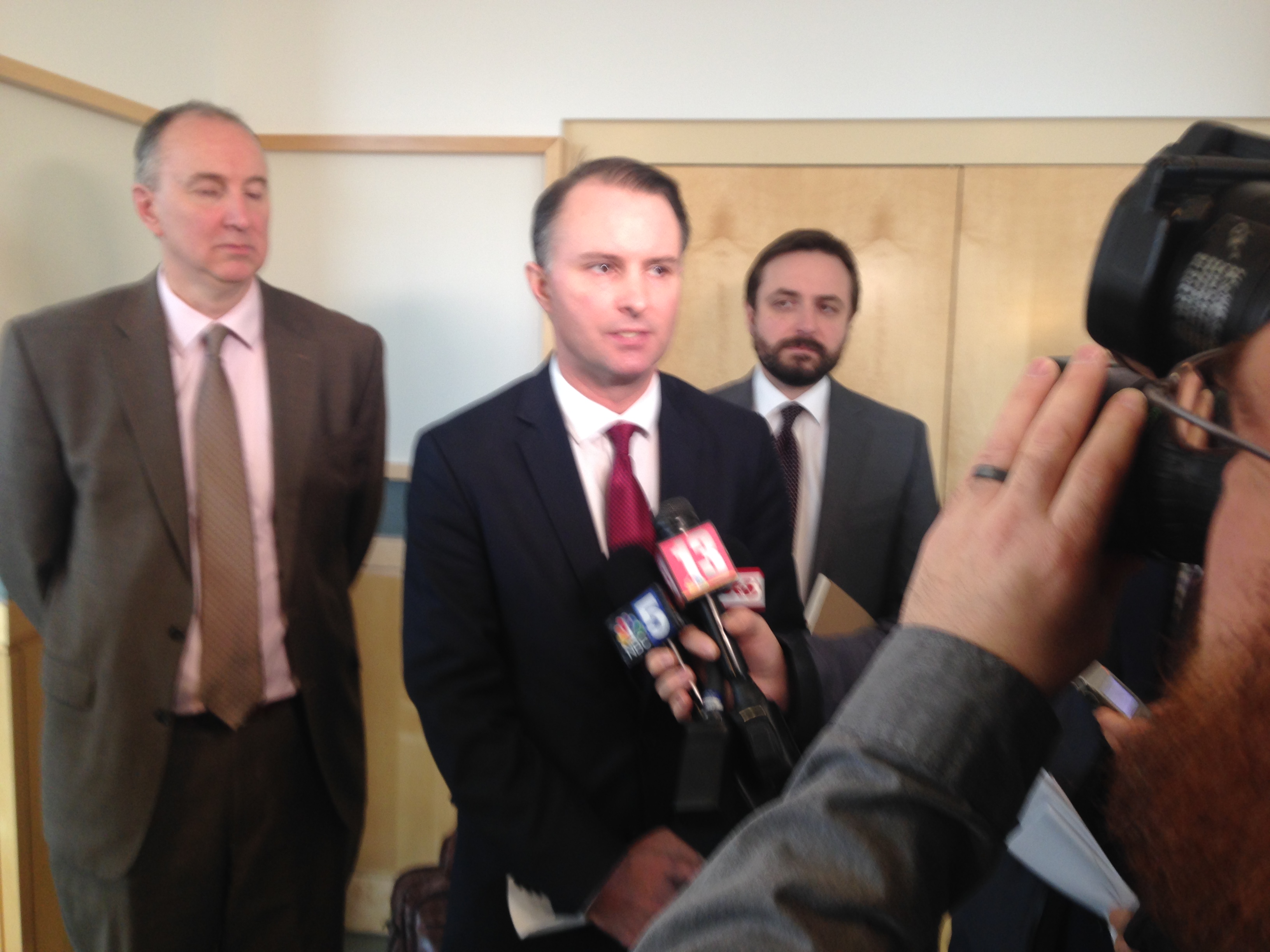
“Like Al Capone, they couldn’t get Capone on murder so they go for him on tax evasion or whatever the tax crime was,” he said. “They couldn’t get me on my speech so let’s try to get him on this gun charge and that’s what they attempted to do.”
He also said, “If I have to go to prison I must.”
Misch, 36, of Bennington, is charged under a law, S.55, now Act 94, that was part of a package of restrictions on firearms in Vermont that went into effect last year.
It was Misch’s ex-wife’s therapist who went to authorities after she heard that Misch was buying large-capacity magazines and weapons.
Vermont State Police detectives later went to the store, Runnings in Hinsdale, New Hampshire, where they believed the purchases were made.

They viewed receipts and security camera footage that showed Misch and his ex-wife shopping there on Dec. 1, the affidavit stated.
The purchases included two 30-round magazines by Misch, according to the filing.
Police said when they questioned Misch about buying magazines after Dec. 1, 2018, “he advised he no longer wanted to answer any questions.”
Later, police, armed with a warrant, went to Misch’s apartment on Gage Street in Bennington, and seized two 30-round magazines “consistent with what was purchased” on Dec. 1, from Runnings, according to the affidavit.
Prosecutor allege that Misch violated a provision of the law setting a limit on magazines purchased Dec. 1 or after to 15 rounds for handguns and 10 rounds for long guns.
The charges were brought about a month after Misch crashed a press conference where Vermont Attorney General TJ Donovan said he wouldn’t be bringing any charges against him, or anyone else, for racial harassment against former Vermont state representative Morris.
Misch was identified as the person responsible for the harassment, but Donovan said at that press conference that there was insufficient evidence to file charges against him, mainly due to free speech protections in the First Amendment.
Donovan came under criticism for not prosecuting Misch for his racist online harassment of Morris, a Bennington Democrat who had been Vermont’s only black woman in the Legislature before deciding not to run again last year.
Speaking to reporters after that press conference, Misch talked about how he enjoyed “trolling” Morris online.
In the courtroom
The arguments in the courtroom Thursday centered on the constitutionality of the magazine ban.
Attorney Rick Burgoon, representing Misch, told the judge that when the legislation made its way through the Legislature the magazine provision was not part of the initial bill, but later added on to it.
The defense attorney said the bill’s sponsor, Sen. Dick Sears, D-Bennington, even voted against the legislation, and, in doing so, questioned whether the measure was unconstitutional under the Vermont Constitution.
Burgoon argued that the cap on a firearm’s magazine size violates Article 16 of the Vermont Constitution, which says that “people have the right to bear arms for the defence of themselves and the state.”
The written defense motion also termed the magazine provision of the law largely unenforceable because there is no tracking system in place for magazines. For example, the devices bear no markings that indicate the date of manufacture.
Judge William Cohen asked Burgoon if he considered the magazine provision of the law a “restriction” or a “prohibition.”
“It doesn’t prohibits large capacity magazines, it prohibits large capacity magazines of more than 10 bullets,” Cohen said.
“Absolutely, your honor,” the defense attorney responded.

“Wouldn’t you think that’s more of a restriction than a prohibition?” the judge asked.
“No, it’s a prohibition, your honor,” Burgoon replied. “Mr. Misch is here today because he had a magazine capacity in excess of 10.”
Burgoon added there was no “determination” whether the limits set by the Legislature “makes sense” to enhance public safety.
Battles, the prosecutor, said the magazine provision of the law did not “sneak” into the legislation, adding that there was “extensive public debate” about the measure.
“I was there when the governor signed the bill and there were huge rallies for and against,” Battles said.
“It was an open process,” he said. “The interest in doing this, in passing this legislation, was to reduce the likelihood of a mass shooting in Vermont and the Legislature should be allowed to make those decisions and make those choices.”
Just because the Legislature passed the measure, Burgoon responded, doesn’t mean that it stands up to constitutional muster.
“Legislatures make mistake all the time with respect to constitutional laws,” Burgoon said. “It’s up to the judiciary to make sure that they don’t.”
Cohen asked Battles the same question he posed to Burgoon, whether he viewed the provision as a restriction or a prohibition.
“I don’t think it imposes a burden on the Article 16 right, which is the right to use a firearm in self-defense,” Battles replied. “There’s nothing in this bill that means someone can’t use a firearm in self-defense, it restricts the permissible magazine size.”
Cohen took the arguments under advisement, and said he would issue a written ruling on the matter.
Correction: The effective date of a high-capacity magazine ban was incorrect in a previous version of this article. The law came into force on Oct. 1, 2018.
