


[T]he state “has some responsibility” to help Vermont hospitals care for psychiatric patients that are in the Department of Mental Health’s custody, a new report says.
But the document does not endorse the current, controversial practice of the state directly paying for law enforcement officers to guard patients in emergency rooms across Vermont.
Rather, it proposes two ways in which the state could provide new types of financial support for hospitals that are struggling with mental health treatment. Neither is currently funded, but state officials say they are discussing the details of how to move forward.
“The recommendations outline options that will help (hospitals) to ensure the safety of patients and hospital staff as well as be in compliance with federal regulations,” said Mental Health Commissioner Sarah Squirrell, who submitted the report to lawmakers this week.
The report comes amid a debate about mental health care in Vermont, where an overtaxed treatment system has led to psychiatric patients waiting for help in emergency rooms at medical hospitals.
Those pressures have led to regulatory problems at some hospitals where inspectors found evidence of mistreatment, including improper use of restraints and law enforcement.
Such concerns led the Department of Mental Health to propose ending the state’s long-running practice of funding sheriff’s deputies who were monitoring psychiatric patients in hospitals.
That funding has been eliminated in the House’s version of the state’s fiscal year 2020 budget. But in the meantime, the department has been talking – at lawmakers’ request – about potential solutions to the problem.
Those discussions included representatives of the state’s attorneys, sheriffs, hospitals, Vermont Care Partners, Vermont Psychiatric Survivors and the state Division of Licensing and Protection. Squirrell called the talks “a great example of collaboration and solution-focused work amongst partners.”
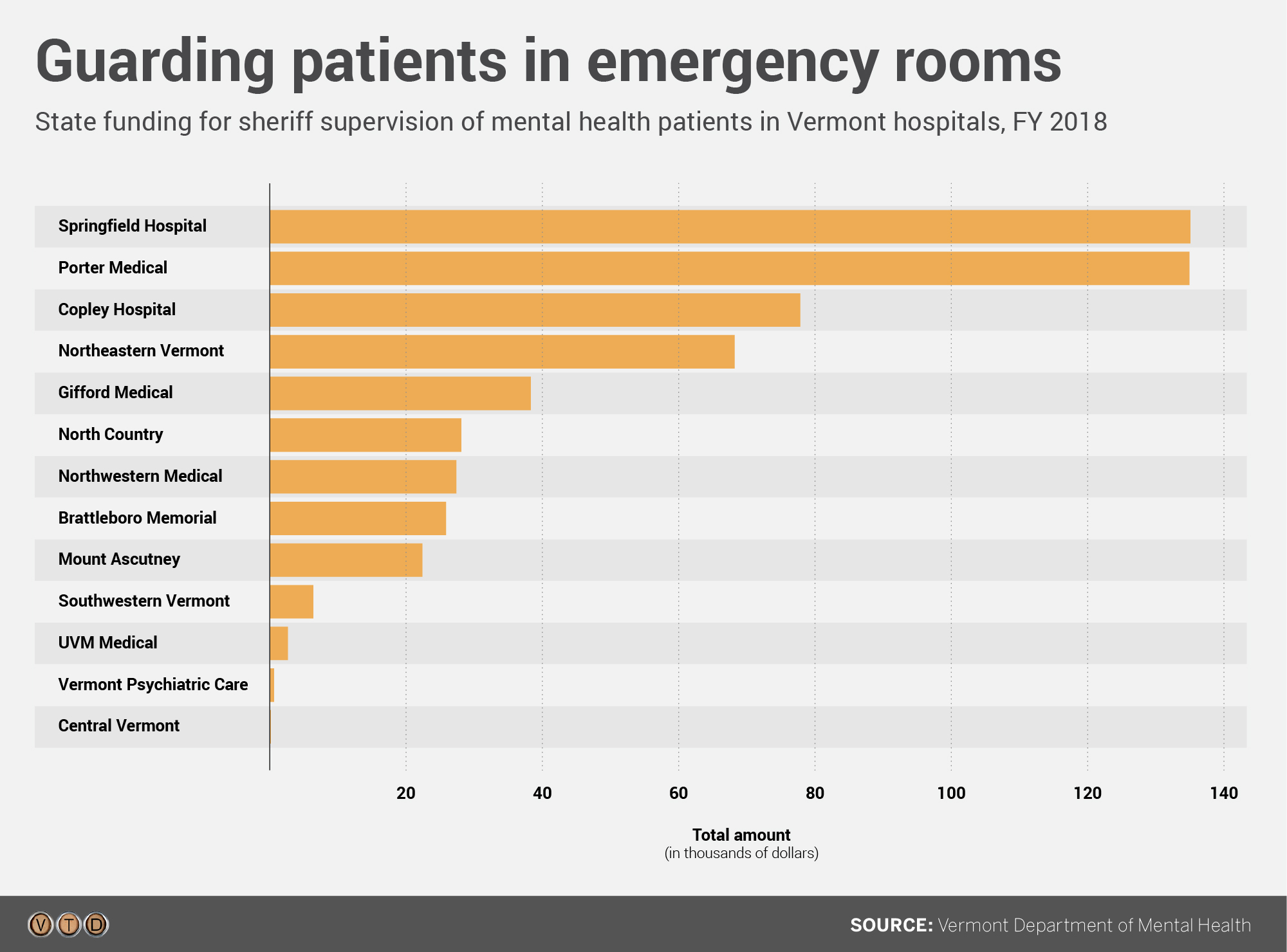
The report makes clear how often some hospitals have been using state-funded sheriff supervision. Total state funding for the service was $567,782 in fiscal 2018, and the biggest costs came at Springfield Hospital ($135,018) and Porter Medical Center in Middlebury ($134,925).
Other frequent utilizers were Copley Hospital ($77,839) and Northeastern Vermont Regional Hospital ($68,206).
Some hospitals, including Southwestern Vermont Medical Center, University of Vermont Medical Center and Central Vermont Medical Center, hardly accessed the sheriff’s funding at all. The report notes that “smaller critical access hospitals have a greater demand for external supervision resources than larger hospitals who are currently able to manage their staffing needs within their budgets.”
The report also shows how perilous the use of law enforcement in emergency rooms can be in a regulatory sense. Hospital staff – or contracted personnel who are trained and under supervision by medical professionals – are “the only people who can provide care and place hands on a patient,” the report says.
The document reiterates that “no law enforcement personnel can lay hands on an individual in a hospital unless they are in ‘protective custody’” – meaning someone who’s in the process of being arrested.
Those restrictions have gotten some hospitals in trouble, as law enforcement officers have used stun guns and handcuffs on mental health patients who were not in police custody.
On the other hand, proponents of sheriff supervision in hospitals say patients are rarely restrained. Lamoille County Sheriff Roger Marcoux, whose department handles most of the state’s hospital-supervision work, said federal regulations are too inflexible on the topic.
“The fact that the law enforcement official is there and helped deter a situation from happening, I think that has some merit,” Marcoux said.

Nevertheless, it seems clear that the state is moving away from the current system. The study group’s report makes no specific mention of sheriff’s deputies; instead, group members generally “agree that hospitals should have supervisory capacity in emergency departments and that they are required to provide this capacity per federal regulations.”
“Stakeholders also believe that the state has some responsibility to help support hospitals in building this capacity for people who are under the care and custody of the commissioner” of mental health, the report says.
The study group also concluded that “some security or other staffing would be beneficial” for smaller hospitals “in order to ensure the safety of patients and hospital staff.”
State support for hospitals to reach that goal could come in two ways – but only if the Legislature decides to allocate money.
One solution is a daily charge to the state for “any person who is under the care and custody” of the mental health commissioner and is waiting in a hospital emergency department for an inpatient psychiatric bed. Mental health officials have begun talking about this option with the Department of Vermont Health Access “to determine the optimal method” for that charge.
The state also could “distribute funds to specific hospitals via grants,” the report says. That money “could be one-time funds to help smaller hospitals grow their capacity around supervision,” officials wrote.
The Vermont Association of Hospitals and Health Systems has opposed the elimination of state support for sheriff supervision, especially for patients who “have the legal status of being in the care and custody of the commissioner of mental health and are not allowed to leave the hospital because they have that legal status,” said Devon Green, the association’s vice president of government relations.

Green was a member of the study group; she said the report’s conclusions “are a good start, and we’re happy to be engaged to work out further details.” Green noted that the vast majority of mental health-related emergency room visits have not required sheriff supervision.
At the same time, she acknowledged that there currently is no money in the fiscal 2020 budget either for sheriff supervision or for the proposals outlined in the new report. “It is a concern,” Green said. “So what we’ll be doing is talking to legislators and making sure they understand the situations our hospitals are in.”
For Marcoux’s department, the state’s changing policies may mark the end of an era. Utilizing retired law enforcement officers, Marcoux developed a specialized program for sheriff supervision in emergency rooms and said his department has “worked for every hospital in Vermont.”
“My thinking is that we’re about done,” Marcoux said.
While Marcoux served on the study group and understands the regulatory pressures hospitals face, he lamented the potential loss of personnel with “special skill” in handling difficult situations in hospitals.
“At the end of the day, police are still going to be called to go to the hospitals to deal with dangerous conditions, so they’re still going to emergency rooms,” he said.

