

[L]ess than three years after state officials concocted a plan to boost payments for ambulance services, emergency medical administrators say they’re still struggling to keep their doors open.
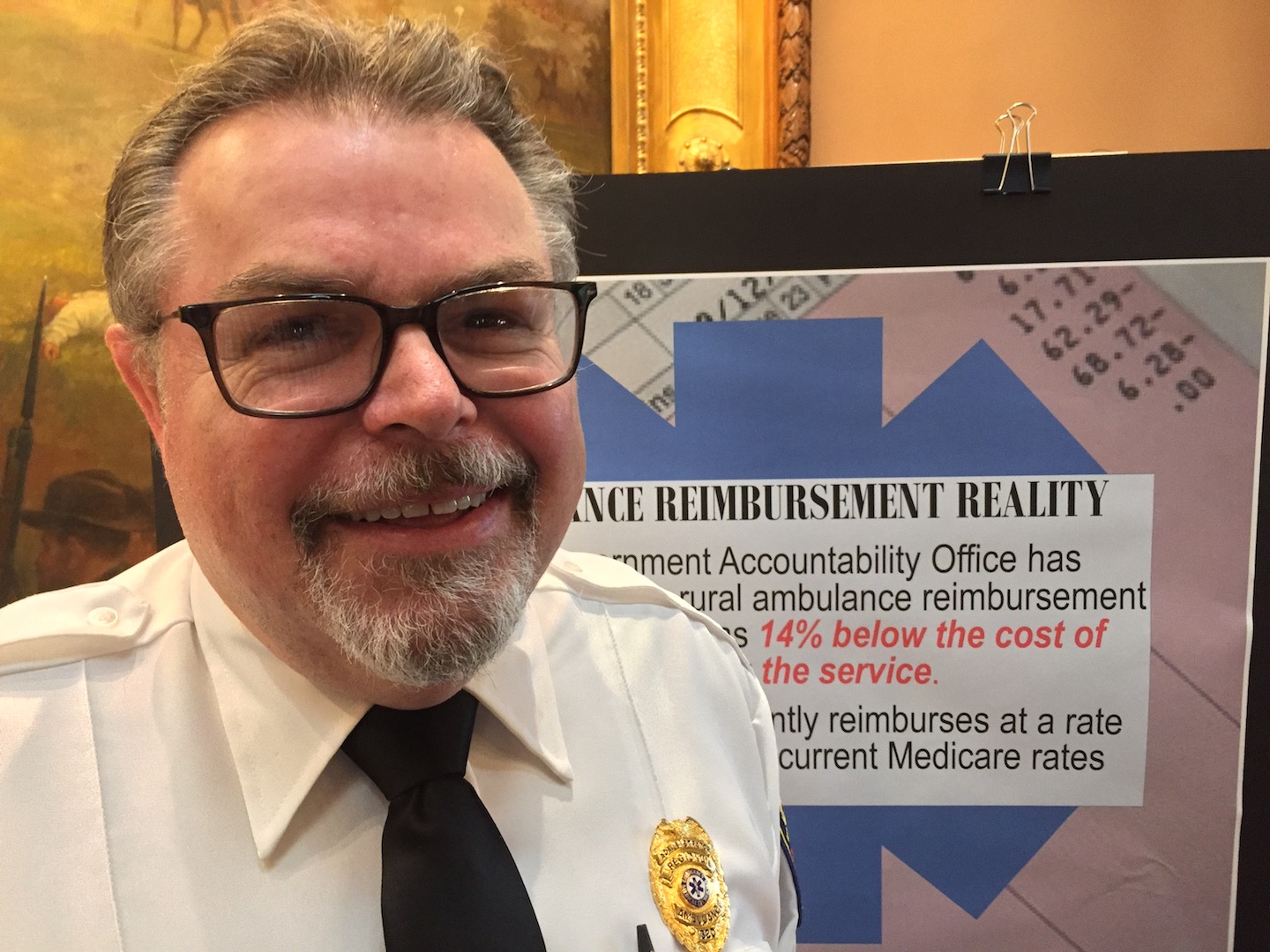
Leaders of ambulance organizations from across Vermont converged on the Statehouse Friday to talk about insurance reimbursement and workforce issues that continue to cause problems in the increasingly expensive business of emergency treatment and transport.
Those issues are affecting the ability of some services to respond to calls, or even to stay open.
“I am absolutely concerned,” said Drew Hazelton, operations chief at Brattleboro-based Rescue Inc. “I’m concerned about the fact that we have services that have closed and we have services that are on the verge of closing.”
Ambulance financial issues are not new, and some of the problem is due to the vagaries of the insurance reimbursement system.
For instance, emergency medical services are paid only for calls in which they transport a patient. If it turns out transport isn’t necessary or a patient refuses – even after being treated – there’s no compensation for the trip.
Nevertheless, there are fixed costs ambulance services are incurring at all times. “You have to have cost-readiness, whether you’re going to transport or not,” said Jim Finger, president of the Vermont Ambulance Association. “You have to have people 24 hours a day, you have to have trucks 24 hours a day.”
Reimbursement rates are a bigger issue. Officials say public insurers like Medicare and Medicaid don’t come close to covering the true costs of an ambulance run.
“We have three (federal) reports that say Medicare funding falls somewhere 10 and 18 percent short of the cost of doing business,” said Dan Batsie, emergency medical services chief at the state Department of Health. “The reason that’s significant is because Medicaid funding is based on that number.”

While state Medicaid rates are pegged to Medicare levels, they’re even lower – currently about 76 percent of what Medicare pays.
In response to emergency medical service advocates raising an alarm about their finances, the state Legislature in 2016 came up with a complex plan to tax ambulance services, draw down federal funding and boost Medicaid payments for ambulance services.
Hazelton, who serves as the ambulance association’s government affairs committee chair, said that solution worked for some services depending on the number of Medicaid patients they handled.
“There were winners that made more in additional revenue than the tax (they paid),” Hazelton said. “There were some cost-neutral departments. And there were some departments in the state that lost money.”
But there’s been no action since then to raise Medicaid rates, which have slipped in relation to costs. “So that number of winners and losers is starting to shift, because the tax is on your overall revenue, not on your Medicaid revenue,” Hazelton said.
Reimbursement issues, he added, are tied closely to workforce issues.
Vermont’s ambulance services are mostly evenly divided between all-volunteer outfits and organizations that are a mix of paid and volunteer staff. Only 4.1 percent of services are fully paid.
But volunteers are getting harder to find and keep. The Fairlee-based Upper Valley Ambulance Inc. is an all-paid service, and Executive Director Alan Beebe said “people don’t have time” to volunteer as they used to.
“It’s hard to get people to want to do it for free, that’s for sure,” Beebe said.
That’s in part due to increasing training and certification obligations. A December report from Vermont’s Emergency Medical Services Advisory Committee said that, while the state “takes direct responsibility” for police and firefighter training, the state’s funding for emergency medical licensure “can cover only rudimentary infrastructure costs and does not commonly impact student tuition.”
As a result, Hazelton said, “if you look at a volunteer EMS provider, often, they’ve got to reach in their pocket and pull out $700, $800, (or) $1,000 to pay for a class to then become a volunteer.”
Paramedic training is much more expensive. And there are ongoing recertification requirements for ambulance personnel.

“It’s clear that people have a passion for doing this … but it’s a lot,” said Mike Chiarella, operations director at Richmond Rescue Inc. “So I think if we were to be able to lower the cost of EMS training, that would be a great step forward.”
Richmond is still about 80 percent volunteer. But Chiarella said the organization has set up a reserve fund to save money for another paid staffer.
“We think, inevitably, we’re probably going to have to add a fourth full-time person,” he said.
Amid all of those pressures, call volumes are rising. The Emergency Medical Services Advisory Committee’s recent report noted a 6 percent year-to-year increase in calls statewide, and Hazelton said Rescue Inc.’s calls jumped by about 1,000 from 2017 to 2018 – and there are no signs that things are slowing down in 2019.
An aging population is one cause, officials say. Mental health needs and drug overdoses are other factors.
The combination of increased workload and a diminished workforce is having an impact on emergency response. The advisory committee’s report found that 79 percent of ambulance services reported inadequate staff, and 17 percent said they needed mutual aid help more than 10 percent of the time.
“What’s really concerning is that the number of mutual aid calls seems to be on the increase,” Hazelton said. “The number of times that the local community can’t support emergency medicine has increased, and the reliance on neighbors – out-of-town resources – to cover those calls.”
Friday’s Statehouse gathering was billed as educational. There are no EMS-specific bills moving in the Legislature, so ambulance officials weren’t making the rounds of legislative committees.
But they had several suggestions for action.
Batsie said tuition discounts could help ease the burden of emergency medical training. And Hazelton mentioned the possibility of steering workforce-development money toward ambulance services.
Hazelton also said that, as soon as the fiscal 2020 budget, lawmakers could insert money to boost Medicaid reimbursement rates. It would cost about $245,000, he said, to get those rates back to 80 percent of Medicare.
Batsie said he wants lawmakers, and the general public, to get a better understanding of “how difficult it is” to keep an ambulance service going.
“No one in EMS is averse to a struggle. After all, adversity is our business. We do our best when the situations are most difficult,” Batsie said. “But … a lot of this financial fight is a fight with one hand tied behind our backs.”


