

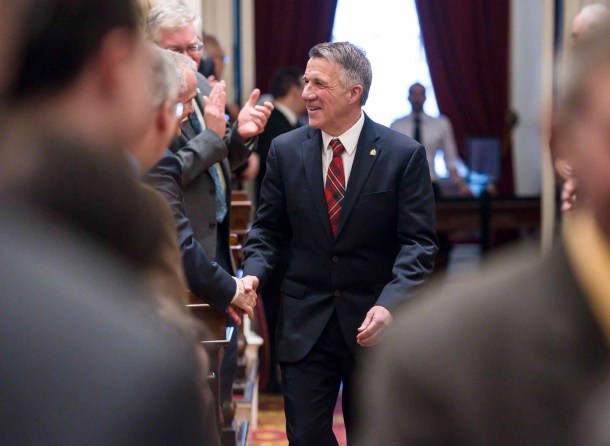
[G]ov. Phil Scott declined to dine with President Donald Trump and dozens of governors from around the country while in Washington, D.C., for a conference this weekend.
Scott was in Washington between Friday and Sunday for the National Governors Association’s winter meeting, which concluded Sunday evening with a dinner at the White House.
The governor, a consistent critic of Trump, said his decision not to have dinner with president wasn’t political, and that he had to fly home Sunday afternoon in anticipation of meetings with his staff Monday morning.
“If his travel plans were a bit different he would have gone,” Ethan Latour, the governor’s assistant director of policy and communications, said Monday.
Latour said that after spending the weekend in the capital, the governor felt he needed to return to Vermont.
“I think the governor felt like two days in DC was enough,” he said.
Scott was one of only 15 U.S. governors who weren’t at the dinner on Sunday, according to a White House guest list. He was one of four Republican governors who didn’t show up.
Scott’s GOP colleagues from New England, Govs. Chris Sununu, of New Hampshire and Charlie Baker of Massachusetts, were in attendance, as was Larry Hogan, a Republican from Maryland who is considering running against the president in a 2020 primary.
In January, Scott told reporters he would support a Republican primary challenge against Trump, though he said he didn’t have a preferred candidate.
The governor has previously attended National Governors Association’s winter meeting and in 2017, joined other governors in dining with Trump. But before that, Scott skipped Trump’s inauguration.
The meetings are opportunity for governors from around the country to meet one another, share policy ideas, and discuss regional initiatives, according to Latour.
During this year’s meeting, for example, Scott and fellow members of the Coalition of Northeastern Governors decided to join together in urging their congressional delegations to ratify U.S.-Mexico-Canada Agreement, a trade deal meant to replace the North American Free Trade Agreement (NAFTA).

