

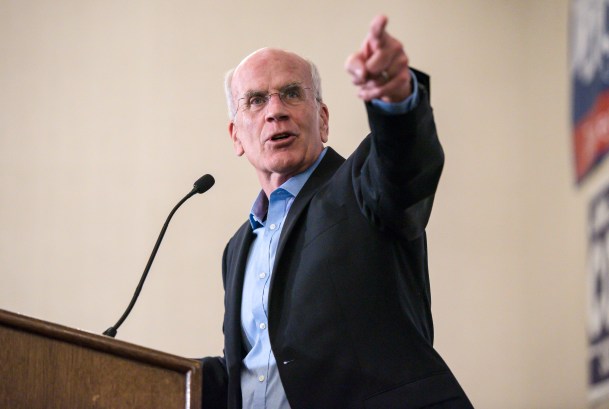
[R]ep. Peter Welch, D-Vt., said he was hoping for a speedy end to the government shutdown as he headed back to Washington, D.C., on Wednesday, but a fruitless meeting between President Donald Trump and Democratic leaders in the afternoon gave little reason for optimism.
Democrats are poised to take control of the House on Thursday and intend to promptly pass legislation to end the shutdown. However, the bills, which do not include funding for Trump’s border wall, would be dead in the Senate, where Majority Leader Mitch McConnell says he won’t vote on a proposal without presidential support.
Welch said in an interview that he hopes congressional leaders work independently from the president to ensure funding for the government.
“Frankly I hope that McConnell, Schumer, Ryan and Pelosi accept the Article I responsibility of being an independent branch of government and pass the budget,” Welch said, referring the top Republicans and Democrats in each chamber.
The risk of presidential veto, he added, should not stand in the way of sending legislation to his desk.
“That’s relinquishing the authority that we have,” Welch said. “We don’t work for Trump, we work for the people who elected us.”
The funding bill heading to the House floor is effectively the same as what Sens. Patrick Leahy, D-Vt., and Richard Shelby, R-Ala., drafted and passed with bipartisan support in the Senate days before the shutdown began.
“There’s a very simple solution here and we in the House will have the vote to reopen government and send it back to the Senate — which is basically the same bill that McConnell already passed,” Welch said.

The partial government shutdown, which has placed about 400,000 federal employees on unpaid leave, will enter its 13th day on Thursday.
Welch said 622 Vermonters who are federal employees have gone without pay since the shutdown took effect on Dec. 22. The heads of state agencies said the shutdown has had limited to no impact on government services in Vermont.
After meeting with the president Wednesday afternoon, Sen. Chuck Schumer, D-N.Y., the minority leader, said the Trump administration would not support the spending bills that Rep. Nancy Pelosi, D-Calif., intends to vote on Thursday, when she is expected to take the Speaker’s gavel in the House.
Speaking to the media, Schumer said the president is trying to leverage the situation so Democrats will give in to his demands.
“To use the shutdown as a hostage is wrong, and we would urge them respectfully to reconsider and support these bills,” Schumer said. “Open up the government as we continue to debate border security.”
The bills prepared by House Democrats include funding for most federal agencies through September and a stopgap spending bill to fund the Department of Homeland Security through Feb. 8. But the bills do not include $5 billion for a border wall that Trump is demanding.
Speaking to the media during his cabinet meeting earlier in the afternoon, the president stressed the need for a southern border wall and blamed the Democrats for the shutdown, which he previously said he would happily take credit for.
“We are in a shutdown because Democrats refuse to fund border security,” Trump said. “We need the wall.”
Trump criticized Democrats for being willing to appropriate funds for foreign aid but refusing to fund a border wall because of their dislike for him as a president. Other members of the Trump administration applauded the president’s stance.
Kirstjen Nielsen, secretary of Homeland Security, said the U.S. border security system is “overwhelmed” and that border agents “need a strong border wall system.”

Vice President Mike Pence said he was thankful the president was standing up against the Democrats. “You recognize that we have a crisis on our southern border,” he said.
Pelosi said Democratic leadership have offered Trump a way to reopen the government and continue the discussion on border security funding until February.
“We are giving him a Republican path to do that, why would he not do that?” Pelosi said.
Leahy sent a similar message to his Republican colleagues in a New Year’s Eve message, telling them that a refusal to act meant they shared responsibility for the problems facing federal employees.
“It’s time this stopped,” Leahy said in the statement. “The path forward is now clear, and I strongly encourage Senate Republicans to support and pass this bipartisan compromise.”
As the shutdown continues into Thursday, it will become the [third longest shutdown in U.S. history.] The longest shutdown was 21 days during former President Bill Clinton’s tenure in the White House and the second longest took place at the end of September 2013, lasting 16 days.
In Vermont, the federal government shutdown has not impacted any state services yet, but state officials say if the shutdown continues Vermonters may start to experience the effects.
Susanne Young, secretary of the state Agency of Administration, said that to date no state programs have been impacted by the shutdown, but did say some departments may be hindered by federal counterparts being closed.
“Most agencies have said they are good to operate for now as long as this isn’t protracted,” Young said.
Adam Silverman, spokesperson for the Vermont Department of Public Safety, said the impact of the partial federal shutdown on the Department of Public Safety and Vermont State Police operations has been “minimal to nonexistent.”

