

This story by Tommy Gardner was published by the News & Citizen.
[H]yde Park zoning officials have approved a homeless shelter in the village, after coming under scrutiny for how long it was taking to reach a decision and facing questions over the transparency of the process.
The board issued its written decision Wednesday evening, after more than a month in deliberative session. All three board members voted in favor.
“When I heard the news, I danced and sang the well-known Jewish song of Siman Tov U’Mazal Tov,” said Rabbi David Fainsilber, one of the many local church leaders who have, over the past year, rallied to help the homeless. “It was a big hoot and holler.”
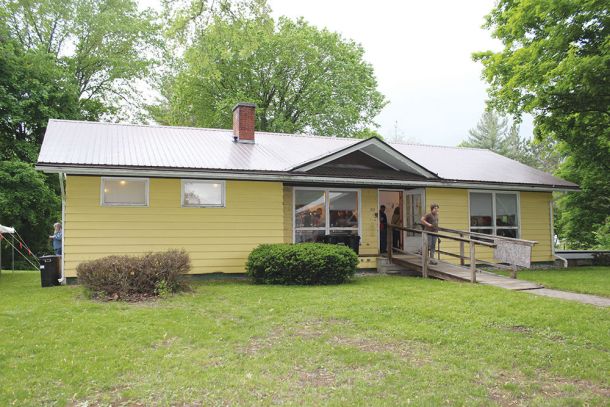
There is still a 30-day window to appeal the project to the state environmental court, so the yellow house located at 103 Main St. won’t be in use until Jan. 18 at the earliest.
In the interim, Lamoille County businessman Howard Manosh will continue to operate a temporary shelter out of his Plaza Hotel in Morrisville. Manosh and the organization that operates the shelter, Lamoille Community House, reached an agreement with the Morrisville town officials Monday.
Lamoille County Sheriff Roger Marcoux said Friday morning that he was grateful for the decision, after expressing frustration that the zoning permit he applied for in late September hadn’t been acted on, even as temperatures sank below zero on many nights in recent weeks.
“I like and understand the people on the (development review) board. They have other jobs,” Marcoux said. “I just think it was an especially difficult time because of the cold.”
The sheriff’s department owns the building, now known as Lamoille Community House. Marcoux opened it up midway through last winter in order to take the load off the trio of Lamoille County churches that had opened pop-up shelters in Stowe, Hyde Park and Johnson, and to provide a more stable, centralized place.
He applied for a zoning permit in late September, and the review board didn’t meet to go over the application until Nov. 15. The board had been in deliberative session between then and Wednesday night, when it gave its official approval.
An article about the homeless shelter in last week’s newspaper reported that review boards need to make their decisions in open session. According to Vermont law, though, that’s not the case. Deliberations and decisions can be made without any agenda or notes of what happened at the meeting, as long as a written decision is made public.
That decision was made public Wednesday night, Dec. 19. In addition to meeting Hyde Park village zoning regulations, such as landscaping and signs, the review board added some conditions that the shelter organizers have to follow:
• Hours of operation: 4:30 p.m., to 7 a.m., Monday through Friday. 4:30 p.m. to 8:30 a.m. Saturday and Sunday. These hours would run from Nov. 15 through April 15.
• Maximum nightly occupancy can’t exceed 14 people, which includes guests and volunteers and/or staff.
• In extreme weather such as flooding, hours of operation won’t be limited.
• Lamoille Community House is required to submit an annual statistical report to the review board at the end of each winter shelter season.
Shine a light
On Friday, the shortest day of the year, more than 40 people gathered for a candlelight vigil in front of the courthouse on Hyde Park village’s Main Street. The rain that had been steadily falling for more than 24 hours had stopped shortly before, and the gathered listened to faith leaders and sang “Imagine” by John Lennon.
Sherry Marcelino, a homeless advocate who works with Lamoille County Mental Health Services, said there has been an increase of awareness about local homelessness over the past year. And, in the past two weeks, the Hyde Park zoning office came under increased scrutiny over how long it was taking to take action on the homeless shelter, which Marcelino thinks may have played a role in getting the decision.
“They say there’s six degrees of separation in the world. There’s, like, two in Lamoille County,” Marcelino said. “So, chances are if you don’t have a story, your neighbor has a story or your relative has a story, and it’s easy to make that connection.”
Kylie Brown, a worker at Capstone Community Action, was the first volunteer the interfaith coalition had a year ago, when Father Rick Swanson opened his Stowe church as an emergency shelter, and has volunteered several times since. Brown said every person who comes to the shelter has a story, and when parents stay over with their kids, the youth “are chatty and they bring everybody to a better place.”
She said, contrary to concerns by some residents about “quote, unquote, junkies on the streets,” most guests get up in the morning and go to work or go to their various support services agencies. She said they don’t want to draw attention to themselves any more than naysayers don’t want them to come to their town.
“The folks you are so worried about have probably been living right here in Hyde Park village on the backside of the (Lamoille Valley) Rail Trail all summer and nobody knew they were there anyway,” Brown said. “They just want a nice meal and a warm shower, and put some dry socks on and face the next day somewhat better than they did when they came in.”
