

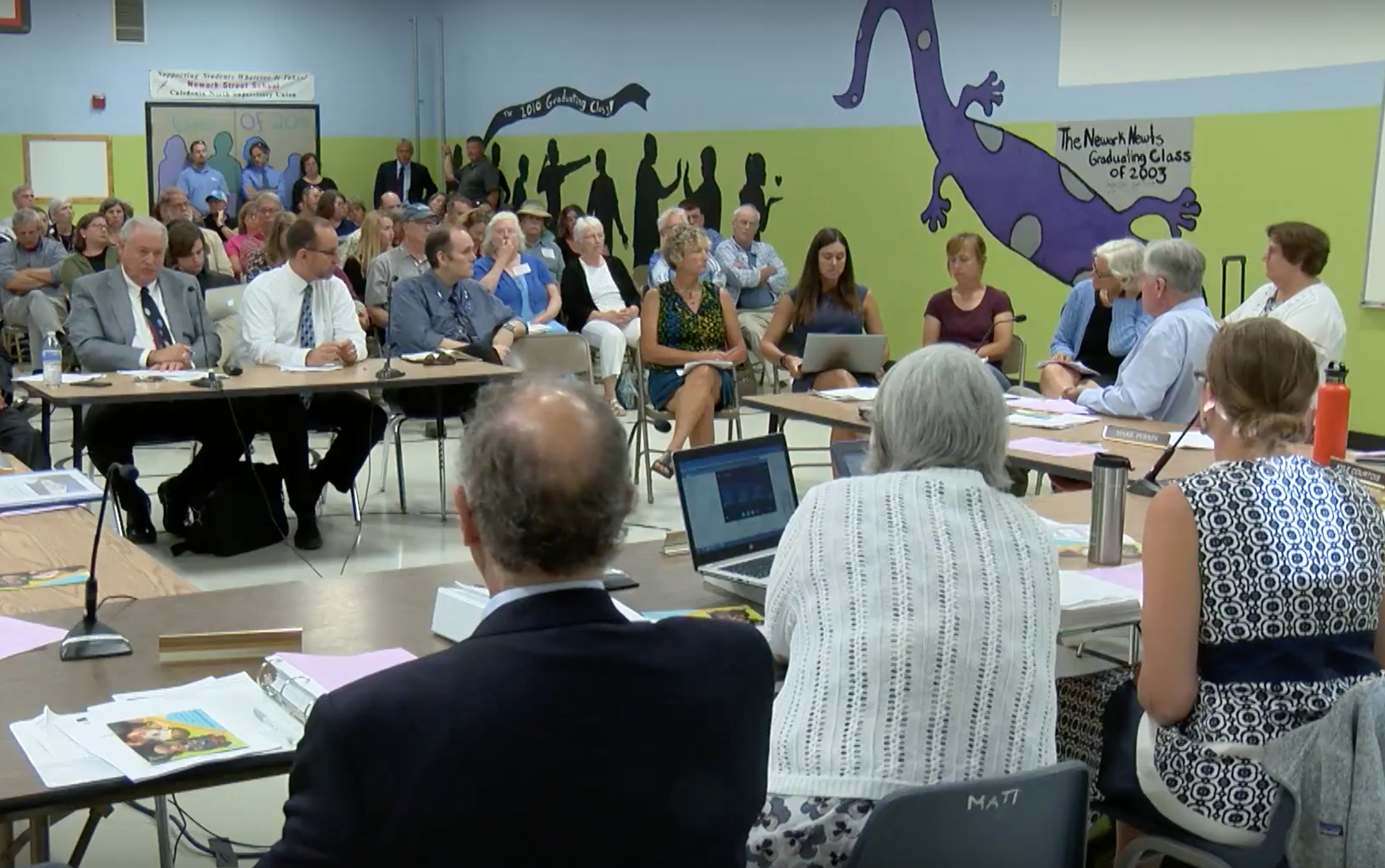
[I]sn’t anybody in favor of school district consolidation?
Not just the namby-pamby kind, where the local boards agree to merge with their neighbors. We’re talking here about consolidation for tough guys, where the locals object but the State Board of Education orders it anyway.
Isn’t anybody in favor of that?
Yes. It’s just that right now most are reluctant to say so.
Start with Gov. Phil Scott, who suggested the other day that the State Board of Education “has too much power” when it comes to forcing local school districts to merge.
“I think it should fall to the administration, to the secretary (of education), but that’s not something that’s going to change overnight,” Scott said.
No, it isn’t, perhaps because Education Secretary Dan French shows zero interest in seizing that power. According to Agency of Education spokesman Ted Fisher, French would prefer not to say anything at all about this forced consolidation business.

That’s because he’s for it, though he hasn’t come out and said so. Like the Legislature, the Agency of Education favors combining school districts. So does Scott. So do most school boards and school supervisors. So quite possibly (though there is no polling) do most Vermonters, which could help explain why so many districts have merged voluntarily.
Then how come this side of the debate has all but zipped its lip of late, abandoning the rhetorical field to opponents who assail the board’s latest ruling – and in some cases Act 46 which authorized it – as an affront to democracy, a usurpation of power, and an offense to what one opponent called “the ideals Vermont has always held dear”?
Perhaps because it could be all three.
Whether forced consolidation offends Vermont “ideals,” it surely defies the state’s self-created mythology, meaning not a fairytale, but a narrative that helps a society explain itself. In this case, it’s a narrative about the virtues of direct democracy, the wisdom of small towns, the devotion to local control.
So if the voters of, say, Irasburg, don’t want to merge into a larger central Orleans County district (and they don’t), that should be Irasburg’s choice. What kind of democracy would allow an unelected board to overrule them?
A representative democracy, where the board members were appointed by the elected governor, approved by elected senators, and used the authority granted them by statute enacted by elected legislators. That’s often how government is supposed to work in America.
Often does not mean always. But it’s worth noting that the argument over how decisions should be made and what level of government should make them goes back at least to the Articles of Confederation. Perhaps the board isn’t usurping power, just using it.
It may also be worth noting that local control is not perfect. Not that long ago, in another part of the country it meant, “don’t tell us how to deal with our African-Americans” (often expressed more crudely). In this part of the country it meant that the town overseer of the poor would publicize the names of everyone on public assistance, the better to humiliate them.
Progress often emanates from the central authority over the objections of the provinces. Remember, one definition of “provincial” is “narrow and self-centered.” There are times when one size does fit all, when Montpelier does know best, or at least better.
Not necessarily the case here. Almost everyone involved in this discussion agrees that the public school infrastructure as it existed a few years ago was unsustainable. As Jeff Francis of the Vermont Superintendents Association put it, “school population was going down and the institutions weren’t changing very much.” Per-pupil costs kept rising. The efficiency of the use of resources did not. Some consolidation seemed to make sense.
But Margaret MacLean of Peacham, an educator who was once on the Board of Education herself, may have a point when she said that while “mergers were obviously something to look at, there could have been a more targeted approach.”
Like other opponents of forced mergers, MacLean said she worries that consolidating districts could end up closing small, rural schools, including “schools that are not necessarily in decline.”
MacLean said she did not know whether this was what the Legislature intended. But a declaration by Vermonters for Schools and Community (MacLean is on its steering committee) warned that forced mergers would grant “power to larger, often richer schools to close small ones.”
Act 46 says nothing about closing schools. But that doesn’t mean nobody wants to close schools. Perhaps one of them is Gov. Scott, whose school spending proposals of last May called for a “better (meaning smaller) staff to student ratio,” which Secretary of Administration Susanne Young agreed “very well could” mean eliminating small schools.
There’s no mystery about why some officials dream about closing schools. That’s how to save money. William Mathis, one of the two board members to oppose the forced consolidation order, said, “if you want to save money, you have to reduce staff, which is 80 percent of school spending. District spending is only 4 percent, so even if you could cut it by 25 percent, you’d only have cut overall spending by 1 percent.”

That’s about $16 million in savings, not chicken feed, but not enough to cut anybody’s taxes, either. One goal of consolidation is saving money. The education agency says it is saving money and points to specific examples — $400,000 in Essex-Westford, $500,000 in the Northeast Kingdom. But agency spokesman Fisher acknowledged that the evidence is anecdotal, and said the agency does not even have a system to measure the potential savings.
Clearly, eliminating scores of high-salaried positions will save money over the years. Some of those savings might help small, rural schools survive.
“I think the fear being spread about closing small elementary schools is unfounded,” said Rep. David Sharpe, D-Bristol, the outgoing chair of the Education Committee. “The demographics of the state, the conditions of life in small rural communities, make sustaining those schools difficult. They’d be better able to survive as part of consolidated districts.”
Those demographics – lots of small schools burdening the state with whatever is the opposite of “economies of scale” – mean education in Vermont is always going to be expensive. But in the final analysis this dispute seems less about money than about community and how to define it. What is one’s community? The town? A larger region? The state?
Board member Mark Perrin of Middlebury, who has also served on his local school board, is one of the few who is not shy about being in favor of more consolidation.
“Districts have a lot of autonomy,” he said, sometimes too much, often with “a very narrow district perspective.” Local control, he said, can be “a code for micro-managing.”
District consolidation, Perrin said, “is not about closing schools. It is about starting to look at a little larger community, a community that’s not just for my town’s kids.”
Still fighting words in some precincts of Vermont.

