


Editor’s note: This commentary is by Andrew Nemethy, who is a longtime Vermont journalist and freelance writer. He lives in Calais.
[A]s a cold-fleeing denizen of the north, I was looking for a few sunny T-shirt days and lots of good food and a few Cervezas in San Miguel De Allende, Mexico, before six months of snowy submission: The last thing I expected on my plate was to witness one of the migrant caravans.
But some American friends in San Miguel, a mountain city in the central highlands that has a large expat community (and a fair number of Vermonters), asked if I wanted to help deliver care packages of food and supplies to the caravan. As a longtime journalist, it didn’t take much convincing, and I figured I’d get in some sightseeing along the way.
Witnessing one of the caravans, I got a lot more than I expected, traversing an emotional landscape that is hard to describe.
Vermont may be far from the turmoil and political dustup of the migrant caravans, but it turns out that there are Vermonters in San Miguel who have become involved in this complex, epic migration of peoples from El Salvador, Honduras and Guatemala, trekking thousands of miles to the U.S. border.
My friends chef Lee Duberman and Richard Fink, who ran the highly regarded Ariels Restaurant in Brookfield for around two decades, moved to San Miguel after vacationing there for years. They now own a B&B and through connections with other expats, had learned of two U.S. immigration lawyers working on migrant issues with the caravans, Charlene D’Cruz from Wisconsin and Nancy Arévalo from California. They offered to host them, and through that involvement and another expat in San Miguel who coordinated the legal response, Rebecca Eichler, they learned that one of the caravans was going to pass nearby. Feeling an urgency to help in some way, they culled names from Facebook and their Vermont restaurant email list and put out a call for donations.

Using PayPal, they amazingly, and quickly, raised more than $1,000.
Loading up shopping carts at a Walmartish center called Bodega Aurrera, they delivered an SUV of supplies in a city of about half a million called Irapuato. My daughter, who was also visiting before I arrived and went along on the trip, was deeply moved by the experience, especially by passing a caravan of flatbed trucks packed with migrants, exposed to the sun and wind and cool temperatures. Apparently, authorities eager to move the caravans along, I was told – in a sense to move the problem elsewhere – commandeer trucks and the migrants are shipped further north, out of sight and mind.
A few days later, another caravan – there are quite a few ongoing, it is hard to know just how many – was scheduled to stop at a stadium in Queretaro, about 90 minutes from San Miguel. Curious about the event, I agreed to help deliver more supplies and ride shotgun with my friend Richard Fink at the wheel. The Bodega Aurrera in San Miguel had been cleaned out of many supplies for the migrants by expats pitching in to help, so we endured several comical misadventures trying to use faulty GPS, only to find first a “Bodega Aurrera” in the booming city of Queretaro that did not exist and then an express version, which is like a 7-11 and not where you will find tarps, backpacks and other things we had been told the migrants could use.
Finally we found one, and loaded with tarps and hygiene supplies, nutrition bars, food, juices, backpacks, toothpaste and brushes, clothes, etc. we headed to the municipal stadium high on a hill. But there was a problem: A chain-link fence surrounded the stadium and the entrances were blocked and police were standing guard around the only entrance we could see.
Was it gringo privilege or kindness? Who knows, but we got in. Richard Fink’s Spanish was good enough to sweet talk a cop, who checked out our load of supplies, lifted a long steel pole gate, and let us drive past the police presence through the fence into the stadium grounds. All the Mexicans we met – police, civil authorities, etc. – were open to our efforts. There were already several American expats there who are deeply involved in the migrant caravan, and they had set up a feed and supplies station next to an old VW bus and a couple of SUVs. Again Vermonters were involved. Lori Greene, it turned out, had gone to Vermont Technical College and now lived in San Miguel with her daughter Aliya, whose Spanish was a godsend and whose smile and grace broke all barriers. The American expats helping there were mostly women, truly angels of grace, swept up in their cause.

We began unloading stuff as migrants streamed in, putting everything out there, giving special attention to women and children. They were orderly and grateful as they filed by the tables set up, largely men with some women and children mixed in. I was told the composition of the caravans is all different, and this one, according to one of the lawyers, had more economic migrants. The men were, mostly young, from what I saw, some quite healthy and chipper, others older and worn down. As Fink noted later from more detailed conversations he had, the reasons migrants flee are multiple and intertwined. If you can’t work because of gang extortion, is that an economic reason, or is it fleeing persecution and terror?
When I inquired (through interpreters) most said they were from Honduras and Guatemala. I was asked not to take pictures of faces of adults, because of fears they could be tracked down by gangs.
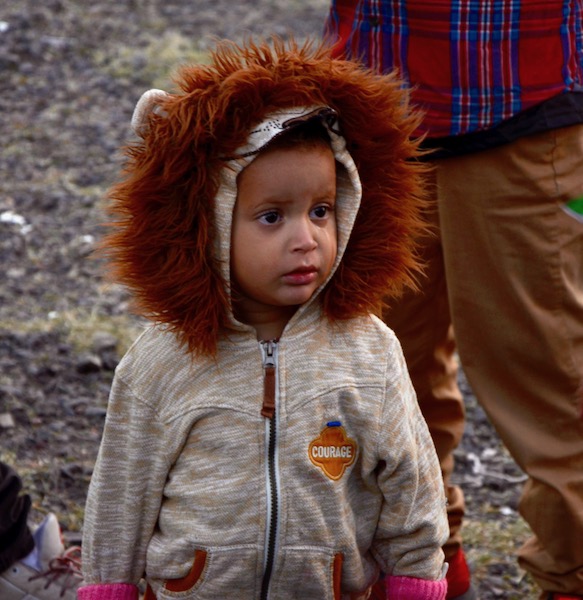
It was the migrant women and children that are seared into my eyes. Some of the kids were so chipper and bright, others quite frightened. Giving them a toy or chocolate milk or shoes or socks or jackets, such as the little girl in one of the photos I took, felt wonderful as a human, and yet, so entirely inadequate. The women were hard to read: Shy, reserved, cautious, scared, exhausted, probably all of that. Since I don’t speak Spanish, all I could do was try to look sympathetic. A few of the men fist bumped or thanked me for helping (which made me feel guilty since I was there entirely accidentally.)
We had planned to only stay a couple hours but Richard volunteered to go pick up a giant order of 300 tamales another helping couple had arranged for and vanished for well over an hour. I decided to go tour the stadium, where the migrants were on the outside concourse under the shelter of the concrete overhang, setting up tents or reclining on foam pads, which many seemed to have. I took pictures of barbed wire and stadium fencing, repurposed as clothes drying racks, hung with pants and shirts and underwear. It seemed symbolic.
This is where I encountered the strongest image, one I didn’t capture on film, feeling as if to shoot it would be a violation, and I was not in official journalism mode. I passed a young woman, her breast out, nursing a young baby. Her gaze seemed to be both piercing and vacant, if that is possible; I could not meet her eyes and moved on. What must someone trudging thousands of miles with a baby have faced? What could she, exposed and vulnerable, possibly think of some gringo with a camera walking past all this misery and hope. And what was it like to sit here, thousands of miles from home, thousands more to go. Passing back through I looked at her again, and smiled and nodded my head – and moved on. I see her face still.
And then suddenly, at the gate, a deluge. As dusk fell, a stream of people began arriving, hiking up the long hill along the chain-link fence, turning right and then through the gate to shelter by the stadium, past our mostly empty tables since we had given almost everything out, wandering in under the dim lights of the stadium grounds. That was a lousy feeling. The nights were in the 40s, and while many had pads and blankets, it would not be a comfortable sleep. There was no effort by the Mexican civil authorities to provide food, though a water truck did arrive. We left around 8 p.m. and migrants were still straggling into the stadium. How they decide where to go next, who organizes that, I have not a clue. There did seem to be some leaders, with two men being interviewed by a camera crew, one masked to protect his identity.
Witnessing this first-hand was an indelible experience that resonates personally. I am an immigrant myself. My parents fled into Austria after the Soviet invasion of Hungary in 1945 as World War II ended, and we almost ended up in Mexico before a quirk of fate got us a visa to America. Seeing the caravan, it brought back to me that I could have ended up speaking Spanish and living in Central or South America.I stood once at Checkpoint Charlie in Berlin before the Wall came down, and the idea of borders, fraught with national identity and ethnicity and politics and inclusion – and intense yearning – has long haunted me. That sense was reawakened again in Queretaro.
What did I take from seeing the migrants? That the simple act of helping others is at the core of being human, and a grace both in the giving and receiving. I felt it deeply, in witnessing and acknowledging this event, even in my paltry effort as mostly a helping bystander, and in seeing the wonderful Americans who have jumped in to assist, whether driven by kindness, a sense of moral service, or politics.
But beyond that immediacy I felt more helpless and as I told my daughter, I felt like I was “spitting into the wind.” It is the long game that we have to keep in mind, the slog of politics and law and educating people that will bring about change and a sane immigration policy that balances national borders and economic needs and our common humanity. What is happening in Tijuana shows we have a long way to go.
These two organizations were recommended by the lawyers as worthy sites to donate to help the migrants on this journey: alotrolado.org and latinamericanrelieffund.org

