


Editor’s note: This commentary is by Susan Green, a longtime, award-winning journalist who lives in Burlington. She’s also written books about Vermont’s Bread & Puppet Theater and the “Law & Order” television series. Her short stories have appeared in several literary journals.
“Yes, yes. The golden land.”
That’s what my paternal great-grandfather, Isrel Babushkin, said in Yiddish when his teenage daughter Bessie pointed to the Statue of Liberty as their ship pulled into the New York harbor. He probably knew of the Emma Lazarus poem inscribed on the monument and its reference to “the golden door.”
The recent awful events around the nation — fear-mongering about a migrant caravan, explosives targeting the president’s enemies, a synagogue massacre — have reminded me of my ancestors’ difficult journey toward an American dream. In these nightmarish moments, pundits keep saying, “We’re better than this.” I keep wondering if we really know our collective selves.
The golden door opened for the Babushkins during the early spring of 1908. From their Ukrainian hometown, Dobryanka, a horse-drawn cart had transported them to a different town, where they took a boat to a third town, followed by a second boat all the way to Liverpool, then the travelers boarded the SS St. Louis, enduring three weeks in crowded steerage class.
My family was fleeing a continuum of persecution. During a 1905 pogrom, for example, anti-Semitic peasants had been massing in advance of a raid on Dobryanka, where the Babushkins lived. But disaster was averted after the villagers paid a Russian policeman to tell the mob that the Jews had bombs.

“For three days and nights, we made fires and ate in the streets and were afraid to go to sleep,” Grandma Bessie said of that time.
Their scheme worked. The mob turned back.
At Ellis Island, the Babushkins gawked at the unfathomable sight of an immigration official chewing gum. “In Russia, only the cows had cuds,” Bessie would later say, laughing about their initial perspective on the New World.
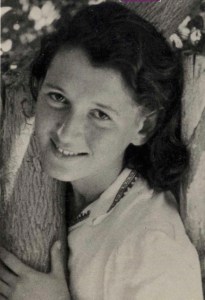
I’ve got a framed photograph of her, with long brown hair and a fringed shawl draped around her bare shoulders. She holds a small bouquet of roses. The picture, tinted pink on lips, cheeks and flowers, captures Bess forever in a moment of glowing girlhood.
Three decades later, relatives that had remained in the old country perished when the Holocaust wiped out millions of European Jews, Gypsies, “homosexuals” and disabled people.
Hitler’s “final solution,” following years of diminishing rights and violent attacks, also decimated some of my maternal kin in Poland. My mother had a book that enumerated all the Jewish residents and organizations in the shtetl (a ghetto) within her hometown of Goniadz. She periodically would read it and cry.
When the Nazis arrived, local Polish citizens that already hated their Jewish neighbors were encouraged to help kill those not transported to concentration camps. Their property was confiscated. The cemetery headstones of their loved ones were used to pave roads.
One of my mother’s first cousins, Bella Papiroff, had left Poland before the German invasion. She hoped to reach Palestine, then a British mandate, aboard the SS Parita.
In Marseille, the ship picked up 80 passengers, then headed to Romania on the Black Sea. An additional 600 people who had traveled from Warsaw to Romania in a sealed train, boarding the Parita along with a number of Romanian Jews.
It was to supposed be a 10-day journey to Cypress, where smaller boats could take them to Tel Aviv. But the ship sustained some damage and stopped in Turkey, where the passengers were not allowed to disembark.
When they finally arrived in Cyprus, the boats were not there to meet them. The Parita, running low on supplies, went to three different ports in Greece but were not welcome. Finally, after eight weeks of wandering, the diaspora decided to head directly to Palestine.
The Parita was purposely beached on the coast of Tel Aviv and the engines destroyed so that the refugees could not be turned away. Although the British authorities detained the weary newcomers at a military camp, they had found a home in the world.
Resettlement had not been as comforting for the Babushkins. Great-grandpa Isrel was a devout man who ate nothing but tomato herring for seven months. In the belief that there wasn’t enough kosher food in all the boroughs of New York, he and his wife Bosha went back to Dobryanka.
Their funds were insufficient to include Grandma Bessie on the return voyage. She sewed buttons in a downtown Manhattan clothing factory lit by gaslight for $9 a week, six of which were mailed to her parents in the Ukraine.
Bessie eventually married, raised two sons and doted on her grandchildren. To this day, I’d sell my soul for a taste of my grandmother’s matzobrei. Nobody else could ever whip up such magic with ordinary matzo and eggs. I imagine that the unwritten recipe, passed down through generations, was originally concocted in some remote Russian enclave before the advent of the Cyrillic alphabet.
Tomato herring, be damned! In a golden land going through dark times, matzobrei makes for a delicious heritage.

