

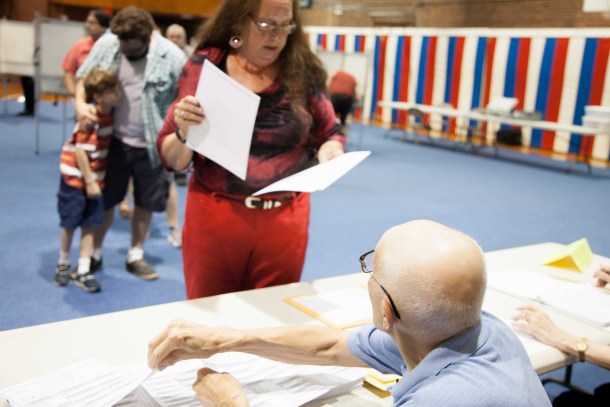
Find bios and issue stances for statewide, House and Senate candidates, plus incumbents’ roll call votes on gun restrictions, marijuana, the $15 minimum wage and paid leave with VTDigger’s 2018 Voter Guide.
For a rundown on how to register at the polls today, here’s what you need to know.
[T]uesday’s election will set the stage for the next two years of policy and politicking coming out of Montpelier, and it’s not just the governor’s race.
Even if Gov. Phil Scott wins a second term, which he is expected to do, a Democratic supermajority in the house could make his veto pen all but inconsequential.
And while Democrats are expected to keep a firm grip on the Senate, hotly contested races for open seats in Addison, Rutland and Franklin will send new faces to the state’s upper chamber — the question is from which party (or in Addison whether an independent ticket can win the day).
With voter registration in Vermont at an all-time high, and talk of a “blue wave” sweeping across the country in response to President Donald Trump, Democratic gubernatorial candidate Christine Hallquist and her party are going into election day with the attitude that anything is possible.

The governor’s race
On the top of the ticket, Vermonters will find the race for governor. Christine Hallquist, a Democrat and the former C.E.O. of the Vermont Electric Cooperative is challenging incumbent Gov. Phil Scott, a Republican. A handful of independents and third-party candidates are also on the ballot.
As the first openly transgender candidate to run for governor with major party backing, Hallquist’s candidacy has generated media buzz around the world. But Scott, a moderate Republican who is campaigning on his record of holding the line on tax increases, is widely considered to be the favorite in the race.
Hallquist is promising to enact many of the Democratic proposals that Scott has opposed during his first term as governor: a $15 minimum wage, a paid family leave program, and legislation to crack down on polluters. She has criticized the governor for focusing on “cost containment” and failing to make investments that would grow Vermont’s economy.
The cornerstone of Hallquist’s economic development plan is a proposal to bring internet connection to every home and business in the state. She also is pledging to offer free college in-state tuition to low and middle income students, and to create a Medicare-for-all system in Vermont as part of a coalition with other states.
Scott has criticized Hallquist for providing scant detail about how she would fund many of her new programs, and dodging the touchy subject of raising taxes to make it happen.
A poll released by VPR and Vermont PBS last month showed Scott with a double digit lead over Hallquist.

Lieutenant Governor’s race
Lt. Gov. David Zuckerman, a popular Progressive/Democrat, is seeking reelection and faces a challenge from outgoing Republican House minority leader Don Turner.
Turner is campaigning on a platform of affordability much like Scott’s: pledging to work to prevent tax increases and spur rural economic growth. Zuckerman has been a staunch advocate for raising the minimum wage, reducing the state’s dependence on fossil fuels, and cannabis reform. Zuckerman has championed a proposal to legalize a tax and regulate system for marijuana after lawmakers and the governor legalized recreational use of the drug.
While polls show Zuckerman has a strong lead over Turner, the Republican challenger has outraised his opponent. He has also benefited from spending from outside groups, including the National Association of Realtors, which poured thousands into advertisements for his campaign last month.
Watch the VTDigger lieutenant governor debate here.

Attorney General’s race
Incumbent Attorney General T.J. Donovan, a Democrat, is running for a second term against outgoing Republican House Rep. Jannsen Willhoit, a public defender from St. Johnsbury, who made a late decision to enter the race.
Willhoit says he would make the Vermont Attorney General’s office more transparent and go further than Donovan on issues of criminal justice reform. Donovan has fought to keep records about the state’s role in the EB-5 scandal out of the public domain.
A VPR-Vermont PBS poll from October showed Donovan with a nearly 40 point lead over Willhoit.
U.S. Congressional races
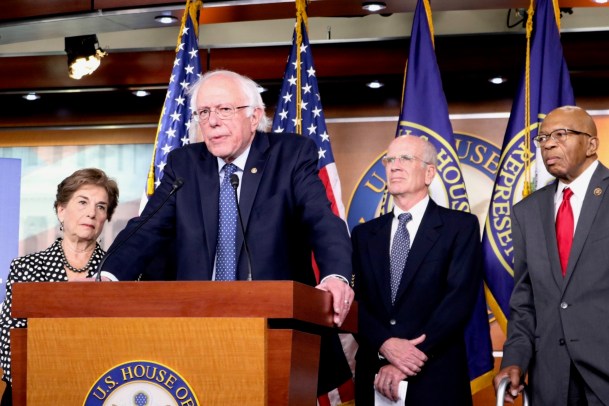
Sen. Bernie Sanders is back on the ballot and barring an earth-shattering upset, will almost certainly cruise to re-election on Tuesday. That’s not to say he isn’t facing challengers. Eight candidates are vying to unseat independent U.S. Sen. Bernie Sanders, including Lawrence Zupan, a Republican, and seven independent or third party candidates.
During a debate with Sanders, Zupan, a real estate agent from Manchester, criticized Sanders’ poor attendance in the Senate during his 2016 presidential run, and accused the sitting senator of “promoting socialism over American values.”
The VPR-Vermont PBS poll showed Sanders with a 41 point lead over Zupan.
Congressman Peter Welch will also likely coast to reelection on Tuesday against a field that includes Republican Anya Tynio, a 25-year-old sales rep for the Newport Daily News, and two independent and third-party candidates.
Tynio is a Second Amendment advocate who hopes to foster growth of Vermont’s agricultural sector and draw more young people to the state. She has never held public office and faces a steep climb to unseat Welch.
In a primary contest against Dan Freilich, a former military doctor, Welch came under fire for corporate contributions to his campaign.
Vermont House Races
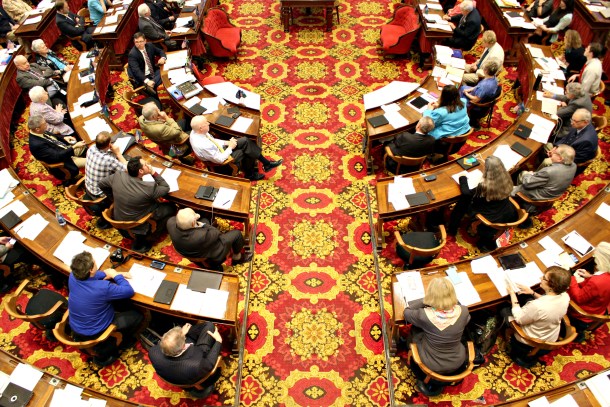
Republicans are hoping to keep enough seats to maintain their collective influence in the House, where 51 votes allows them to uphold the governor’s vetoes.
For the past two years, Republicans have held 53 seats in the House. The Democrats had 83 House seats this past session and had reliable support from seven Progressives and about six independents. If Dems can win 89 seats in this election, they could have, with these allies, a total of 102 votes.
At the end of this year’s legislative session, nine Republicans representatives announced they weren’t running for reelection, paving the way for new candidates on both sides of the aisle to step forward. Forty three-incumbent Democrats and/or Progressives in the House are running for their seats unopposed. Only nine Republican incumbents are running for reelection unchallenged.
In some of this year’s more high-profile House races, Democrats are running against entrenched Republican incumbents.
In Burlington, Democrats hope Robert Hooper, a well-known Chittenden County Democrat, will be able to muster the votes unseat Kurt Wright, the city council president and a longtime House member. Burlington Mayor Miro Weinberger, a Democrat, broke with his party to endorse Wright in that race.
In Stowe, Marina Meerburg, a small business owner and ski instructor is campaigning against 12-year Republican incumbent Heidi Scheuermann. And in a perennially close race in Tunbridge, incumbent Rep. David Ainsworth, a Republican, is up against John O’Brien, a Democrat.
Senate Races
Democrats had 23 out of 30 Senate seats in the last session and face little risk of losing absolute control of the chamber. However, a few open seats across the state have sparked hotly contested races.
In Addison County, two independents, a Republican, a libertarian and two Democrats, including Sen. Chris Bray, are competing for two seats, including one left vacant by Claire Ayer, a longtime Democratic leader in the Senate.
The path to the Senate for Ayer’s chosen successor, Ruth Hardy, became tougher after two independents joined the race this summer. Paul Ralston, the owner of Vermont Coffee Company, and Marie Audet, the owner of Blue Spruce Farm, are running as a ticket and together have outraised Hardy.
The independents have criticized the Democratic candidates for not taking strong enough stands on climate change and for poorly representing the agricultural community. Republican Peter Briggs is hoping to build on the 20 percent of the vote he won last time around, which put him only six points behind Bray.
Greg Cox, a vegetable farmer from Rutland, is hoping to break the Republican grip on the county after longtime senator Peg Flory, a Republican, retired. In Franklin County, outgoing Sen. Carolyn Branagan, a Republican, has endorsed Pam McCarthy, the Democratic candidate, against Republicans Sen. Randy Brock and Rep. Corey Parent, who is hoping to move from the House to the Senate.
And with all six incumbents on the ballot in Chittenden County, a young Republican is making a well-funded long-shot bid to snag a seat.
BALLOT INTIATIVES
Montpelier is voting today on a controversial $10.5 million parking garage and $13.4 million upgrade to the wastewater treatment system.
Burlington is considering a $30 million wastewater upgrade and a $70 million school construction project.
In South Burlington, voters will decide whether to approve a $21.8 million downtown project.
