


[C]ASTLETON – Greg Cox stood alone on a narrow patch of grass surrounded by pavement and stop-and-go traffic Wednesday afternoon.
The 67-year-old West Rutland vegetable farmer, wearing a thick sweater and worn pants, waved his green and white campaign sign at those passing by.
There was barely enough turf for a lawnmower, let alone one of his tractors. It was also a little too chilly for him to be short-sleeved in one of his trademark tie-dye T-shirts.
Cox, with his signature bushy hair and mustache, is well-known for his work in growing Rutland’s farmers market and agricultural economy, so much so he earned the award as the Rutland Region Chamber of Commerce Businessperson of the Year in 2016.
On Wednesday, Cox was letting motorists at the interchange of routes 4 and 30 in Castleton know he’s running for one of three state senate seats from Rutland County.
A busier and much more popular spot for state senate candidates to do a sign wave is about 20 minutes east, at the corners of routes 4 and 7 in Rutland City, the county’s most populous community by far.
However, Cox said he chose this location Wednesday on the advice of a past state senator from the county.
“Bill Carris told me about this spot,” Cox said, referring to the last Democrat to win a state senate seat from the Republican stronghold of Rutland County.
Cox then talked about how the vehicles flowing through the two highways had travelers heading to and from Castleton, Poultney and Fair Haven, as well as other points on the western side of the county, a constituency he hopes to tap into.
Carris, a three-term state senator, last won election to a state senate seat in 2012. He was the first Democrat to get a seat from the county after passage of the civil union bill in 2000, which saw backlash against the law’s backers in conservative areas across the state.

This past legislative session, three of the seven GOP members in the 30-person state Senate hailed from Rutland County.
Now, Cox, owner of Boardman Hill Farm in West Rutland and president of the board of Vermont Farmers Food Center in Rutland, is seeking to become the next senator with a “D” next to their name to represent the county in the Legislature’s upper chamber.
And, while there’s no polling data to backup the claims, some think he has a pretty good shot.
“He has signed on to be a Democrat, but honestly, he is more of an independent,” said Julian Fenn, chair of the county’s Democratic Party. “He has an agenda that appeals to people across parties.”
Illustrating Cox’s cross-party appeal, he was recently featured in a book on aging hippies in Vermont and feted by the region’s largest business group.
The Democrats didn’t even have a candidate for state senate on the primary ballot back in August.
Several factors appear to be at play that could help the party catch up after its slow start to the countywide campaign, not the least of which is only one incumbent left running in the three-seat race.
And even if a “blue wave” bolstering Democratic candidates in the wake of President Donald Trump’s election doesn’t occur, Fenn said just a small ripple could produce enough to send down ticket candidates over the top.
Cox is making his first run public office.
“Nobody really knows my politics,” he said. “I had Republicans trying to get me run to as a Republican. I had Dems and Progressives, also trying to get me to run.”
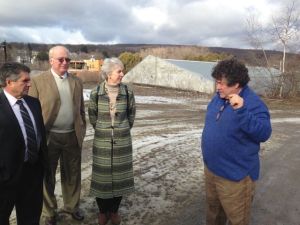
He started his campaign as an independent, but eventually agreed to run on both the Democratic and Progressive tickets.
“I was up front up with them. I told them, ‘I do not wear a team T-shirt, I am not representing a party,’” he said. “I really believe that parties are, in fact, one of the biggest, if not the biggest, problem in politics.”
Cox added, “I just want to represent people in Rutland County and break down some of that crap.”
He said he’s campaigning with a focus on small business, and further expanding Vermont’s agricultural economy and brand.
He talks of providing more incentives to Vermont-based startups and “emerging local companies,” while assessing impact fees to out-of-state franchises and multinational corporations, such as Starbucks, which recently announced plans to open a shop in Rutland.
The matchup
The Rutland County Senate race features six major party candidates vying for three seats. Only one incumbent is on the ballot — Republican Brian Collamore, a local radio personality running for his third term.
Another Republican incumbent, David Soucy of Killington, was running his first countywide race as a sitting state senator following his appointment to the post by Gov. Phil Scott last year.
Soucy filled a seat vacated when former state Sen. Kevin Mullin was tapped by the governor to be chair of the Green Mountain Care Board. Soucy finished last in a five-person GOP primary in August.
Another GOP incumbent, Peg Flory, did not seek re-election.
Former Rutland Town state representative James McNeil, a downtown Rutland businessman, and Ed Larson, a retired member of the Rutland Police Department and past city alderman, earned the party’s two other spots on the general election ballot.

Larson, though, had to survive a recount to confirm his win over Terry Williams, a Poultney Selectboard member, by five votes in the GOP primary.
On the Democratic side, the primary was much more of a snoozer. However, the party emerged with three candidates thanks to write-in campaigns.
Those candidates included Cox, who initially planned to run as an independent; Cheryl Hooker, a former member of the both the state House and Senate, as well as a past member of the city Board of Aldermen; and Scott Garren, former chair of the Rutland County Democratic Party, who also ran for a state Senate seat in 2016
That same slate of candidates won write-in campaigns in the primary on the Progressive Party ticket, and each will be running with a “P” and a “D” next to their names on Nov. 6.
Fenn, the county’s Democratic Party chair, admitted the party was left “scrambling a little bit” ahead of the primary, leaving “some folks saying that we were unorganized.” He said a couple promising candidates opted against running for various reasons.
“When it came time to get the work done,” Fenn said, “we got it done.”

And, he’s hopeful with Cox opting to run as a Democrat, the party will be sending its first member to the state Senate in years.
“If I had to bet the farm on it, I think that we will probably take one of those three seats, and Brian Collamore and Jim McNeil will take the other two,” Fenn said. “Maybe we can take two of three, but that’s pretty ambitious … a lot of it is going to come down to turnout.”
Fenn said with people on all sides of the political spectrum energized over national events and Trump’s election two years ago, he expected more people to be heading to the polls this midterm election cycle than in a typical one.
“It does look like that we’re going to have a little bit of a — I’m not going to say a blue wave like some folks have been saying — but I think we’re certainly going to see some increased turnout,” he said, “and I think that’s going to be advantageous for us.”
When voter turnout increases, Fenn added, “it tends to skew to blue because it tends to be young people that are coming in and voting for the first time.”
Look back
Two years ago, Democrats were hopeful that Korrine Rodrigue, a public health researcher who had a well-organized campaign, was going to take one of the three county senate seats.
However, she finished fifth in the race.
In that contest, Flory topped the field with 14,782 votes, followed by Mullin with 14,191 votes and Collamore with 13,680.
Left out of the running were Hooker, a Democrat who is running again this year, with 10,641 votes, and fellow Democrats Rodrigue, with 9,212 votes, and Garren, also running this year, with 6,428 votes.
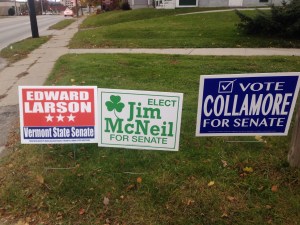
Collamore said this week he’s hopeful Rutland County will again send three GOPs state senators to Montpelier.
“Rutland is sort of one of the few remaining conservative-leaning counties in the state,” he said. “I think we represent people well in this area because I do think the great majority of people in the area tend to lean in that conservative way.”
Those three county seats, combined with possible pickups of senate seats in other parts of the state, Collamore said, could go a long way to helping the chamber’s minority party get 11 seats, enough to sustain a governor’s veto, though he admits that may be a bit of longshot.
Predictions on how the race will shake out in Rutland County, he said, depends on who you ask.
“There would be some people that would tell me that they feel the Republicans will be fine and that we’ll hold the three seats,” Collamore said. “If I talk to some other folks, they’ll say that Greg Cox is certainly going to get some of his share of the votes.”
Rich Clark, a political science professor at Castleton University and the former director of the Castleton Polling Institute, said this week that he’s not aware of any polling done on state senate races in Vermont.
However, he said, national polls are suggesting greater turnout than typical for midterm elections, and there are highly motivated voters in both Republican and Democratic parties.
And with Rutland County a heavy Republican part of the state, Clark said, higher turnout could mean more Republicans heading to the polls.
But, ticket-splitting, or a voters casting ballots for candidates of different parties, he added, occurs quite a bit in Vermont.

“We’ve seen it in the past and we’re going to see crossing party lines in top ticket races,” he said, pointing out polls predict Republican Scott winning re-election while showing more liberal candidates like Sen. Bernie Sanders, I-Vermont, and Rep. Peter Welch, D-Vermont, cruising to victories.
“Vermonters are apt to cross tickets,” Clark said. “Whether Rutland (County) is going to follow suit, I’m not sure.”
One thing Clark said he is sure about is that incumbents get re-elected at a high rate. With only one candidate in the Rutland County state senate field seeking reelection, the party out of power has a chance to make up ground.
“It’s a better opportunity than they normally would have,” Clark said.
Collamore, a morning talk radio host on the local station WSYB in Rutland, has been out of the studio this election cycle.
That’s because, he said, federal equal access rules require the station to provide the same amount air time to the other candidates as he would have as a member of that show.
And with five competitors, Collamore said, that wasn’t even an option.
He said in the meantime he’s been selling advertisement for the station, and hopes to be back on the morning show after the election.
All signs point to Collamore returning to the Statehouse in January. By late Tuesday, he’ll know whether Cox will be joining him.
