

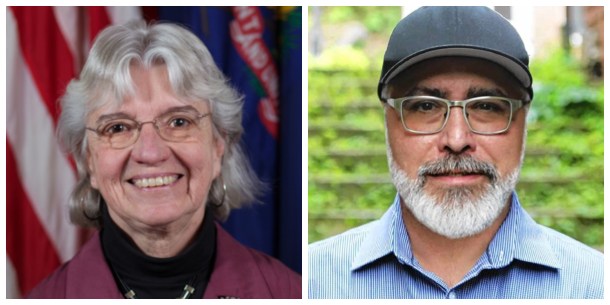
[B]ETHEL — Republican Robert McFadden, of Stockbridge, and state Rep. Sandy Haas, P-Rochester, both grew up and were educated far from Vermont but long ago moved to the Green Mountain State and made it their home.
That’s about all they have in common.
The race for the Windsor-Rutland seat in the Vermont House, representing Bethel, Rochester, Stockbridge and Pittsfield, is between a veteran Progressive lawmaker seeking her eighth term and a Republican challenger who wants to see Vermont take the lead in cultivating the marijuana market on the East Coast.
McFadden, 42, a regional salesman with Timken Aerospace, lives in the village of Gaysville. Haas, 72, was born in California, graduated from the University of California-Berkeley and its law school, and decades ago moved to Rochester, where she practiced law and co-owned a bed-and-breakfast. She first was elected to the House in 2004.
McFadden said he hadn’t been thinking about a run for office until he was approached by GOP party members asking if he would support a write-in campaign on his behalf. He did — and received 31 write-in votes.
“I didn’t really have any political aspirations,” McFadden said. “One of the (Republican) guys came up and said, ‘We really need someone to run.’ I said, ‘I’m not a Republican.’ They said, ‘Well, you don’t have to be.’ ”
“I’m real active in the community and I care about it,” McFadden said, citing his involvement in the now-defunct Tweed River Music Festival and recovery work in the aftermath of Tropical Storm Irene. “I think that’s why they called me. It was hard to say no.”
McFadden, who grew up in Ohio and attended the University of Toledo before moving to Vermont in 1994, considers himself “one of those fiercely independent Vermonters.”
“I’m more moderate,” he said, noting that he wants to counter the hyper-partisanship he has seen coloring the country nationally and now making its way into the small towns of his district.
Regulating and Taxing Marijuana
When it comes to regulating and taxing recreational marijuana, McFadden is unequivocal where he stands.
“The state is screaming for money,” he said. “And our kids are leaving and there are no good jobs.” A regulated marijuana market in Vermont, he said, “could bring so many good-paying jobs instantly.”
McFadden likens marijuana to the craft beer and maple syrup for which the state is known. “Craft consumables is our brand. It’s what Vermont does well. … I’m a sales guy, so I’m always looking for an opportunity,” he said.
Haas, who ran a bed-and-breakfast and practiced law in Vermont until she entered the Legislature, said that her legal background makes her “really care about the content of bills.”
Haas said she “supports the concept” of taxing and regulating marijuana and has voted for liberalizing state laws, but “once again, details matter.”
“I’ll be looking to see what the structure is in terms of quality control,” Haas said, noting that there still are unknowns about how marijuana affects brain development.
Moreover, while Haas said a marijuana tax could provide revenue, it is critical that the state not be overly aggressive and end up pushing consumers to unregulated suppliers.
“I want to see us completely (eliminate) the black market in cannabis,” she said, explaining that someone who utilizes a dealer also is in danger of being exposed to other drugs, including narcotics.
Carbon Tax
Haas said the debate over a so-called carbon tax often is oversimplified and doesn’t by itself speak to the real issue of reducing carbon emissions, which she said is critical.
“I am a lawyer and really care about the content of bills, and I have not seen anything in writing I thought was ready for prime time,” Haas said.
Saying she would give serious consideration to any bill that made it through “the rigorous” committee process, she said that it nonetheless is “tricky to operate as a single state” in terms of assigning a price to carbon. She prefers a regional approach.
McFadden is opposed to any sort of carbon tax.
“I know a lot of friends around here working two to three jobs,” McFadden said. “The idea to penalize them for how they heat their home and what car they drive is foreign to me. … I’m not blind to the issue of global warming at all. I just don’t think a carbon tax is the way of going about addressing it for our (small) population.”
Gun Restrictions
McFadden isn’t happy with Republican Gov. Phil Scott’s April signing of legislation that expanded background checks, banned bump stocks, limited the capacity of magazines and now requires people under 21 to take a safety course before they can purchase a gun.
“I don’t know why the governor would mess with the Second Amendment,” he said. “I think it was a misstep. … If I was living in Chicago, maybe I’d have a different point of view on this.”
Haas voted for all three measures and applauds Scott’s “courage.”
“I recognize that there is probably no law that can completely eliminate the possibility of a mass shooting,” Haas said. “But I think several of the provisions we adopted on gun stocks and magazine size will reduce the carnage if someone gets past security. If someone is in an active shooter situation and the shooter has to change a magazine, that’s also time for someone to get out.”
Haas said she isn’t worried her position puts her at odds with some voters in her rural district.
“My constituents in general supported the (gun restrictions) bill,” she said. “You hear from those who don’t, but it’s a small number.”
Act 46
Haas did not support the state’s school consolidation plan and said she still is evaluating its effects.
“I voted against Act 46,” she said. “That said, it’s now the law.”
She noted that all the towns that were affected in her district have complied with the plan “in one way or another,” noting that Rochester closed its middle and high school and Bethel closed its high school after voters decided in favor of consolidation.
Bethel merged with Royalton, and Rochester now tuitions its students.
All three towns maintained their elementary schools.
“I’m sad,” Haas said. “It’s a cost to the community when you lose that glue.”
McFadden said he hasn’t noticed many drawbacks from consolidation and to some extent likes the “school choice part” that tuitioning affords parents.
“There’s not a high school in my district anymore,” McFadden said. “That hurts the labor force. But there are not kids here anymore. I don’t know if they could have come up with anything different.”
“There is nothing I can do about Act 46 now,” McFadden said. But when it comes to funding rural schools with diminishing student populations, “that’s where the cannabis tax can help us all,” he said.
