

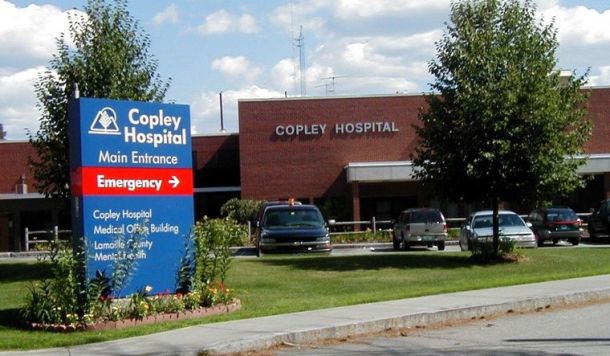
[S]tate regulators say they’re worried about the financial health of Copley Hospital, especially if patient numbers continue to decline and expenses continue to rise at the 25-bed facility in Morrisville.
At the same time, the Green Mountain Care Board, the state’s health care regulator, has slashed the hospital’s requested revenue increases for the fiscal year that began Oct. 1. Officials say Copley must focus more on reducing its costs.
Copley’s final numbers aren’t yet tallied for fiscal year 2018, but administrators have projected a $2.2 million operating loss. It will be the third consecutive year of operating deficits at the hospital.
Art Mathisen, the hospital’s chief executive officer, said he’s not surprised by the care board’s concern. But he believes Copley is on a path to sustainability, and he said administrators have gone “back to the drawing board” to further pare down the hospital’s spending plan.
“We certainly want to be part of bending the (health care) cost curve,” Mathisen said. “We’re working towards that, and we continue to, almost on a daily basis, talk about how we manage costs appropriately but also provide high quality, safe patient care.”
Green Mountain Care Board members arrived at final decisions last month on fiscal 2019 budgets for Vermont’s 14 hospitals. The majority of those hospitals had their budgets modified in some way, but the care board’s action on Copley’s budget was particularly severe.
In an order dated Sept. 28, the board said Copley’s net patient revenues should grow by 3.2 percent this fiscal year – to $70.2 million in total — a sharp decrease from the 5.9 percent growth the hospital had proposed.
Board members also sliced the hospital’s requested rates – the amounts charged to insurers. Copley had asked for a 7.9 percent increase, which was the biggest such request from any hospital; the board instead opted for a 4.5 percent increase.

In their budget order, care board members wrote that they are “concerned that the hospital is relying too much on commercial rate increases to address budgetary challenges and resolve ongoing financial concerns.” Copley leaders should be “considering other business changes, such as finding additional expense reductions and implementing operational efficiencies, to achieve a positive margin,” the order says.
The board added a warning about Copley’s future: “We are concerned about the hospital’s sustainability if utilization continues to decline and expenses continue to exceed (patient revenue).”
Copley administrators don’t deny the hospital’s recent struggles. In explaining the 2018 losses, the hospital cited “a significant and unforeseen change” in patient utilization, resulting in below-budget revenue.
On a related note, Copley has struggled with a problem common throughout Vermont – a chronic workforce shortage that increases reliance on expensive temporary staffing.
The hospital recently added a new general surgeon, Dr. Courtney Olmsted. That will help boost revenues, but Mathisen noted that the search for a general surgeon had taken several years.
Copley also has been dealing with steep cost increases. That includes a big jump in pharmaceutical prices as well as rising costs for orthopedic implants.
“More than half of our surgeries are orthopedic, and a great deal of those surgeries are total joint surgeries,” Mathisen said.
Hospital administrators point to another significant financial pressure: Prior to Copley’s approved rate increase for fiscal 2019, the hospital’s rates had been reduced by a total of 11 percent over three years.

Copley’s 2019 budget – as initially proposed by the hospital – was designed to combat and reverse those trends by producing nearly $1.5 million in operating surplus.
The care board’s budget order dramatically changes that scenario. The hospital’s patient revenues were lowered by about $1.8 million, which would have resulted in a net operating loss if Copley’s expenditures had stayed the same.
But Mathisen said Copley has further whittled down its fiscal 2019 budget in the wake of the care board’s order. While cautioning that “hospital budgets are very dynamic” with “many moving pieces,” the revised plan projects a $230,000 operating surplus in fiscal 2019 – a margin of about 0.3 percent.
He said hospital managers were asked to take “one last look at their budgets to see if there were any expense reductions that we would achieve.” One cost-cutting strategy, he said, is a decision to leave several administrative positions unfilled.
Another example is an ongoing, initially successful effort to curtail repeat usage of the hospital’s emergency room. And Copley leaders also are keeping close tabs on their capital budget, asking managers to justify “why they need an item now versus later – or at all,” Mathisen said.
That cost-reduction effort is ongoing and predates the care board’s order, Mathisen said. Copley has a goal to cut $3 million in expenses and is about 61 percent of the way there.
“To cut over $1.5 million over two fiscal years is pretty significant for a small hospital,” he said.
Additionally, Copley is attempting to maximize the efficiency of its new surgical center. Mathisen said the idea is to “treat every second and minute and hour … like they’re gold.”
Hospital administrators also see collaborations as another way to boost efficiency.
On Tuesday, Copley announced the expansion of a telemedicine agreement with Dartmouth-Hitchcock Connected Care. That will bring the New Hampshire-based health network’s specialists in nephrology (kidney care) and pulmonology to Copley via live, two-way, secure video connections.
Copley already had Dartmouth-Hitchcock telemedicine service for rheumatology. A second rheumatology provider will be added as part of the newly expanded agreement.
Telemedicine is another way of “meeting our mission of providing high quality care to our patients,” Mathisen said. “We’re really excited to be working with them on bringing in certain specialties where we wouldn’t probably hire someone (full-time) to come in here, because we don’t have the demand.”

