Editor’s note: Mark Bushnell is a Vermont journalist and historian. He is the author of “Hidden History of Vermont” and “It Happened in Vermont.”
[T]he numbers didn’t look good. During the 1850s Vermont’s population grew by only .3 percent. That was an increase of only 978 people, if you are keeping track. In comparison, the U.S. population increased by nearly 36 percent during that period.
The imbalance was enough to give Vermonters an inferiority complex. While the rest of the country was booming, Vermonters saw their state becoming a backwater.
People were still moving to the state, but many native-born Vermonters were leaving. Many headed to the Midwest, where farmland was cheaper and more productive. Others moved to California in hopes of cashing in during the gold-mining mania. And many more moved to southern New England, where expanding industries needed workers. Vermont agriculture, the state’s main industry, could do little to attract people to the state.
Vermont’s political and business leaders feared that time was passing the state by. They initially believed that railroads, which arrived here in the late 1840s, would help Vermont farms flourish. Railroads greatly cut transport time and costs and made it possible to get goods to urban markets throughout the Northeast. But of course trains also connected Midwestern farms with those markets, and Vermont farms found they couldn’t compete.
If Vermonters were abandoning hill farms, the state’s leaders believed, perhaps others could be persuaded to take their places. The Board of Agriculture began marketing the state to Swedish immigrants by printing maps, in both English and Swedish, showing where farms were for sale. In the end, the initiative only attracted 23 families to Vermont. While the board was recruiting Swedes, longstanding prejudice prevented it from appealing to the region’s many French-Canadians.
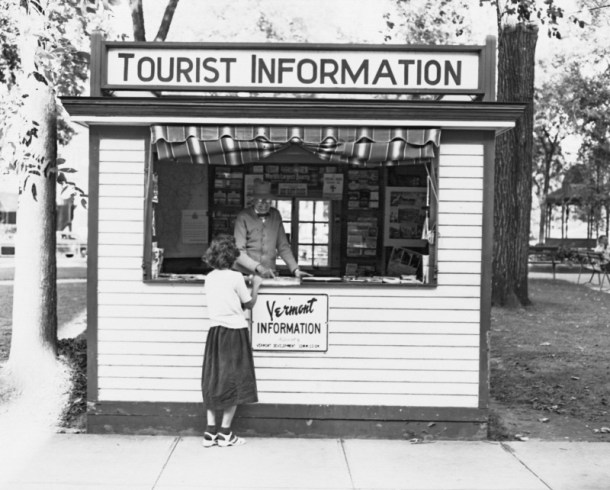
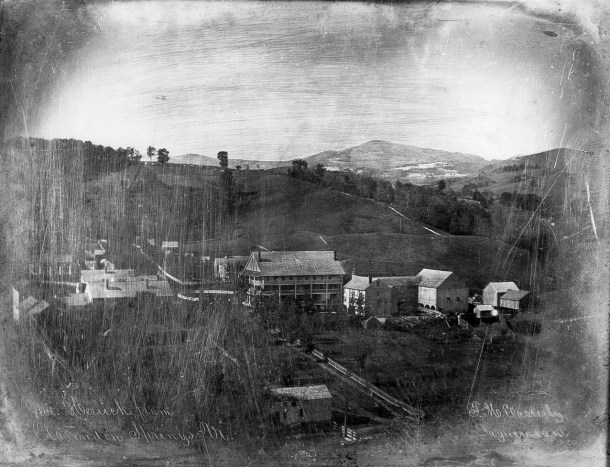
The state also tried to attract another kind of visitor — tourists. Vermont’s first tourism boom came thanks to the spa industry, which attracted visitors for the supposedly curative powers of the state’s mineral springs. The water-cure industry peaked in the mid-1800s, when more than 20 hotels catered to people seeking cures. Towns across the state appended the word “Springs” to their names as a marketing ploy to attract visitors. The era gave us Middletown Springs, Sheldon Springs, Clarendon Springs, Highgate Springs, among others.
But for tourism, Vermont couldn’t compete with New Hampshire, whose White Mountains had become a fashionable destination. The lofty and wild White Mountains were considered “sublime,” or awe inspiring, a quality that tourists sought during the 1800s. New Hampshire’s vast and rugged landscape could give people a spiritual experience, providing them an understanding of the grandeur of creation and a thrill from pondering the comparative insignificance of humankind. Vermont, with its rolling hills, patchwork agricultural landscape and small villages, couldn’t compete. (Of course, for later generations, those same qualities would bring millions of visitors to the state.)
Railroads tried their best to highlight Vermont’s beauty in their guidebooks. One guide promised “the angler, or the man and woman seeking after rest and retirement from the bustle, confusion, and fashion of the city, that the Central Vermont Railroad offers superior inducements. Excellent fishing, quiet, peaceful repose, delightful scenery, healthful food, bracing, stimulating air—in fact, every desideratum for a summer’s vacation can be found along the line of this Railroad.” But railroad guides gave far more ink to other destinations, suggesting that Vermont was merely a stopover for tourists traveling between their two real destinations — the White Mountains and New York’s Adirondacks.
At the end of the 19th century, Vermont officials started looking to another group to reinvigorate the state, former Vermonters. Beginning in 1899, the state promoted “Old Home Week,” an annual event that sought to attract Vermont expatriates, and anyone else who admired the fabled ideals of Vermont. The week was designed to coincide with Bennington Battle Day, Aug. 16, to reinforce a nostalgic feeling for those ideals.
During the 1890s, the Board of Agriculture began advertising farms for sale in hopes of attracting second-home owners. If people didn’t want to live their entire lives in Vermont, at least they could spend summers here.
For all of Vermont’s feverish attempts to increase its population, the efforts were largely fruitless. The 1850s proved to be only the start of a century of sluggish growth. Population grew only 20 percent between 1850 and 1950, while the nation as a whole grew 560 percent. Some refer to that century as Vermont’s Dark Age.
All this focus on population in decline, however, makes it seem that all that was happening in Vermont during this period was decay. But as some things declined during the era, others grew, and Vermont changed in ways that made it more like the state we know today.
Though overall population stagnated, that didn’t mean people weren’t moving within the state. The greatest trend was people moving down from the hills. Early Vermont farmers had settled in the hills because the fields there were easier to clear than were those in the thickly forested valleys, and the hills were less prone to flooding. Sheep farming, which predominated in Vermont during the early 1800s, proved well suited to hillside farms.
But when sheep farmers found they couldn’t compete with Midwestern farmers, Vermont gradually became a dairying state, and dairy farms didn’t work well on hillsides. The cows needed plenty of pastureland and farmers needed to get the milk quickly to market, before it spoiled. Farming in a valley near in a town served by a rail line suddenly became a distinct advantage.

Though the state’s population hardly budged during the period, Vermont saw a steady growth of its larger communities, while its smaller ones shrank. In 1850 only 2 percent of Vermonters lived in communities of more than 2,500 people. By 1950, nearly 40 percent did. Some of that change can be attributed to the booming marble and granite quarries and other industries. Vermont was becoming more urbanized as people moved to where the jobs were.
The concentration of Vermont’s population meant that its landscape changed too. During the height of the sheep boom, Vermont was 75 percent cleared land. By 1960, it was 75 percent forested, about what it is today.
This period of stagnation, during which so much changed in Vermont, created a landscape we would recognize today. Vermont officials are again worried that the state’s population, which is about twice what it was in 1850, is again stagnating. At least this time, we don’t have to worry so much about attracting tourists. Roughly 13 million visitors a year come to see the landscape that evolved during Vermont’s last period of stagnation, a landscape of quaint villages that time forgot surrounded by wooded hillsides.