


The director of a state ethics panel issued an opinion Wednesday saying the body does not have the investigative authority to determine whether Gov. Phil Scott has violated any ethical rules by maintaining a financial relationship with his former company.
Brian Leven, the executive director of the Vermont State Ethics Commission, did say that Scott had failed to avoid the appearance of conflict of interest, but made clear that he and the five commission board lack the authority to find out whether other ethical rules have been violated.
Critics of the new commission, including Secretary of State Jim Condos, decried its lack of investigatory and enforcement powers when it was debated by the Vermont Legislature. The commission began on Jan. 1.
The Vermont Public Interest Research Group, an advocacy organization, had requested the commission issue an “advisory opinion” whether Scott’s “ongoing financial relationship” with Dubois Construction violated ethical rules and constituted a “conflict of interest.” Dubois does business with the state of Vermont.
Under pressure, Scott sold his half-share of the Middlesex construction company back to the company after he took office in January of 2017. In exchange, Scott agreed to be paid $2.5 million over 15 years.
The governor said the company could not get regular bank financing for the full amount, but critics said by holding a note, Scott continued to have a financial interest in the company’s success, and therefore a conflict of interest as the state’s chief executive.
The company recently underwent more ownership changes, including taking on more debt.
In his preliminary opinion, Leven wrote, “the Commission lacks the authority to investigate the information that forms the basis of your request. Therefore, the Commission is not in a position to take evidence from the subject of the request, nor is the Commission authorized to determine whether or not the evidence before it leads to a conclusion that one or more of the principles enumerated in the State Code of Ethics has been violated.”
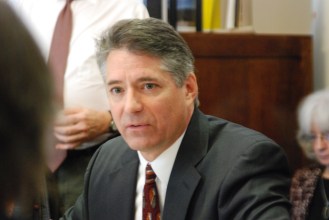
Levin noted the executive director only had the power to refer a complaint to another agency and that the commission, unlike similar bodies in other states, had no investigatory or enforcement powers.
“A determination as to whether or not one or more of these principles has been violated must be left to an arbiter following a proper investigation and opportunity for due process. However, no such process has yet been established by law,” he wrote.
Paul Burns, executive director for VPIRG, said he remained hopeful the commission would strengthen Leven’s initial assessment.
“This is a draft opinion, and though it’s weak, I expect it’ll be strengthened substantially by the full commission,” Burns said.
“The facts in this matter are not in dispute and the ethical violation seems clear. If the new state Ethics Commission turns out to be unwilling to hold state leaders to account, even in an advisory capacity, then they might as well turn out the lights and lock the door,” he said.
Leven said one aspect of the state’s newly adopted code of conduct, agreed to in June, did appear to be violated “by virtue of the information provided” and simply because a formal request for an opinion had been filed. Leven noted the code called for public officials to avoid “the appearance of a potential or actual conflict of interest” and italicized “appearance.”
Leven added that “public officials must use their own discretion in determining whether or not to adhere to this guidance.”
Scott has said repeatedly he has no day-to-day involvement with Dubois and that his only financial involvement with the company is holding the note, for which he received $75,000 in interest last year.
The governor’s spokesperson, Rebecca Kelley, said the complaint filed before the election “appears designed to politicize and weaponize the ethics commission in order to rehash old political attacks, which is unfortunate for Vermonters.”
