


Federal authorities have shut down the main runway at the Northeast Kingdom International Airport, substantially restricting commercial traffic, because of safety concerns caused by trees the state of Vermont was supposed to have already removed.
The Federal Aviation Administration issued a notice to pilots late Tuesday that runway 36 was closed for landings at speeds greater than 50 knots, eliminating landings for all but the smallest of private planes and hang gliders at the Coventry airport. Jets of the size that typically land at Coventry require speeds in excess of 100 knots at landing or risk stalling out. Several pilots said the restriction would affect 95 percent of the aircraft that go to the airport.
Jim Peters of the FAA said the restriction was put in place because of “safety issues” caused by an acre of trees on a property adjacent to the airport that can affect a pilot’s approach and need to be removed. A contractor conducting an inspection at the airport recently notified the FAA the trees were still standing, Peters said.
Peters said the restriction on the main runway was in place until Nov. 1. Vermont officials, he said, have assured the feds the trees would be removed by then. The state of Vermont owns the airport.
Transportation Secretary Joe Flynn said Wednesday the trees had not been removed earlier because endangered bats were found, which required the trees to not be removed any earlier than Nov. 1. Dan Delabruere, the director of rail and aviation at VTrans, said a contractor was scheduled to remove the trees on that date.
Flynn stressed on Wednesday that the airport and other runways remained open, but he acknowledged — and several pilots confirmed — that the closed runway was the one most used by commercial craft because of the runway length and because the prevailing winds come from the north. The runway on the same pavement as 36 but which runs in the opposite direction is considered unsafe to land on when the winds are coming from the north.
The main runway was extended about 1,000 feet three years ago to 5,300 feet to accommodate commercial jets, which were expected to increase in part because of the $600 million in EB-5 projects in the Newport area planned by developers Ariel Quiros and Bill Stenger. Some of those EB-5 projects were constructed before the federal Securities and Exchange Commission charged Quiros and Stenger with fraud in connection with the money they raised from foreign investors.
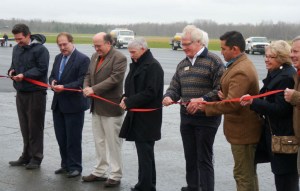
Removal of trees was supposed to be part of the runway extension, which opened to much fanfare in 2015.
Overall, the feds, with a 10 percent match from the state, spent more than $20 million on improvements at the airport, including about $9 million on the runway. Quiros and Stenger, who took over the contract to run the airport and leased the airport land from the state in 2012, planned their own substantial improvements, another $20 million, including a new terminal. Many of those plans died after the federal charges were filed in April 2016 and the developers’ airport contracts with the state were not renewed.
As a result of the Quiros-Stenger developments, state aviation officials had expected the number of flights per year to jump from 8,825 to more than 12,700. The most recent FAA figures were from 2015 and pilots said traffic has substantially increased since the runway expansion, especially small commercial jets.
Delabruere said the state had successfully worked out a deal with an adjacent landowner to cut down the trees affected by the FAA order.
However, Delabruere acknowledged the state had not settled with another key adjacent landowner who also has trees that need to be removed and whose land provides the best approach to the expanded airport.
That landowner, Todd Mosher, told VTDigger on Wednesday that the state had not negotiated in good faith. He said talks had been ongoing for at least four years since the airport expansion was proposed.
“I treat people fairly and I just want to be treated fairly and that hasn’t been the case at all,” said Mosher.
According to Mosher, state officials offered him $7,700 for an easement to cut down the trees, but Mosher said he wanted to sell outright because cutting the trees would leave the land difficult to develop. He said the assessed value was $37,800.
As part of the runway extension, the FAA and state agreed trees on several adjacent properties needed to be removed. Documents from 2013 from the Agency of Transportation clearly state the runway project will “result in the removal of obstacles, including trees, south of the extended runway.”
Flynn said the Scott administration could be held accountable for the last 18 months of delay and was not aware of efforts under the Shumlin administration.
Mosher said state officials initially thought they had an easement on his property already “and sent up four lawyers to bully us,” but later discovered they did not have the right to gain access to the trees without cutting a deal with Mosher.
Delabruere would not comment on negotiations with Mosher.
Dan Gauvin, who has managed the airport for more than 15 years, could not be reached for comment on Wednesday. As the fixed-base operator, Gauvin’s company sells jet fuel, which is expected to see a drop in sales with fewer jets landing at the airport, pilots said.

