

[B]urlington will wait to decide on a proposal that would allow late-night food trucks in the downtown.
The move would amend the city’s “central peddling district” to allow four food trucks to be parked on Bank Street between Church Street and South Winooski Avenue.
The city council’s license committee approved a motion on Tuesday to postpone the proposal and return with a work plan at the next meeting.
Current regulations allow for carts and small tables in one of 12 designated spots in the downtown district. Vendors pay for a license to use any of the locations, bounded by Main Street, Battery Street, Pearl Street and South Union Street. City Hall Park and the Church Street Marketplace are excluded.
The proposal, introduced by Christine Dunbar of the City Clerk’s Office, would allow the trucks to operate curbside between 9 p.m. and 3 a.m. Cart and table vendors would still be permitted in those locations.
Dunbar, who oversees licensing, wrote in her proposal that the peddler spots were designed in 1995 and have become “impractical and problematic” for businesses as Burlington as changed.
“I get an overwhelming number of people coming in who want to have food trucks downtown and we simply don’t have the space to accommodate them,” she told councilors on Tuesday.
She wrote in her proposal that the amendment would respect the daytime operating hours of most neighboring businesses, while expanding late-night food options after downtown bars close.
“My recommendation was to start small and see how this works,” she said at the meeting.
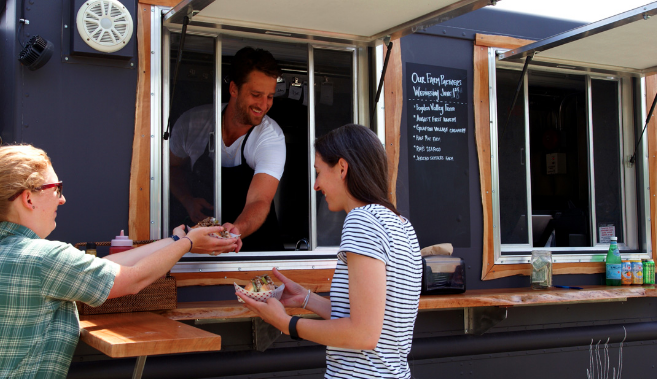
Food trucks have seen a rise in popularity in the Queen City and around Chittenden County, and are often spotted around lunchtime in parking lots and parks.
Seasonal food truck gatherings draw customers behind ArtsRiot in the South End every Friday night and every other Wednesday at Leddy Park in the New North End.
The growth is part of a booming trend nationwide of increased popularity in mobile eateries. U.S. food truck revenue was estimated at $2.7 billion for 2017, according to the National Restaurant Association.
Councilor Richard Deane, D-East District, said he has received input and inquiries from councilors and constituents about the effect of adding food trucks downtown.
“There’s concerns both in terms of the number of people they attract and hanging out on the streets, in terms of safety,” he said.
Deane, who is chair of the licensing committee, said he has also heard concerns from brick-and-mortar restaurants that feel they would be competing for the same customers. He said one restaurant owner reported 30 percent of its business disappearing as a result of Friday night food trucks off Pine Street.
“Hearing the concerns I’m a little hesitant to make a move and approve this without seeking further input,” Deane said.
Councilor Adam Roof, I-Ward 8, shared similar reservations about the proposal. He said the city needs to take into account changes since the original peddler district was created in 1995.
“I think we need to look at more holistically how food and other sorts of peddlers, including food trucks, can add to that vibrancy,” Roof said. “But we need to be realistic about the timing right now with major construction going on and added difficulty that different brick and mortar businesses are dealing with.”
Roof motioned to postpone action on the measure until the next meeting, which was supported by Deane.
Roof said there’s an issue of “level playing field” with brick-and-mortar businesses that pay taxes and deal with other cost implications to have to compete with food trucks.
Starting up a food truck costs around $50,000 to $100,000, while a restaurant typically comes with a price tag of $500,000 and up.
Several downtown restaurant owners who spoke with VTDigger said they’re not pleased about the increased competition food trucks might bring, but asked not to be named to avoid generating negative publicity.
Bilon Bailey, owner of the Jamaican Supreme Food Truck, said he supports the idea of adding food trucks in the downtown area. He began his business in 2015, and has two trucks that typically park on Pine Street and Riverside Avenue in Burlington.
He rejected the idea put forth by councilors that food trucks would negatively impact brick-and-mortar food establishments.
“Most of the restaurants in the downtown are high-end,” Bailey said. “These are just food trucks, they’re street food, as you might call it.”
He said the city’s permitting process for food trucks has been challenging, and he is currently applying for a permit to park at another location.
Bailey said allowing food trucks in the downtown could be an opportunity for the city to make more money by charging higher fees.
“I don’t mind paying more if I’m getting a piece of that pie,” he said.
City Councilor Max Tracy, P-Ward 2, who also serves on the committee but was absent, did not return a call seeking comment on Wednesday.


