

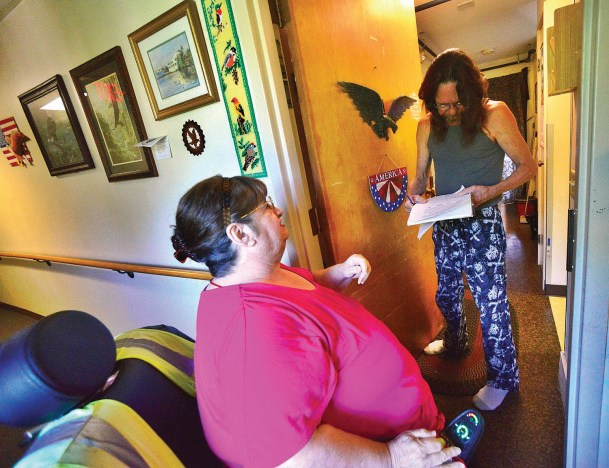
Editor’s note: This story by Bob Audette was published in the Brattleboro Reformer on Aug. 8.
[B]RATTLEBORO — Residents of the Samuel Elliot Apartments can have their in-window air conditioners back … for now.
After a meeting between administrators of the Brattleboro Housing Partnership, which manages the high-rise on Elliot Street, and residents of the building, the BHP made a decision to step back from the policy that made in-window air conditioners verboten.
“We made a very responsible and compassionate decision that for the rest of the summer, in light of the actual weather, that the residents can install the units,” said Chris Hart, BHP’s executive director.
On Thursday, BHP staff and apartment residents met to discuss the BHP’s decision that only floor model air conditioners would be allowed in the building that was built in 1982. Last September, the BHP crafted a policy mandating the removal of all in-window units on the grounds that condensation dripping from the units was causing damage to the building. BHP administrators were also worried that installation of the units was sometimes done in a haphazard manner, leading to the potential of a lawsuit if a unit was to fall out and hurt someone.
BHP recommended that residents purchase floor-model air conditioners, but residents complained that they were too expensive and didn’t work as well as in-window models.
The Thursday meeting was convened after a petition with 52 of the high-rise’s 54 tenants asking the BHP to reconsider the policy.
“We won the battle,” said Elizabeth Snyder, the president of the SEA Tenant Association. “It’s wonderful. We got our air conditioners back. It’s quite a relief. Everyone is feeling better. This makes their lives better.”
“It’s beautiful in here,” said Judith Ressler on Monday, when temperatures in Brattleboro reached the mid-90s.
Hart said she was pleased with the meeting and the decision that came out of it.
“It was absolutely the right thing to do,” she said. “It was the best decision to make as the manager of that particular building, a low-income building, given the weather we are experiencing.”
While Hart felt BHP gave residents “lots of time” to prepare for the change that was implemented this year, she admitted, “We need to work much closer with the residents so that if they need to make changes, they know about it sooner and our support staff can start working with them to prepare for the change. We will be more hands on and present in terms of helping them with implementing the new policy and helping them find the right air conditioner.”
Hart also noted that BHP has issued a request for proposals to look at the existing energy needs of each of its properties, especially the Samuel Elliot Apartments. However, installing central air in the high rise is problematic, she said, because the building doesn’t have duct work. Each unit has its own thermostat to control electric heating, but no provision was made when the building was built for air conditioning.
“It doesn’t mean we shouldn’t look at it again,” said Hart. “Energy technology is changing all the time.”
Hart also noted that because BHP is a public housing program governed by the federal Department of Housing and Urban Development, BHP has to meet certain benchmarks, or standards, before it can invest in energy improvements or change the way tenants get their heat or air conditioning. In other words, BHP has to conduct a cost-to-benefit analysis to justify any changes. Hart said that’s one part of the energy review BHP hopes to conduct soon.
While residents were allowed to re-install their in-window units, said Hart, they have to come out in September, and what to do next year still hasn’t been determined.
“We were very clear,” she said. “We’ll be working on what the policy will be for next year.”
Snyder said she understands the decision that came out of the Thursday meeting is only an interim decision.
“In the spring, we are going to get people to sign up again,” said Snyder. “We are going to do this thing all over again.”
