

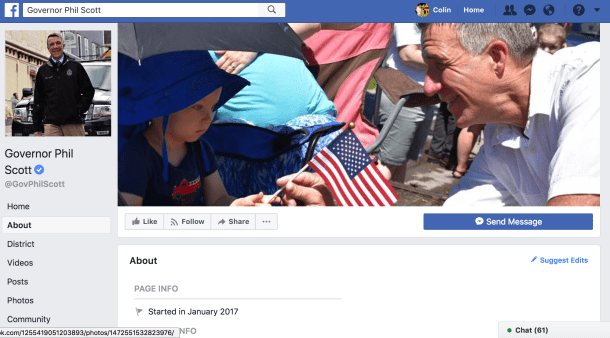
[A]fter coming under fire from the American Civil Liberties Union and constituents for blocking users from his Facebook page and censoring comments, Gov. Phil Scott has unblocked the banned accounts while his administration adapts its social media policy.
The ACLU sent a letter to Scott last month accusing him of violating the First Amendment and the Vermont Constitution by restricting speech on his Facebook account. The group said blocking critics was a “form of viewpoint-based censorship.”
The Scott administration maintains that it has only blocked users who used hateful, abusive or obscene speech, but it still decided this week to unblock all users as it revises its social media policy in response to the criticism.
The governor’s social media pages will more clearly outline how comments will be moderated going forward, Scott told reporters Wednesday.
“We’re starting over from scratch with a policy that we feel is more in line with what the ACLU would like,” he said.
But the governor said his staff would continue chaperoning the public forums on his social media pages to prevent attacks on others and inflammatory or racially charged remarks.
“When there’s that much discourse, and really hateful discourse, we felt there was an obligation to mute that in some way,” he said.
The letter the ACLU sent to the governor last month criticized the previous policy posted on the governor’s page, noting that its “restrictions use vague terminology that confers overly broad discretion” to his office.
In an interview Thursday, Jay Diaz, an ACLU staff attorney, said that after the organization reviewed some of the posts of the individuals who were blocked from Scott’s page, it appeared the administration’s “earlier justifications” for censoring the accounts were “not valid.”
Many of those who were blocked openly opposed the governor for his political views, particularly on the issue of gun regulations, Diaz noted.
“We have not looked at all the comments of all the people who were blocked previously, but of the comments we have looked at, it looks like pure political speech without violating any of the governor’s previous policies,” Diaz said.

Facebook records that the ACLU obtained and provided to VTDigger show that between April 4 and May 22, the Scott administration blocked 57 users from its page.
Scott signed a sweeping package of gun control into law on April 11, a move which sparked anger among many of his supporters who had expected the governor to hold the line against new gun control measures — a promise he had made during his campaign two years ago.
Rebecca Kelley, a spokesperson for the governor, insisted Thursday that the administration has never blocked users over their political opinions.
“The policy is based strictly on vulgarity of language, hate speech, not political viewpoint whatsoever,” she said.
Moderators on the governor’s Facebook page have only focused on blocking users who launch vile attacks against others, use profanity, or make comments targeting minority groups, she said.
“His page is a page for all Vermonters of all ages and everyone should feel able and comfortable coming to the page,” Kelley said.
Major public officials across the country are being taken to court over their decisions to censor or block constituents on official social media pages.
In May, a federal judge in New York ruled that President Donald Trump could not blocker users from his Twitter feed.
In April, a lawsuit filed by the Maryland ACLU and several other plaintiffs against Maryland Gov. Larry Hogan was settled. He was accused of censorship on government Facebook pages. Another federal lawsuit filed against Maine Gov. Paul LePage over his alleged censorship is still pending.
The Scott administration did not specify when it will roll out its new social media standards, but Kelley said the new policy will more clearly spell out the guidelines for user conduct.
“We’ll fine tune the language to improve and make it more clear as to what we’re moderating, and we’ll start from scratch from there,” she said.
If the administration decides to reinstate its policy of blocking certain users, it will have new rules for doing so, according to Jaye Pershing Johnson, the governor’s general counsel.
The ACLU hopes the administration will start keeping records of the comments it alleges violate the social media policy, and give users “due process” so that they can challenge moderators’ decisions to delete comments, Diaz said.
“This ensures that, before a final decision to censor is made, the governor’s office will carefully analyze them before delineating between speech that is or is not protected,” he said. “That did not happen before.”

