

[T]he American Civil Liberties Union of Vermont is confronting Gov. Phil Scott for allegedly violating the First Amendment by blocking users from viewing his Facebook page and deleting some of their comments.
The ACLU wrote in a letter to the governor on Wednesday saying they have been contacted by multiple constituents who have had comments deleted and profiles blocked by the administrator of Scott’s official Facebook page.
ACLU attorney Jay Diaz said the social media censorship goes too far and violates the First Amendment of the U.S. Constitution and Article 13 of the Vermont Constitution, as he considers the accounts public forums for expression.
“In effect the governor is muzzling people in preventing them from commenting on his Facebook posts,” he said.
Diaz said the individuals who voted for Scott in 2016 were vocal with concerns about Scott reversing his position on gun control, only to see their comments deleted and accounts blocked from his official page shortly after.
Those who reached out to the governor’s office to complain were sent a copy of the governor’s official social media policy, but there was no explanation of how or if particular comments were in violation of those guidelines, according to Diaz.
“Blocking constituents is never going to be OK, especially when it comes to political speech,” he said. “That is a prior restraint and the courts have been clear for a long time that prior restraint is not something the First Amendment allows.”
The governor’s office acknowledges that the social media channels are a public forum, but says moderation is necessary for respectful and civil dialogue.
“To be clear, comments are only deleted when they are abusive, obscene or hateful and users are only blocked when they display a pattern of this behavior,” Scott’s communications director, Rebecca Kelley, wrote in a statement.
“Even a cursory review of the comments on the Governor’s Facebook page makes clear that dissenting, critical and even insulting comments towards the Governor are left on the page,” she added.

Scott faced backlash last year for blocking users from his official Twitter account. Indivisible Vermont, an account which posts material around the “resistance movement” against President Donald Trump, sparked a debate online in August 2017 after tweeting they had been blocked.
The governor’s office quickly responded by unblocking the account, claiming that it had been mistakenly identified as spam.
A block on Twitter prevents a user from viewing tweets or interacting with the account when signed in, but a user can still view tweets when signed out. On Facebook, a block prevents a user from liking or commenting on a post. Blocked users are still able to see posts on a public page.
Diaz said the recurring issue of Scott blocking users on Facebook was one of the factors that prompted the ACLU to send a letter.
“We thought the matter was understood and decided, but that seems to not be the case now,” he said. “We want to make sure everyone has equal ability to express their views in a public forum, and the governor has created several of those.”
A series of recent and current court cases are testing the limitations of public officials ability to censor users on social media accounts.
In April, a lawsuit filed by the Maryland ACLU and several other plaintiffs against Maryland Gov. Larry Hogan was settled. He was accused of censorship on government Facebook pages. Another federal lawsuit filed against Maine Gov. Paul R. LePage is awaiting a ruling.
In May, a federal court ruled in favor of plaintiffs who argued in a lawsuit that Trump’s blocking of users was unconstitutional. The judge determined that the president’s social media channel was a public forum, and that prohibiting individuals from reading or commenting on tweets constitutes a violation of the First Amendment.
Diaz said officials can only censor speech in the context of social media if the restrictions are narrowly tailored to meet a compelling state interest.
“Social media is a new public square. That is where people go to voice their opinions and discuss a wide variety of topics,” Diaz said. “The governor should treat it as such and allow a wide variety of voices from across the political spectrum to be heard.”
Dan Richardson, a Montpelier-based lawyer and adjunct professor at Vermont Law School, said the extent to which the law recognizes social media pages as a public forum was still in flux.
In the case of Trump’s Twitter account, his regular announcement of policy decisions via what was originally a personal channel led to court to determine it as a public forum. Additionally, the account was accessible and operated by White House staff.
Richardson said he would expect courts facing similar questions about other officials to look at the nature of posts, nature of the account and who is authoring the posts. This assessment would be based around the impression a reasonable person might have of the account.
“This is an undetermined area of the law because social media is dynamic, because social media tends to cross these lines,” Richardson said.
Kelley, Scott’s spokesperson, said the governor is open to tweaking his current social media policy.
“We would welcome any specific recommendations from the ACLU to narrow certain provisions or improve our procedural documentation and communication related to this policy, while ensuring the civil discourse that encourages all to engage with the page,” she wrote.
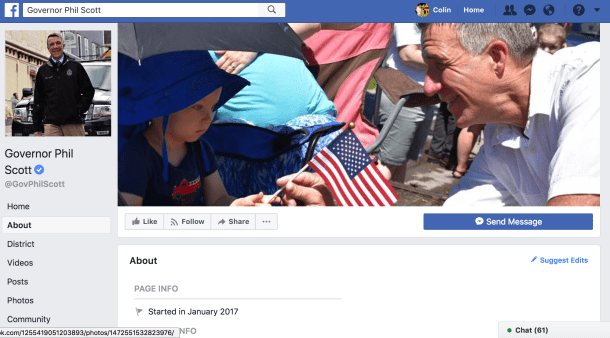
Scott’s social media policy is posted in the About section of his Facebook page, and prohibits content such as spam activities, violent language, bullying other users or commenting in a derogatory manner or on issues unrelated to the post.
If the comments were deleted based on their hostile agenda, Richardson said that could be viewed as a violation of free speech.
“There’s fairly consistent rulings that support that you can’t have viewpoint discrimination in a public government forum,” he said.
The ACLU’s letter argues that Scott’s social media policy essentially allows for prior restraint. Diaz said language such as the term “derogatory” leave too much discretion to public officials to censor users in violation of the First Amendment.
Richardson said the law allows for certain controls on forum speech, such as obscene material or threats, but restrictions need to be clearly defined.
“Prior restraint is when the standards on the commenting are so vague they don’t give the speaker a clear indication of what’s acceptable or not acceptable and can have a chilling effect of misuse,” Richardson said.
“If somebody responds to a comment about gun control with a point about how it’s a public health issue, it could be seen as irrelevant to the initial post,” he added.
Richardson said that part of these controls are just the growing pains of learning how to handle speech on new platforms.
“You have the strong First Amendment right to make any comments, good bad or ugly,” he said, “but you have a media that has invigorated people to bring out their worst tendencies.”

