

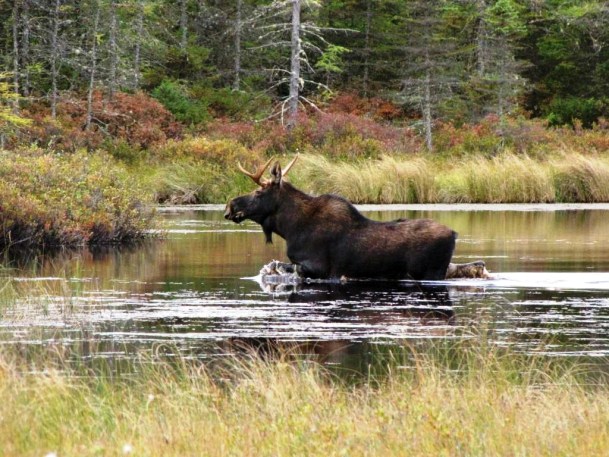
[T]he way to reverse the decline in moose numbers in the Northeast Kingdom may initially be to reduce the population further, state wildlife specialists said last week. Officials from the Vermont Department of Fish and Wildlife explained at a public meeting that further thinning of the moose herd could reduce the numbers of the winter ticks that have been a plague on moose populations for some years now, by depriving them of their food source. But the explanation was met with skepticism from some, who called for a moratorium on moose-hunting until the tick problem is better understood.
The meeting, sponsored by the Agency of Natural Resources, was one in a series of talks led by agency Secretary Julie Moore and other natural resource professionals to provide information on how the agency is addressing key environmental issues in the state.
“We’re very worried about the health of Vermont’s moose herd,” Moore said, opening the meeting, the focus of which was to provide an overview of the state’s research on moose mortality in the Northeast Kingdom, the heavily forested region that is home to most of the state’s moose. Department biologists said the herd had been experiencing higher than normal mortality rates in the past few years, a phenomenon they believe is likely linked to a population explosion of winter ticks, which attach themselves to moose in the fall, while they are still in larval form, and then drop off in the spring, as adult ticks.
The state launched a three-year study in 2017 to assess the impact of winter ticks on cow and calf survival, joining similar studies in New Hampshire and Maine, said Cedric Alexander, who has been head of the department’s moose program since 1993.

Moose in Essex County have been captured and fitted with radio collars, Alexander said. If the collars indicate that a moose has not moved for more than a few hours — a sign of mortality — researchers locate the moose in the field, and determine the cause of death, he said.
Results from the past two years have shown ticks to be the cause of death for many of the calves that did not survive the winter, said Alexander. In the winter of 2017, 12 of 30 calves wearing collars died — a 40 percent mortality rate. The following winter 15 of 29 collared calves died — a 52 percent mortality rate. Louis Porter, commissioner of Fish and Wildlife, said in an email that the mortality rate is higher than what is regarded as normal for moose calves.
Alexander noted that the bone marrow of the dead calves looked like “grape jelly,” indicating a low fat content. “Anytime a calf loses 15 percent of its body weight through its first winter, it is likely not to survive,” he said. And while the mortality rate among cows is not as high as had been feared, the increased stress due to the loss of blood to ticks can cause them to lose fetuses, he said.
Research has indicated that a population density of .75 moose per square mile yields lower winter tick levels, Alexander said, while a density of 1.3 moose per square mile or higher leads to “high parasite loads and significant impact on calves’ survivorship and productivity of cows.”
Essex County — the state’s “prime moose habitat,” in the words of state wildlife director Mark Scott — has 1.05 moose per square mile. In the early 2000s, when the moose population was at its highest point — the density was more like 4 or 5 per square mile.
The state is considering setting a new goal of one moose per square mile “in hopes that the tick numbers on the landscape that probably developed during these high moose periods will eventually diminish to a point where the health of the moose will improve,” Alexander said.
“It’s something that you don’t actually get to witness in your time as a wildlife scientist — changes that are coming so fast,” Scott said.
Some attending the meeting asked why the state was not more focused on controlling the outbreak by killing the ticks. Scott said more research is needed, but for now “there’s no magic bullet” for managing winter ticks. Alexander said the department is working with the University of Vermont to test the possibility of using a soil fungus that is known to kill ticks as a means to attack winter tick populations in moose rutting areas.
Several people at the meeting questioned why there is moose hunting at all, given the threat to the herd from winter ticks and climate change. The state’s Fish & Wildlife Board — the 14 member board that decides many of the state’s hunting, trapping and fishing regulations — voted earlier this year to issue 13 bull-only permits for the 2018 hunting season, a significant departure from the more than 1,000 permits granted from 2005 to 2010, while the moose population was still high.
Brenna Galdenzi, president of Protect Our Wildlife, expressed concern that the department had continued to issue a high number of permits even after it had become known that ticks were having an impact on moose herds in neighboring states.
Sophie Bowater, a Protect Our Wildlife member, asked how certain the department was that climate change wasn’t the primary cause — that tick numbers could continue to increase, even with a reduced moose population. “Why wouldn’t we take a break from hunting and see what happens?” she asked Alexander.
“The impact of a warming climate is complicated,” he acknowledged, adding that state biologists will be monitoring whether keeping the moose density at one per square mile is effective in reducing the tick population.
Alexander added that the number of permits issued this year was “very conservative.”
“There could be 10 moose harvested,” he said. “That’s 3,000 pounds of meat that hunters in Vermont can still get without endangering the population.”


