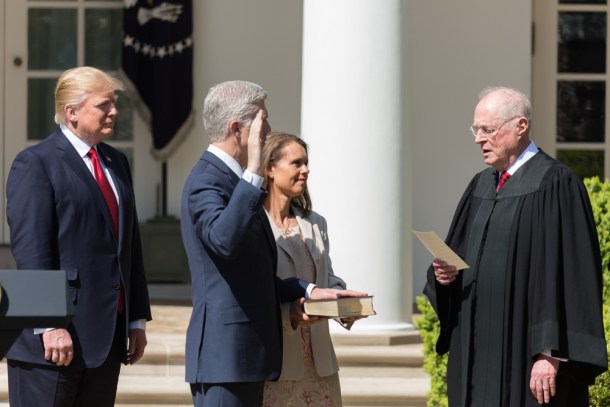
[B]URLINGTON — As the White House gears up for the process of selecting a nominee to fill an upcoming Supreme Court vacancy, Senate Democrats are strategizing how to counter another conservative pick from President Donald Trump.
But they may not have many options, according to experts.
Sen. Patrick Leahy, D-Vt., addressing a conference hosted by Vermont Law School on Friday, said there was only one way for a moderate to end up replacing retiring Justice Anthony Kennedy — Democratic control of the Senate.
“I don’t want a super liberal or a super conservative on the Supreme Court,” Leahy said Friday. “I want somebody who’s representing all of us.”
Kennedy, nominated by President Ronald Reagan in 1988, has tended conservative but has served as a key swing vote in many controversial decisions.
Like many others in the minority, including Sen. Bernie Sanders, I-Vt., Leahy said he believes Majority Leader Mitch McConnell, R-Ky., should put off a vote until after the midterms in November.
McConnell refused to proceed with then-President Obama’s high court nominee in March 2016 until after the presidential election.
“I think he should wait until after the election,” Leahy said to reporters. “Do I think he will? No.”
Senate Republicans, however, are unlikely to drag their feet on the relatively rare opportunity to fill a seat on the high court. McConnell has said he expects to vote on Trump’s nominee this fall.
Senate Democrats and liberal-leaning groups have expressed concerns that Trump will put forward a nominee who will cement a conservative bent in the court for decades.
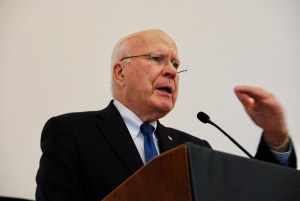
Asked what tools Senate Democrats have at their disposal to try to block a nomination, Leahy said there have been meetings about strategy. But he deferred to Sen. Dianne Feinstein, D-Calif., ranking Senate Judiciary member, for details on the strategy.
“I’m old school, I’ll let her speak to it,” Leahy said.
In the meantime, Vermont’s senior senator called for members of the public to speak up and pressure Trump over the nominee.
“If we do, it might have an effect. We saw it when he changed his outrageous and illegal grabbing of children at the border because the American people stood up,” Leahy said. “They have to do it again.”
Gregory Koger, a political science professor at the University of Miami and a specialist in filibustering, said Friday that the best tactic for Senate Dems is likely a political, rather than procedural, approach.
There are not many procedural options available, he said.
When it comes to pressuring the majority to move on a particular issue — such as family separations — one option for the minority could be to withhold a quorum. Senate rules require at least 51 senators to participate in a vote. With Sen. John McCain, R-Ariz., on medical leave, Democrats could refuse to come to the floor for a roll call and cause everything to come to a halt.
“Democrats have leverage to try to make demands to complicate the business of the Senate, but I don’t think quorum breaking is a way to indefinitely block a Supreme Court nomination,” Koger said.
Koger said there are ways Republicans could break the logjam, if they were determined. They could use the sergeant at arms to force senators into the chamber, then, when there are enough people, they could change the precedent for a quorum.
“If you’ve got a committed majority that’s trying to force one thing through … they do have procedural options to make that happen,” he said.
Koger said Democrats’ best option would be to take a political approach.
In the short term, they could create a link between Trump’s nomination and another issue, like the special counsel probe. If Robert Mueller were to subpoena Trump in the investigation, and the president refused, the case would likely go directly to the Supreme Court.
Democrats could argue that Trump should not select a judicial nominee until the investigation is closed. Some legal scholars are already making the case.
They also could take an approach of lobbying other senators to oppose Trump’s nominee. Republicans currently hold a narrow majority of 51 to 49. The two senators seen as being most likely to take a principled stand on the Supreme Court pick are Sens. Susan Collins, R-Maine, and Lisa Murkowski. R-Alaska.
“They only need one,” Koger said.