

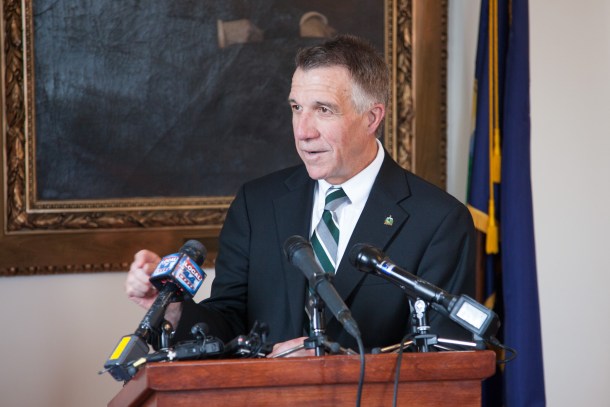
Gov. Phil Scott said Thursday that he would have faced the brunt of the blame if he didn’t prevent a government shutdown and allow the third budget bill passed by the Legislature to become law.
“The focal point would be on me,” he said during his first public comments since the political impasse ended on Monday. “I think we’d all suffer in some regards and it was just unfair to put Vermonters and state workers through that.”
Scott reiterated Thursday that by reneging on a spending agreement reached with House leadership on Friday, just a week before the budget deadline, lawmakers left him with no choice but to accept a spending bill that raises taxes.
“I think that it would have been unfair for Vermont, our constituents, state employees,” he said of a government shutdown on July 1.
So the governor decided to let the third budget pass into law despite his pledge to keep tax rates level next year.
As the dust settles on that decision — the bill will actually pass into law today, after being left unsigned for five days — political analysts say it’s difficult to say which side was the political winner in this year’s skirmish over the “big bill.”
But as the final act in a legislative session that also included marijuana legalization and a package of new gun laws, a victor may emerge as campaign season gets into full swing in the coming months and voters weigh in at the polls this fall.
“I really think if there’s a winner it was state government,” Rich Clark, a professor of political science at Castleton University, said. “It didn’t shut down.”

The threat of a shutdown had prompted concerns about state agencies shuttering their doors, vulnerable Vermonters being cut off from basic services and state workers not receiving pay.
Despite the heated rhetoric of recent weeks, Vermonters ultimately witnessed “responsible government,” Clark said, as compromise was reached before damage was done.
“The governor and the Legislature both felt strongly and passionate about their positions,” he said. “To have given up earlier would have been a betrayal of the ideals.”
In order to break through the weeks-long budget impasse, both lawmakers and Scott made significant sacrifices, and gave way on their “non-negotiables.” For Scott, it was his tax pledge, and for lawmakers it was a principle to not use one-time money to pay for ongoing expenses.
“Overall, I think it’s a wash,” said Eric Davis, an emeritus professor of political science at Middlebury College, noting he doesn’t think either side came out of the budget battle in better shape than when it started.
The bill slated to become law this weekend, H.16, will prevent a residential property tax increase next year, but will also lead to 4.5 cent hike in the nonresidential property tax rate, paid on property like small businesses, rental homes and summer camps.
“Scott had to give up his no new taxes or fees in my first term pledge and you know that’s a big give-up for him,” Davis said.
However, to assure that the residential property tax rate doesn’t see a hike next year, he said the Democrat-controlled Legislature also gave a lot of ground. It agreed to use about $20 million of surplus money to artificially buy down taxes.

Lawmakers had argued that the buydown would only exacerbate tax increases in the future. The Joint Fiscal Office has estimated, for example, that budget slated to become law will lead to a $30 million to $35 million gap in the education fund next year.
When asked who he believed made the larger concession in reaching a budget agreement, Scott suggested it was too soon to tell.
“My goal was to get through the biennium without raising taxes and fees, and so from some people’s perspective I didn’t accomplish that,” he said. “So I think we’ll see.”
Steve Terry, a longtime Vermont political journalist and analyst, said that while the budget impasse has been resolved, the issues underlying the disagreement will be folded into this year’s campaign season narratives.
“The immediate headline is that the governor backed down, but I think it’s a little early to judge how that will play,” Terry said.
Democrats and Republicans will both try to more effectively market what they did during the special session to voters, according to Terry.
While Democrats will argue they tried to chart a path of fiscal responsibility in crafting the budget, Republicans will say they fought tooth and nail against a tax hike, he said.
“And frankly, whichever side can do the best in the message battle and war will probably gain some votes,” Terry said.
As governor, Scott will have the advantage of a more prominent platform than Democrats from which to “wage a message war” during election season, Terry said.
But analysts believe that in the fall, the political focus will likely settle on the legislative races.

“I think that the most competitive elections in Vermont in November may very well be House districts scattered all over the state rather than any of the statewide races,” Davis said.
The upcoming House election is a critical opportunity for Democrats to pick up seats and capture a veto-proof majority that would cripple Scott assuming he wins another term.
Republicans are only fielding candidates for about half of the 150 House seats, but say they are still hoping to get write-in and party appointments to compete in other races.
The importance of the GOP’s 53 seats, just over a third of the House, was borne out repeatedly toward the end of the session. Voting as a near-unified block, they were able to sustain Scott’s veto of two budgets, a bill that would have raised the minimum wage and a bill that would have regulated the use and sale of toxic chemicals.
Scott said he hopes Republicans can sustain those numbers. “I certainly don’t want to lose any and we certainly could use more commonsense candidates,” he said.
Terry said candidates in the upcoming elections can expect at least a few questions about these last few weeks in Montpelier.
“I think voters will ask candidates the question ‘What took you so long to get your work done?'” he said.

