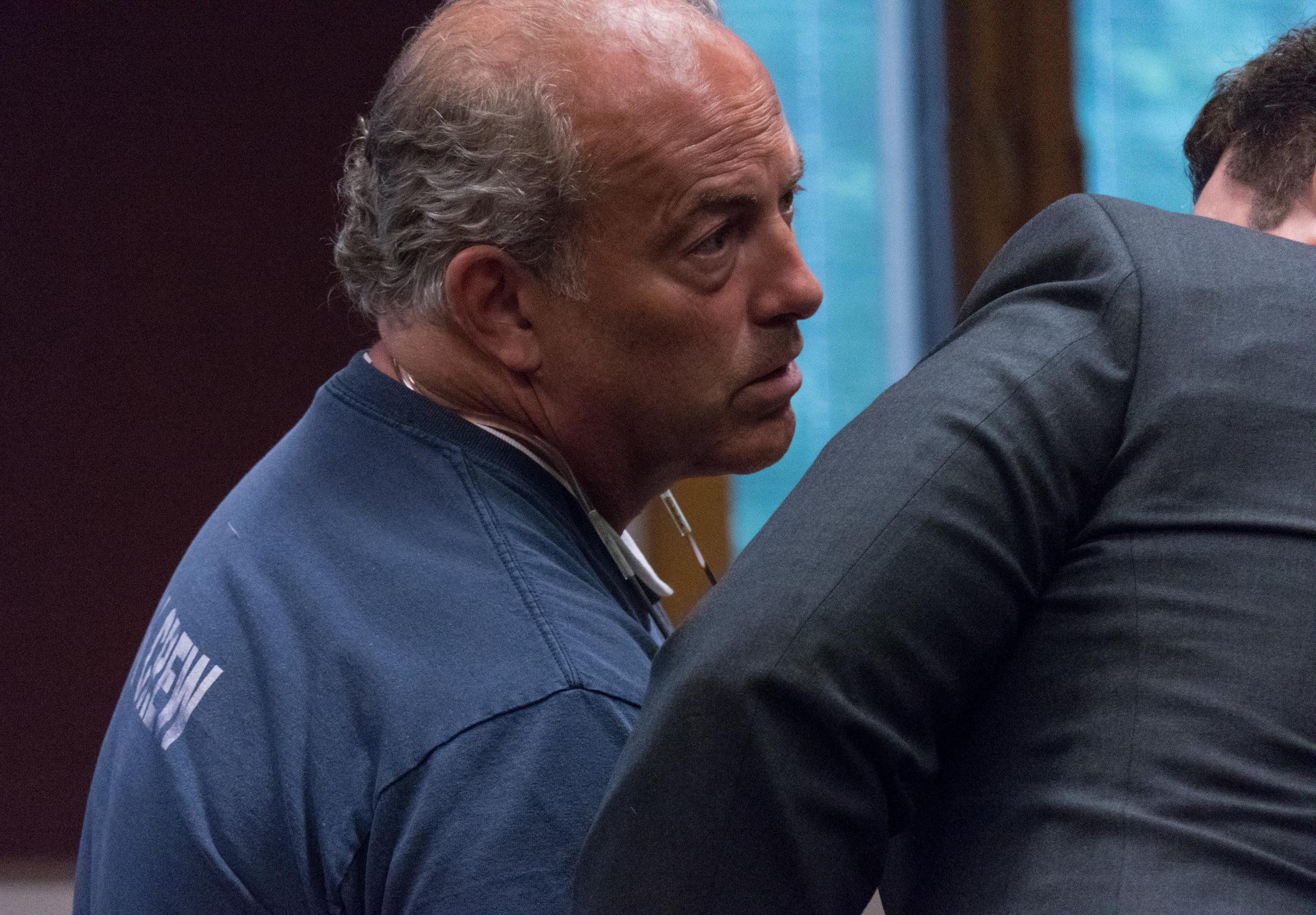
[A] lawyer for the former attorney for the city of Rutland says the judge who sentenced him for driving drunk and fleeing a fatal crash abused her discretion by handing down the identical prison term at a follow-up hearing after the original sentence was thrown out.
And, attorney Rebecca Turner, a public defender representing Christopher Sullivan, told the Vermont Supreme Court at a hearing Tuesday that Judge Theresa DiMauro in handing down the latest sentence used “near verbatim, word-for-word” language as she did at the first hearing.
“Her decision, in the end, exemplifies the prejudgement that she showed,” Turner said of DiMauro.
As a result, Sullivan’s attorney asked the the state’s highest court to overturn the prison term her client received of four to 10 years in prison, and order a new, and third, sentencing hearing in the case, with a new judge presiding over it.
Prosecutor David Tartter countered that the judge did not abuse her discretion in sentencing Sullivan on convictions stemming from the April 2013 crash that killed Mary Jane Outslay, 71, of Mendon.
Tartter told the five justices of the Supreme Court that the judge simply did not buy the arguments presented by Sullivan’s attorney at the second sentencing hearing that any change was warranted.
“The fact that a sentencing judge’s criticism is ‘harsh,’ or constitutes a ‘stinging public admonition’ does not amount to an abuse of discretion,” Tartter added in a filing to the court.
“Such an admonition can serve ‘the important function of deterring like conduct,’ and can provide the ‘harsh awakening’ that a criminal defendant needs rehabilitation.”
The judge delivered strong words to Sullivan before imposing that same four-to-10-year prison term, which is now under appeal, at the August 2017 sentencing hearing.
“He stated that he panicked and was unsure what to do,” DiMauro said of Sullivan. “It is simply not credible that he was totally disoriented.”
The issue of DiMauro’s action on the bench during the case has long been a target of Sullivan’s attorneys.
Prior to his second sentencing hearing in August 2017, Sullivan’s attorney tried to force DiMauro off the case, arguing that the judge had “prejudged” the matter based on comments she made at a hearing a couple months earlier.
At that hearing, the judge indicated the chances that Sullivan would get a sentence with no additional prison time were slim.
Eventually, another judge ruled that DiMauro could continue to preside, and that issues raised by Sullivan’s attorney could be argued on appeal.
Sullivan was convicted in 2015 of drunken driving and leaving the scene of a fatal crash that killed Outslay in downtown Rutland on the evening on April 10, 2013. He was then sentenced by DiMauro to four to 10 years in prison.
However, he appealed, and in April 2017 the Supreme Court upheld his convictions but overturned his sentence.
The high court ruled Sullivan should have been given more time to present “mitigating” testimony from an expert witness, to help explain his action in fleeing the scene.
According to court records, Sullivan fled the crash scene in his 2004 Lexus 330. He didn’t tell police until a day later that he was behind the wheel of the vehicle that struck and killed Outslay as she left a restaurant and was crossing a street.
At that second sentencing hearing in August 2017, clinical psychologist Thomas Powell testified that Sullivan suffered from a traumatic event on the night of the crash and Sullivan’s action of the leaving the scene “was reflexive, not the result of deliberation or self-preservation.”
Turner argued before the Supreme Court Tuesday that DiMauro did not take that testimony into proper account, adding that the only new evidence at that hearing was mitigating, yet the sentence stayed the same.
Brian Burgess, a retired Supreme Court justice hearing the case due to a conflict involving another justice, said it could be possible the judge considered the mitigation evidence presented at the second sentencing hearing, but didn’t give it any credit.
“Is the problem here that she didn’t buy?” Burgess asked.
Turner responded that the judge displayed “inherent skepticism” of Powell’s testimony, and that the prosecution did not put on an its own expert to counter or dispute him.
Tartter told the high court that while the prosecution didn’t put on its expert witness, it did “vigorously” cross-examine Powell on his testimony.
The prosecutor added that the judge, in delivering the second sentence, also spoke about Sullivan’s lack of “sincerity” in saying he accepted responsibility for his actions on the evening of the crash and his expression of regret.
“The court is entitled to make a judgement that the expressions of regret were not sincere,” Tartter told the high court.
Burgess asked Tartter if a defendant in that situation is in a Catch-22 situation at that point: either apologizing for his actions and risk coming across as insincere, or saying nothing and expressing no regret.
Tartter replied that was a hole Sullivan put himself in.
“He created a situation where his credibility was poor,” he said. “I agree, it’s an uphill battle, but it’s an uphill battle of his own making.”
In contending that her client did accept responsibility for his actions, Turner, in her filing to the court, quoted directly from Sullivan at that sentencing from August 2017.
“Your Honor, first I want you to know as clearly as I can state that I accept full and complete responsibility for causing the death of Mrs. Outslay,” Sullivan said at that hearing, according to the filing.
“I have always felt this. I feel devastated, overwhelmed, and guilty about it every day,” he added. “There isn’t a day that goes by that this isn’t on my mind.”
In addition to challenging his case in the Vermont Supreme Court, Sullivan has filed a request for post-conviction relief, a civil process that involves challenges to actions that take place in state criminal courts at the trial level.
In that separate civil court challenge, Sullivan is pursuing a claim of “ineffective assistance of counsel,” based in part on an argument that his attorney at trial, Barry Griffith, failed to call an accident reconstructionist expert to the stand.
Sullivan, who is currently serving his sentence in the Springfield prison, did not attend the hearing Tuesday. He had served as either city attorney or deputy city attorney for nearly two decades.
His minimum release date from prison is Aug. 5, 2019.