


Editor’s note: Mark Bushnell is a Vermont journalist and historian. He is the author of “Hidden History of Vermont” and “It Happened in Vermont.”
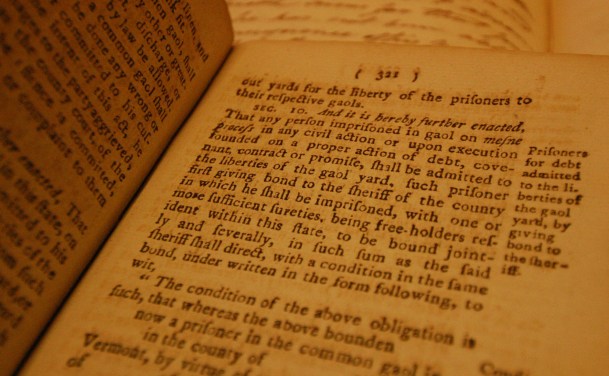
[D]ebt haunted peoples’ dreams in early Vermont. They had ever reason to fear it. Not only was debt common, it was also treated rather like a crime. Fail to pay your bills, and a civil court could throw you in jail until you could.
When Vermont leaders met in Bennington in 1779 to create statutes for this new, self-proclaimed autonomous region, they moved to make it more forgiving than the country from which they were breaking away. They cut the number of possible death-penalty offenses from the roughly 100 codified in English law to three: treason, rape and murder. Crimes like theft and counterfeiting were to be punished swiftly and often physically, with whippings, confinement in the stocks or mutilation, such as having an ear cut off or being branded.
Jails and prisons were reserved for the offense of being poor. County jails were for debtors and beggars.
It is hard to imagine that everyone didn’t know someone who had gone into debt. The boom-and-more-often-bust nature of the economy made debt a common trap in early America.
By 1786, the United States had fallen into an economic depression. Farmers, who made up much of the rural population, were running up large debts. Creditors had loaned them hard money, the kind stamped out in silver or gold, and expected to be repaid in kind. The farmers, who had already spent the money, found it difficult to find coins, which were suddenly in short supply.
With the end of the Revolution, the newly minted Americans found they had lost access not only to the British economy but also to British specie, the literal coins of the realm. In the place of this hard money, the various states issued their own paper currencies, but these bills were not backed by gold or silver. As such, this paper money was difficult to value accurately and made trade between states difficult.
Creditors were understandably wary that these new bills were worth no more than the paper on which they were printed. Under the circumstances, many Vermonters fell into debt, including Gov. Thomas Chittenden, though he managed to avoid prison.
During the fall of 1786, a group of men, carrying a variety of weapons and playing fifes and drums, marched to the Windsor courthouse and threatened to close it down if something wasn’t done about the personal debt crisis. Another mob disrupted proceedings at the Rutland County courthouse. Both groups may have drawn inspiration from the popular uprising that summer in Massachusetts, led by Revolutionary War veteran Capt. Daniel Shays. Where the Massachusetts revolt was put down by force, the Vermont rebellion dissipated on its own.
But debt, and imprisonment for it, remained an issue as Vermont’s economy continued to teeter. During the early 1800s, Vermonters were changing from a system of subsistence farming to one in which they created products for the market. This capitalist system offered the chance for wealth, but it also came with considerable risks. Those who fell into debt ran the risk of imprisonment.
Ironically, an effort to reform criminals made the consequences of being locked up for debt more severe. By the early 1800s, social activists came to believe that corporal punishment did nothing to improve a criminal’s character. They believed criminals should instead be sentenced to prison to give them time to consider their misdeeds. The move meant that debtors in state or county custody often shared cells with more dangerous criminals.
Furthermore, the jails were unsanitary, often overcrowded places. One former convict at the state prison in Windsor wrote of the extreme cold he endured during winter. “Many a time have I made large balls by scraping the frost with my hands from the stone walls of my cells.” His hands grew so cold, he wrote, that “I had to tax my ingenuity to turn over the pages of my Bible.”
Efforts had been made since 1820 to change the debtor laws. Sympathetic legislators regularly introduced reform bills but they were always blocked, often by members of the Governor’s Council, the precursor of the state Senate.
The Prison Discipline Society, a reform group, estimated in 1831 that more than 4,000 Vermonters served time each year for debt. The same group found, for example, that during the first half of 1831, the Addison County jail in Middlebury held 94 men and women debtors. And some of the debts were a relative pittance. One quarter of Middlebury’s debtors owed less than $5 each.
Another reform organization took up the cause of debtors in the early 1830s. In towns across Vermont, artisans, mechanics and farmers formed Working Men’s societies. Groups started in such communities as St. Albans, Woodstock, Calais, Middlebury, Burlington and Norwich. They argued that the words of the Declaration of Independence had been corrupted and that an elite now controlled the country. “When in the course of human events…” began their constitution, which went on to express concern that “power and influence is passing from the many to a few.” Among their top goals were equal universal education and “abolition of imprisonment for debt.”
The Working Men groups pressed for changes to the debtor laws, which were becoming unpopular with the larger public. Vermonters began to learn that jailing for debt was a more common practice in their state than in neighboring states. Also fueling public opposition to the law was the celebrated case of a Revolutionary War veteran who was then in a Burlington jail for debt.
The Northern Sentinel newspaper of Burlington blamed the politically connected elite for preventing repeal. “The voice of the people is against the law,— why then is it not repealed?” the paper asked. “The answer is this – a few cold hearted, miserly men control the elections of the freemen of Vermont. Freemen yet slaves – slaves to men who are slaves to their passions.”
Finally, the Working Men gained an ally who would help make repeal possible – Gov. Silas Jennison. In 1838, the governor pushed through a change to the statute that no longer allowed imprisonment in cases of debt. In supporting the legislation, Jennison, like many others before him, declared the repeal “an act of humanity, as well as of justice.”

