


[B]ENNINGTON — Vermont officials are poring over a long-awaited government report on the toxicity of chemicals like PFOA, hoping it will lead to more effective regulation and environmental cleanup responses.
The Environmental Working Group, also reacting to the release, said the report “concludes that the ‘minimal risk level’ for exposure to PFOA and PFOS, two notorious PFAS chemicals, should be seven to 10 times lower than the level previously recommended by the EPA.”
A recent analysis by the nonprofit, non-partisan group also suggested that tap water supplies for an estimated 110 million Americans are contaminated with PFOA/PFOS or related chemicals. In Vermont, residents of Bennington County have been directly impact by contamination.
Olga Naidenko, senior science adviser with the organization, said the study especially highlights the harm the contaminants “can cause to the developing fetus and to young children.”
“As more tests are conducted across the country, scientists are finding these PFAS chemicals are ubiquitous,” Naidenko said. “This means that many more communities are contaminated and the families living there would need to install specialized water treatment to protect their health.”
Peter Walke, deputy secretary of the Vermont Agency of Natural Resources, said the study “supports a lower threshold for human contact” with PFOA and many related substances. “I think this definitely highlights the importance of Vermont moving early to come out with new standards.”
Judith Enck, a former EPA regional administrator, also says “every state should develop new drinking water restrictions based on these new numbers” because states “can’t count on Scott Pruitt’s EPA to embrace” the recommendations in the report.
A public comment period on the draft report is now underway.
Bennington an epicenter
By far the greatest environmental threat and ongoing state response in Vermont, Walke said, involves the PFOA (perfluorooctanoic acid) contamination of more than 300 wells in an area near two former ChemFab Corp. factories in Bennington.
Walke said the chemical has been found in water in other Vermont communities as well, as has a related chemical, PFOS (perfluorooctanesulfonic acid), which was detected at airports and training areas where firefighting foam has been used.
Scientific studies have shown that PFOA exposure, primarily through drinking water, has been associated with high cholesterol, ulcerative colitis, thyroid disease, testicular cancer, kidney cancer and pregnancy-induced hypertension.
The 850-plus-page report from the Agency for Toxic Substances and Disease Registry, a division of the U.S. Department of Health and Human Services, was released on Wednesday, about a month after news reports indicated the federal Environmental Protection Agency under Administrator Scott Pruitt might be holding it back.
The report “never should have been held up,” Walke said.
A report by Politico in early May referenced emails in which a White House official warned that the report’s draft findings could pose a “potential public relations nightmare” for some industries. Among those calling then for release of the report were U.S. Rep. Peter Welch, D-Vt., and Vermont Sens. Patrick Leahy and Bernie Sanders.
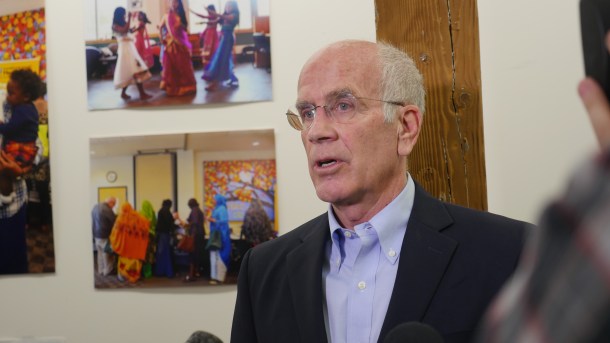
“Now, we know why Scott Pruitt didn’t want this to be released,” Welch said. “It is bad.”
Welch said the delayed release provides “overwhelming evidence that the EPA was protecting polluters,” and the report shows that the “health hazards are at much lower levels than previously understood.”
The EPA “was depriving people, and not just in Bennington,” of information about the threats posed by these chemicals, Welch said.
“The EPA should get back to doing its job, but we probably won’t get that under Scott Pruitt, or maybe with this administration,” Welch said.
Sears: State action needed
Saint-Gobain Performance Plastics was identified by the state as the party responsible for the contamination in Bennington. The company and state officials last year reached a settlement for the firm to fund new water lines in roughly half the area with PFOA contamination of wells.
The state is negotiating with Saint-Gobain over other properties, east of Route 7A. Walke said Thursday that state officials plan to update Bennington area residents next week on the status of those negotiations and on the water line projects underway since last fall.
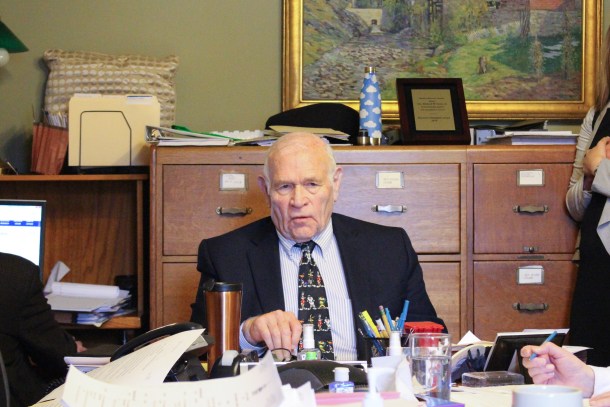
Sen. Dick Sears, D-Bennington, who lives in one of the areas of town with PFOA contamination, said he was not surprised by the report. “It confirms Vermont’s standard, which Saint-Gobain tried to fight,” Sears said.
The delayed release of the report constituted “despicable behavior by the Trump administration, keeping this from the American people,” Sears said.
Sears is “still disappointed with the Scott administration and their veto S.197,” a bill he sponsored that would make it easier for residents exposed to hazardous chemicals to seek funding from companies for ongoing medical monitoring for illnesses associated with the pollutant.
“Perhaps this revelation will give [Vermont administration officials] pause if we are able to pass a similar bill next year,” Sears said.
David Bond, associate director of the Center for the Advancement of Public Action at Bennington College, which sponsored the college’s ongoing Understanding PFOA project, is concerned about the new lower drinking water standards.
“Although this is only a draft report and warrants further scientific review, its preliminary findings — and the difficulties it faced finding the light of day — are troubling,” Bond said.
He said the draft report suggests the future health guidance level for PFOA in drinking water may be roughly half of Vermont’s current standard.
“The gray area between our current standard and the level proposed by the ATSRD (Agency for Toxic Substances and Disease Registry) report has tremendous local relevance,” Bond said, as a number of homes in the Bennington area with well levels below Vermont’s 20 parts per trillion standard for PFOA might “suddenly find themselves in this worrisome gray area.”
Sen. Brian Campion, D-Bennington, said the suppression of the report “is one of the most disturbing bits of information coming out of Washington.”
“I am proud that we set the health advisory level for PFOA where we did and believe we will remain diligent and set the limit even lower if more data supports that action,” Campion said.
Exposure standards
After PFOA, which was used for more than five decades in the manufacture of Teflon and other non-stick substances, was discovered in 2016 in wells in Bennington, the state moved quickly to develop and set a new standard for safe drinking water that December, at 20 parts per trillion — one of the lowest in the nation.
The EPA standard, set in 2016, is 70 parts per trillion, which several states have set levels considerably lower. New Jersey is now considering 8 parts per trillion.
Walke said he hopes the peer review that will follow release of the federal report will begin to point to new regulatory standards and cleanup approaches to deal with some 4,000 substances similar to PFOA/PFOS.
“Regulators have to figure out a way to understand these compounds,” he said.
Walke, who was a Vermont representative to an EPA-organized summit meeting on these issues in Washington in May, said one concept being considered is to look for common markers that identify this type of contamination threat in nature, which could lead to more precise standards.
“We really have to get a handle on the broader challenges these compounds pose,” he said.

