[C]ongress is taking another shot at answering a decades-old question: What should be done with nuclear waste that’s stranded at sites like Vermont Yankee?
U.S. Rep. Peter Welch, D-Vt., was among 340 House members who voted last month for H.R.3053, which advances both short-term and permanent storage options for spent nuclear fuel.
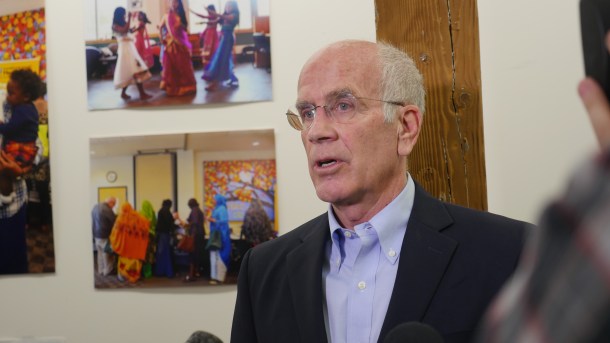
The bill faces an uncertain future in the Senate, and the movement and storage of radioactive spent fuel has spurred stiff opposition in some quarters. But Welch noted that the federal government pledged decades ago to get spent fuel out of Vermont, and he says “the promise that Congress made is the promise we should keep.”
“The folks in Vernon were promised that they were not going to be sitting on nuclear waste forever,” Welch said.
Vermont Yankee stopped producing power at the end of 2014, but all of its spent nuclear fuel will remain on site for the foreseeable future because there’s nowhere for it to go. Plant owner Entergy is in the final stages of a $143 million project to move the fuel into more stable storage in sealed casks.
Vernon is not alone in hosting nuclear waste: Federal officials say there are 121 such sites in 39 states.
The issue causes environmental concerns, and it stymies the redevelopment of former nuclear sites. It’s also an expensive problem: Nuclear licensees regularly recover monetary damages from the U.S Department of Energy due to the federal government’s failure to adhere to fuel-storage obligations in the 1982 Nuclear Waste Policy Act.
The U.S. House Energy and Commerce Committee says taxpayers currently are on the hook for more than $34 billion in nuclear waste litigation costs. And that number “is projected to grow in perpetuity,” officials say.
H.R.3053 takes two big steps toward a possible solution.
First, the bill pushes forward the licensing process for a permanent “geologic” storage facility on federal land at Yucca Mountain in Nevada. Federal officials worked on that project for decades, but the Obama administration scuttled the initiative in 2010, saying it was “not a workable option for long-term disposition” of nuclear waste.
Welch supports Yucca Mountain, but in an interview Tuesday, he acknowledged that the project “has been incredibly controversial because the people in Nevada don’t want it.”
“I think we do need a consolidated storage site somewhere,” Welch said. “Obviously, the science and the geology and those questions are ones that the experts have to answer.”
Yucca Mountain opposition in Nevada – where a federal lawmaker has declared H.R.3053 “dead on arrival” when it gets to the Senate – makes the bill’s future unclear. But President Donald Trump has supported restarting the Yucca project, and Welch said that “definitely sends a signal to my Republican colleagues.”
The bill also lays the groundwork for so-called “consolidated interim storage” of spent nuclear fuel. And that holds some potential for shorter-term impacts on sites like Vermont Yankee.
The idea is that the Department of Energy would take custody of spent fuel and possibly contract with a non-governmental entity to store the material while a permanent repository is being built. Welch said there was debate about whether current federal law allows this, so H.R. 3053 “gives the green light” for such a project.
There currently are two interim storage projects in the works, both with Vermont Yankee connections.
Holtec International, which makes the fuel-storage casks used in Vernon, has designed an interim storage facility for New Mexico. Also, Waste Control Specialists and Orano USA – both of which would be involved in a possible accelerated decommissioning project at Vermont Yankee – have pitched a storage facility in Texas.
In recent documents filed with the federal Nuclear Regulatory Commission, proposed Vermont Yankee buyer NorthStar Group Services expressed optimism that such plans will make a big difference in Vernon.
“NorthStar projects that an off-site interim storage option will be available by no later than the mid-2020s, and therefore, it should be able to remove the irradiated fuel from Vermont Yankee by no later than 2030,” company administrators wrote.
But even interim storage of nuclear waste has detractors. Last year, groups opposed to such plans organized a speaking tour of New England states, urging residents and officials to consider the environmental and social impacts of consolidated interim storage in Texas and New Mexico.
Earlier this week, the Massachusetts-based Citizens Awareness Network – which has been active in Vermont Yankee issues – urged residents to lobby federal legislators to oppose H.R. 3053. The group is against the Yucca Mountain project and calls interim storage sites “unacceptable.”
“Parking lot dumps are a way to kick the can down the road,” Chris Williams, a board member for the network, wrote in an email to supporters. “To move thousands of shipments to Texas or New Mexico only to have to move them again is dangerous. To say we will find a permanent repository in the future is quite possibly disingenuous. Once parked, the waste may never move again.”
Welch said the proposed process for creating interim storage sites would “require state and local government participation.” But he’s aware of the controversy surrounding those projects.
“The environmental justice issues are very compelling and have to be considered,” Welch said.
At the same time, Welch has heard from citizens’ groups in New England states demanding the removal of spent nuclear fuel. The bottom line, the congressman said, is that the material shouldn’t stay in Vermont.
“You don’t solve (the problem) by just saying, ‘We’ll keep it here forever,’” Welch said.